Bearish Trading Strategies for Bitcoin in 2026
Discover our analysis on placing bearish trades for Bitcoin in 2026.
12 min read
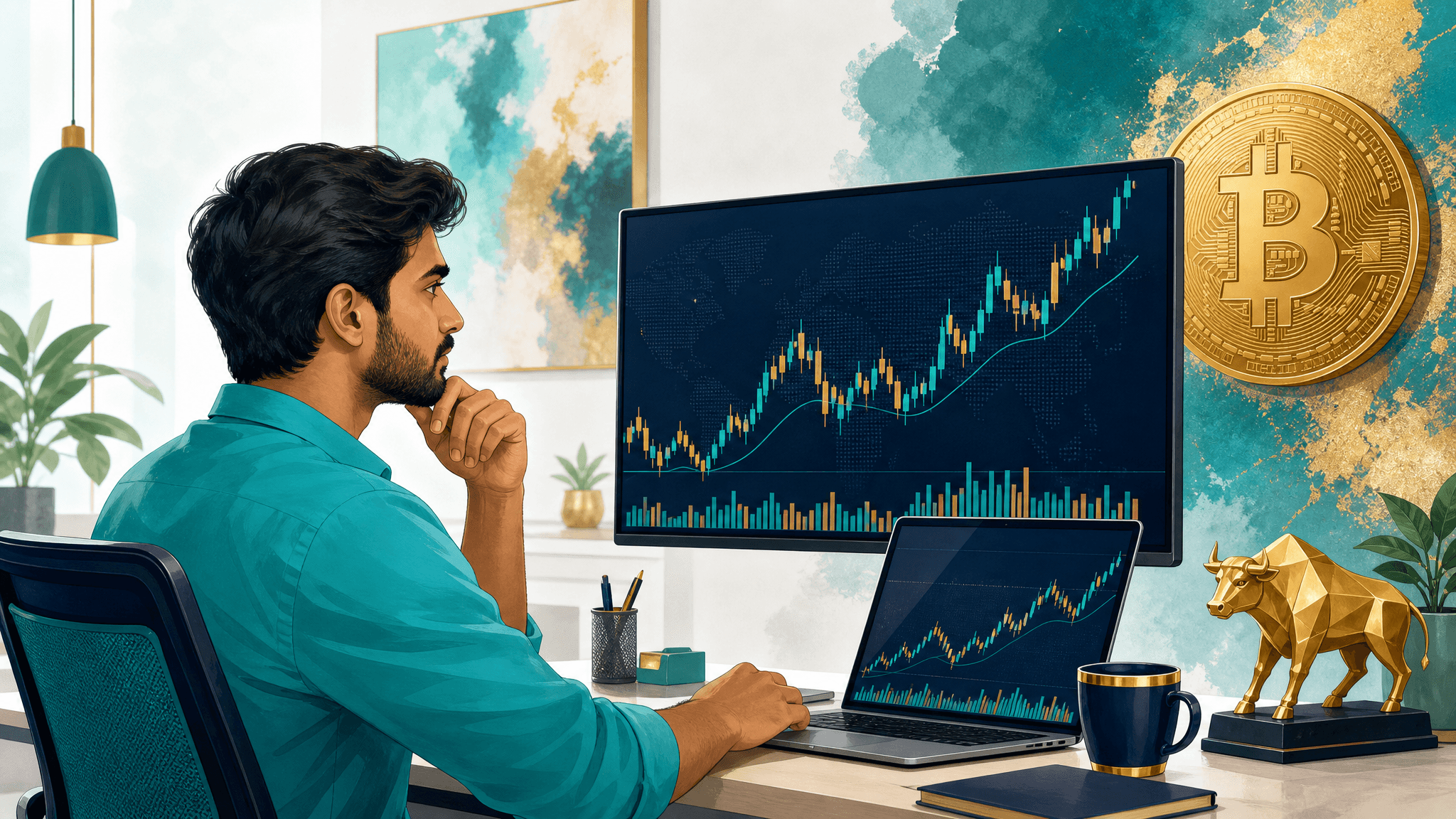
Bitcoin sitting roughly 42% below its January 2025 all-time high of $109,000, trading around $62,852. The bearish trading strategies for Bitcoin 2026 are becoming the most important conversation in crypto right now. On a recent Hitpoint Live stream, Fahad was direct about it: the smaller timeframes were flashing clear warning signs, and the structure simply did not look like a credible bottom. The team spotted VWAP rejection, choppy price action, and a previous day's low that screamed 'poor low' to anyone paying attention. This wasn't panic. This was pattern recognition. And the market was cooperating with the bear case.
Key Takeaways
- Multiple timeframe bearish signals combined with VWAP rejection create a far stronger short thesis than any single indicator alone.
- VWAP is most powerful when price consistently fails to reclaim it. That repeated failure is the signal, not just the level itself.
- Price lingering too long on a support level without bouncing is itself a bearish confirmation. Strong support bounces fast.
- A stop-loss is a hypothesis test. When price hits it, your trade idea was wrong, and honoring that conclusion is the entire point.
- Pre-defining entry, stop, and target before the trade goes live is the single most effective way to keep emotions out of execution.
What are the bearish signals for Bitcoin in 2026?
Our team identified bearish signals in Bitcoin's smaller timeframes, emphasizing the need for caution. Fahad noted a potential bearish trend using VWAP. The price was struggling to reclaim it, and that failure was telling. When BTC can't hold above VWAP on a lower timeframe, the path of least resistance is down. That's not opinion. That's structure.
So what exactly were we seeing on the stream? Fahad put it plainly: "If you look at Bitcoin's smaller timeframe, it's turning out to be slightly bearish." And then he went further. "Alright, look, this does not look like a very good bottom to me." That's not a hedge. That's a read.
Here's the thing: the bearish case wasn't built on one signal. It was a confluence.
- VWAP rejection: Price failed to sustain above the Volume Weighted Average Price, signaling seller dominance
- Poor previous day's low: The structure of the prior session's low suggested it wasn't a genuine demand zone, just a resting point before continuation lower
- Smaller timeframe breakdown: 15-minute and lower charts were already printing lower highs and lower lows
- Choppy price action: No clean impulsive moves to the upside, only grinding, overlapping candles. Classic distribution behavior.
The macro picture is backing this up too. According to data cited by Seeking Alpha, the probability of Bitcoin falling below $50K has climbed significantly. Odds of a drop below $45K sit at 46%. That's not a fringe view anymore. That's the market pricing in continued weakness.
Wait, actually... the VWAP piece deserves more attention here. It's not just about where price is relative to VWAP. It's about HOW price is reacting to it. A sharp rejection is different from a slow grind below. On the stream, we were watching a slow grind, which is typically more bearish than a fast flush. Why? Because it signals sustained selling pressure rather than a panic event.
For anyone looking to understand the other side of this coin, our earlier breakdown of Bitcoin bullish divergence setups is worth reading. Precisely because knowing what a real bullish signal looks like helps you recognize when one is absent.
The point is: multiple signals were aligning. And when they align like that, the trade idea becomes clearer, even if the execution still requires patience and confirmation.
How does VWAP enhance Bitcoin trading strategies?
VWAP, or Volume Weighted Average Price, helps traders evaluate Bitcoin's price trends over time by weighting price by volume. This gives a more accurate picture of where the 'average' participant is positioned. It assists in confirming entries or exits because it shows whether buyers or sellers are in control at a given moment. Price above VWAP generally favors longs; price grinding below it favors shorts.
On the stream, VWAP wasn't being used as a magic line. It was being used as a reference, one piece of a larger picture. Fahad's team was watching how BTC interacted with VWAP across multiple timeframes. And the interaction was not encouraging for bulls.
Think of VWAP this way: it's the weighted consensus price for the session. If price keeps getting sold every time it approaches VWAP from below, the market is telling you that sellers are defending that level. That's the kind of institutional behavior that shows up in order flow, and it's the kind of signal worth respecting.
(And this is where it gets interesting.) VWAP is especially useful in crypto because the market runs 24/7. Unlike equity markets where VWAP resets cleanly at open, crypto traders need to decide which VWAP anchoring makes sense: session-based, daily, weekly. On the stream, the daily VWAP was the primary reference, and BTC was failing to reclaim it.
Here's how different VWAP levels played out in our analysis during the session:
VWAP Impact on Trade Decision
| VWAP Level | Trade Action | Outcome |
|---|---|---|
| Price below daily VWAP, failing to reclaim | Short bias initiated | Confirmed bearish structure, price continued lower |
| Price approaching VWAP from below (test) | Wait for rejection candle | Rejection confirmed, valid short entry zone |
| Price above VWAP with volume | No short, wait for structure break | Avoided a false short, preserved capital |
| Price oscillating around VWAP | No trade, choppy zone | Correct decision, choppy conditions meant no clean setup |
The last row is the one most traders ignore. Honestly? When price is just bouncing around VWAP with no directional conviction, that's not a trading opportunity. That's noise. And trading noise is how accounts bleed slowly.
For a deeper look at how our team approaches Bitcoin liquidity levels alongside VWAP analysis, that post covers the mechanics in detail.

Why is trade confirmation essential in 2026?
Confirmations are essential to reduce trading risks in any market environment, but especially in 2026's choppy Bitcoin conditions. Our team spotted that without proper signals, entering a trade becomes speculative rather than analytical. And speculation without an edge is just gambling with extra steps.
Fahad was unambiguous on this during the stream. Someone in chat was asking about entries, and the response was immediate: "Honestly? You need confirmation for that side. Trading is not done like that." No softening. No 'it depends.' Just a direct statement about how the team approaches the market.
So what does confirmation actually look like in practice? It's not waiting for certainty. Certainty doesn't exist in trading. It's waiting for the market to show its hand before you act. A few things the team looks for:
- Structure confirmation: A lower high forms after a rejection. Price tried to go up, failed, and now the next move is more likely down.
- Volume confirmation: A bearish move accompanied by rising volume is more credible than one on thin volume
- Candle close confirmation: Don't react to wicks. Wait for the candle to close below a key level before acting.
- Time-based confirmation: "If you see like for almost half an hour price is on your support level, don't take the trade," Fahad said. If price is sitting on support too long without bouncing, that support is weak. Get out or don't enter.
That last point is underrated. Price that lingers on a support level isn't being absorbed. It's being distributed. Strong support bounces fast. Weak support gets tested, retested, and eventually breaks. The time dimension of confirmation is something most retail traders completely ignore.
The 2026 environment makes this even more critical. CNBC reported that Bitcoin's summer swoon has created unusual volatility patterns, which means false breakouts and fake bounces are more frequent than in trending markets. You need confirmation precisely because the market is trying to fool you more often.
You know what I mean? The market in 2026 isn't trending cleanly. It's chopping. And in choppy markets, the traders who survive are the ones who wait for confirmation rather than anticipate moves that never materialize.
I changed my mind is actually a healthy thing to say during a session. Fahad said it during the stream when a setup that looked promising stopped cooperating. Knowing when to walk away from a setup? That's not weakness. That's discipline. For a broader framework on why confirmation separates consistent traders from gamblers, that post breaks it down clearly.

What are effective stop-loss strategies for Bitcoin?
Stop-loss strategies protect against severe losses by setting predefined points to exit trades before they turn catastrophic. Our team suggests flexible approaches depending on market volatility. A fixed pip stop doesn't work the same way in a volatile crypto session as it does in a range-bound one.
Here's the honest version of the stop-loss conversation: most traders either don't use them, or they place them so tight that they get stopped out of perfectly good trades. Both extremes are wrong.
On the stream, the team discussed BTC short setups with stops placed near previous resistance. The logic being that if price reclaims a level it just broke below, the thesis is invalidated. That's not arbitrary. That's the market telling you the structure has changed.
A few principles the team operates by:
- Stop above the last significant high for short trades. If price breaks above that, the bearish structure is broken.
- Don't move stops into loss. If you placed your stop at a logical level, leave it there. Moving it because you're uncomfortable is emotional, not analytical.
- Widen stops in volatile conditions. A tight stop in a choppy market is just a donation to the market makers.
- The stop defines your risk. Know exactly how much you're risking before you enter. If the stop placement makes the risk too large, reduce position size, not the stop distance.
What else do we have? The geopolitical backdrop matters here too. With oil prices being pushed by ongoing global tensions, and that kind of macro uncertainty spilling into risk assets, Bitcoin's volatility isn't going anywhere soon. Grayscale's reported $3B Bitcoin sale to meet cash obligations is exactly the kind of large-scale selling pressure that can invalidate a stop placement that looked fine an hour ago.
So basically, the stop-loss isn't just a risk management tool. It's a hypothesis test. You're saying: 'If price does X, my trade idea is wrong.' And if price does X, you honor that conclusion. No second-guessing. No hoping.
For context on how Fahad has approached bold short plays during market turmoil in real sessions, that post covers the thought process behind sizing and stop placement in detail.
How to avoid emotional decisions in trading?
Emotions can skew trading strategies in ways that are hard to see in the moment but obvious in hindsight. Our team stresses the importance of a logical approach over impulsive actions, enhancing long-term trading success. Because the market will exploit every emotional weakness you have, and it will do it consistently.
Fahad put the philosophy plainly during the stream: "You must have a logical reason to leave it, and whichever market you will trade in, you must have a logical reason why you will trade in it." That's the whole thing. Two sentences. If you can't articulate the logical reason, you don't have a trade. You have a feeling.
Here's what emotional trading actually looks like in practice (and this is where it gets interesting for most people):
- Chasing a move that already happened because you missed the entry
- Moving a stop loss to avoid being stopped out, then watching the trade go further against you
- Taking a trade just because you've been sitting on the sidelines for a while and feel like you 'should' be doing something
- Closing a winning trade too early because you're scared of giving back profits
- Overtrading after a loss to 'make it back'
The team's position on this is clear: quality over quantity. As Fahad said during the stream, "I do prefer quality over quantity; it makes no sense to take 10, 20, or 50 trades if your trade quality isn't good." That's not a casual observation. It's a trading philosophy that protects capital over the long run.
And look, there was a moment on the stream that perfectly illustrated the human side of this. A setup that looked promising stopped cooperating, and Fahad called it out directly: "This has become quite a shameful incident on the live stream." Humor, yes, but also honesty. Bad trades happen. The question is whether you learn from them or repeat them.
The best defense against emotional decisions is a pre-defined plan. Know your entry trigger before price gets there. Know your stop before you enter. Know your target (or at least your first partial) before the trade is live. When you have a plan, emotions have less room to operate. When you're making it up as you go, emotions fill every gap.
For traders building that kind of systematic discipline, Fahad's price action framework is a solid starting point. It's about reading the market without letting the market read your emotions.

The bearish trading strategies for Bitcoin 2026 that the team covered on the stream aren't complicated. They're disciplined. Here's what actually matters:
- VWAP rejection is a signal, not a level. Watch HOW price reacts to it, not just where it sits relative to it.
- Confirmation before entry. If the market hasn't shown its hand, wait. Choppy conditions in 2026 mean false signals are more frequent than ever.
- Stop-losses are hypothesis tests. Place them at logical levels and honor them when hit. Moving stops is emotional, not strategic.
- Quality over quantity. Five well-confirmed trades beat fifty impulsive ones every time.
- Logical reasons only. If you can't articulate why you're in a trade, you shouldn't be in it.
The market doesn't care about your feelings. It doesn't care if you missed the last move or if you've been watching screens all day. It moves based on structure, volume, and the decisions of everyone participating. The edge comes from reading that structure clearly and acting only when the setup is real.
Join the Hitpoint community for live market coverage and real-time trade alerts, where we work through setups like these in real time, not in hindsight.
Watch the full stream: Bearish Trading Strategies for Bitcoin in 2026 on YouTube
Disclaimer: This article is for educational purposes only and is not investment advice. Crypto assets are unregulated in India, are highly volatile, and can lose value rapidly; there is no established investor-protection or grievance-redressal mechanism for them. Trading With Sidhant LLP is not a SEBI-registered Investment Adviser or Research Analyst, and nothing here constitutes a recommendation to buy or sell any asset. Income from virtual digital assets is taxable in India at 30% plus applicable cess, with 1% TDS on transfers. Past performance is not indicative of future results. Do your own research before trading.
Frequently Asked Questions
- What are the key bearish signals for Bitcoin trading?
- The key bearish signals include price failing to reclaim VWAP on lower timeframes, poor structural lows that lack genuine demand, overlapping choppy candles indicating distribution rather than accumulation, and lower highs forming after rejection. When multiple signals align simultaneously, rather than any single indicator, the bearish case becomes significantly more credible and worth acting on with proper confirmation.
- How can VWAP be used in Bitcoin trading strategies?
- VWAP functions as a weighted consensus price for the session. In Bitcoin trading, it helps identify whether buyers or sellers are in control. Price grinding below VWAP with repeated failed attempts to reclaim it signals sustained selling pressure. Use it as a reference for entry bias: short setups become more credible when price consistently fails to hold above VWAP rather than making sharp, impulsive moves above it.
- Why is confirmation important in trading?
- Confirmation transforms speculation into analysis. Without it, you're entering trades based on anticipation rather than evidence, and anticipation is just hope with a chart open. Waiting for a candle close below a key level, a lower high to form, or volume to confirm a move means you're reacting to what the market has actually done rather than what you think it might do. That distinction separates consistent traders from gamblers.
- What stop-loss strategies are effective for crypto?
- For short trades, place stops above the last significant high. If price reclaims that level, your bearish thesis is structurally invalidated. In volatile crypto conditions, widen stops rather than tighten them, and reduce position size to compensate. Never move a stop further into loss to avoid being stopped out. The stop's job is to tell you when you're wrong. Let it do that job without interference.
- How to avoid emotional trading decisions?
- Pre-define everything before entering: your entry trigger, your stop level, and at minimum your first target. When the plan exists before the trade is live, emotions have no decisions left to make. Avoid overtrading after losses, avoid chasing moves you missed, and avoid taking trades just because you feel you should be active. As Fahad puts it, quality over quantity. Fewer, better trades beat more frequent, impulsive ones every single time.
Share this post

How to Use Direction Area Trigger in Nifty Trading
A Nifty short near 24,000 needed more than a pin bar: daily bias, a defined area and footprint evidence had to agree.
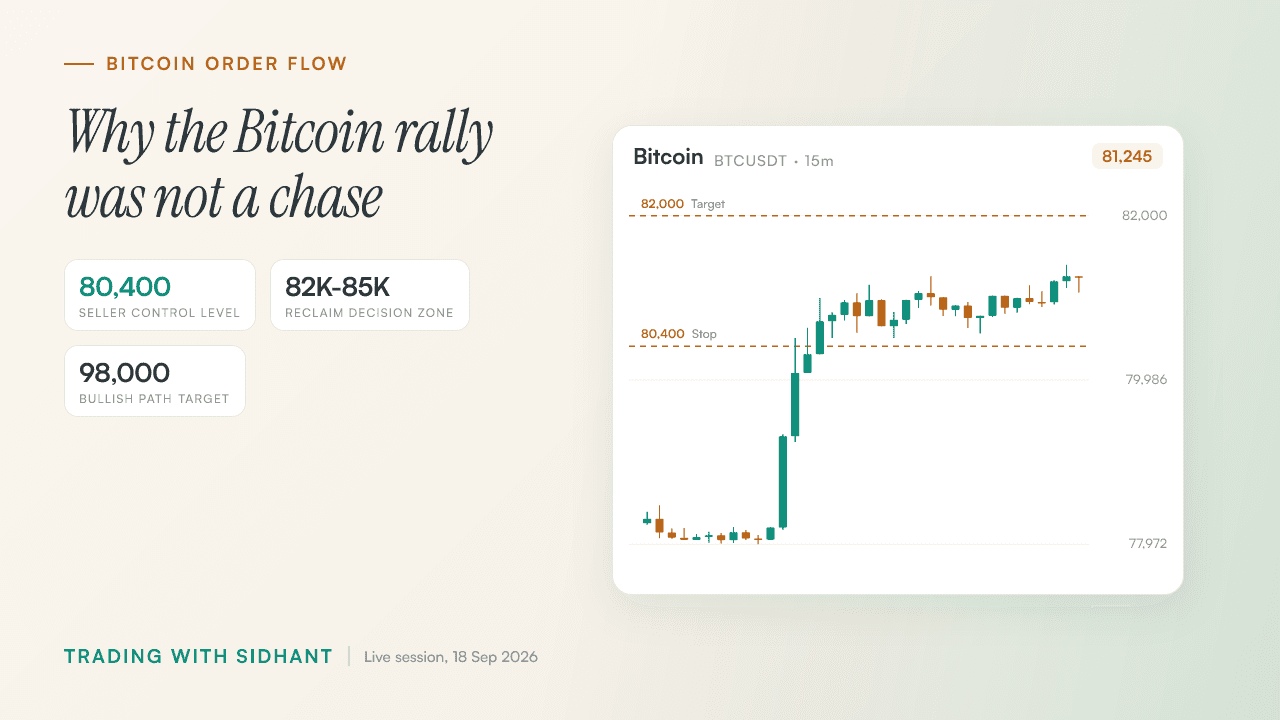
Bitcoin Order Flow Analysis After a Rally
Bitcoin had already rallied, so Fahad used 80,400, delta and seller exhaustion to explain why waiting beat a FOMO entry.
When to Quit a Profitable Intraday Strategy
Rs 12 lakh in profit looked different after Sidhant counted the 1,500 hours and the freedom the strategy had consumed.
Get post alerts in your inbox.
New blog post? We'll email you. No spam, unsubscribe anytime.
Join our Telegram community.
Get post alerts, trading discussions, and market updates.