When to Quit a Profitable Intraday Strategy
Rs 12 lakh in profit looked different after Sidhant counted the 1,500 hours and the freedom the strategy had consumed.
8 min read
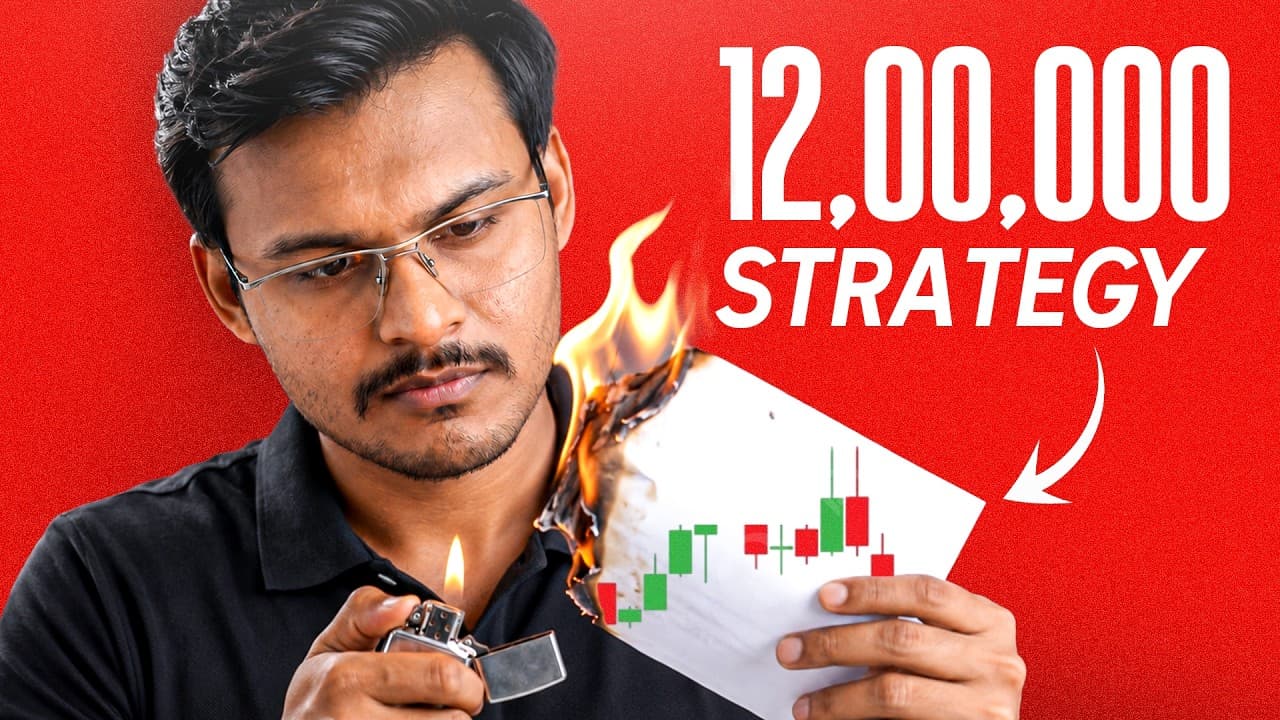
Rs 1,200,000 in reported profit sounded like proof that I had made the right call. Then I counted roughly 1,500 hours spent earning it, and the number lost some shine. That is when to quit a profitable intraday strategy: when the P&L is green but the system quietly owns your time, mood and choices. I quit a strategy that was profitable, backtested, and dangerous because it was working. The video is about that audit.
Key Takeaways
- A green annual P&L means little until you measure the hours, attention and personal flexibility spent producing it.
- The hidden cost of screen dependence appears in how trading changes your reactions to ordinary people and ordinary time.
- Tools are fine, but your strategy is dependent if missing outside information leaves you unable to explain or make your own decision.
- Freedom is measured by control of your time, not by whether income arrives through a salary or a trading P&L.
- Do not confuse fear of missed profits with a reason to stay dependent on a strategy that no longer fits your life.
Rs 12 lakh looked smaller after the 1,500-hour audit
I learned that a profitable intraday strategy can look far less attractive once its return is divided by the hours needed to run it. About Rs 1,200,000 across roughly 1,500 hours exposed a cost that a green P&L had hidden, inside the fixed 9:15 a.m. To 3:30 p.m. market window.
Profit is only one part of the return. I had treated Rs 12 lakh as the whole scorecard. It was not.
Before the NSE open, I checked global cues, market context and world news. Then I stayed at the screen until closing, ate lunch at the desk and rushed basic errands because a setup might appear.
The time audit behind the reported intraday trading profit
| Metric | Figure | What it reveals |
|---|---|---|
| Reported profit | Rs 1,200,000 | The headline number looked strong on its own |
| Trading days | Approximately 250 | The strategy demanded near-daily participation |
| Daily screen time | Roughly 6 hours | The market took the centre of the workday |
| Annual screen time | About 1,500 hours | 250 days multiplied by 6 hours |
| Implied hourly return | About Rs 800 per hour | Time changed how I saw the profit |
This was not an attack on intraday trading. It made me calculate an hourly income instead of admiring gross profit like a reel caption. A trade plan also needs rules, which is why I value a documented trading strategy process more than an annual screenshot.
A strategy can pay and still charge too much.
A flat market turned a family call into the real loss
A flat day showed me that screen dependence affected more than my calendar. Around 1:00 p.m., I reacted irritably to my mother's call while waiting for possible movement after 2:00 p.m., yet the market reached its 3:30 p.m. close with zero trades.
Nothing dramatic happened that day. Price stayed flat until around 1:00 p.m., with no clean setup, but I remained glued to the screen because the market might wake up after 2:00 p.m.
Then my mother called. My first reaction was irritation because market time had become untouchable in my head. Later, I had to admit: 'I got irritated with my mother for a trade that never came.'
What the waiting had already taken:
- Mood: A flat chart decided how I spoke to someone at home.
- Family interruptions: A normal call felt like an obstacle.
- Ordinary time: I gave up a conversation for a setup that did not exist.
At 3:30 p.m., the market closed with zero trades. No action, but the cost was real.
Intraday trading burnout does not always arrive with a large loss or a blown account. It can show up when you eat while watching candles, carry tension into a family call, or refuse to leave a dead chart. My old focus on quality over trade quantity needed to include quality of life.
A market can be flat. Your nervous system does not need to stay on alert for six hours.
The missing 9:00 a.m. Message exposed borrowed conviction
A trading edge was not fully mine when a website, mentor, channel or vendor supplied the information that made my decisions possible. When the Level Paglu update stopped arriving around 9:00 a.m., I realised I had been executing someone else's edge with my own capital.
Level Paglu generally sent daily levels, context and bias before the 9:15 a.m. market open. I built my setups on that information. Then the message did not arrive for a day, then days, then weeks.
Meanwhile, the market opened at 9:15 as usual. Candles formed and stops got hit. The problem was mine.
'I was the execution layer for the person who ran the website.' It hurt because it was accurate.
Dependency checks I had to run:
- Data: Could I source and verify it myself?
- Levels: Did I know why those zones mattered?
- Framework: Could I explain the logic without borrowed language?
- Decision-making: Could I form a bias and reject a trade alone?
Tools are fine. The final read, risk decision and reasoning must remain yours. I had to move from copied conviction toward confirmation in a trading plan.
If one missing message freezes the process, the edge belongs somewhere else.
At 2:47 p.m., the one-minute chart became another boss
At 2:47 p.m., while waiting for a one-minute candle to close, I recognised that intraday trading had rebuilt the control I left employment to escape. A chair governed by the 9:15 a.m. opening bell and 3:30 p.m. close can still behave like a job, even with variable income.
I started trading partly to control when I woke up, worked, ate lunch and took time away. After about 18 months, I was still tied to a chair, waiting for the next one-minute candle to finish.
'I left my job for freedom, and in the name of freedom I grabbed another chair.' That was when the story stopped being about P&L.
How a trading routine can resemble employment
| Work feature | Traditional job | Intraday trading routine |
|---|---|---|
| Working hours | 9 to 6 schedule | 9:15 a.m. To 3:30 p.m. market window |
| Controlling force | Manager or company | Opening bell, setup, FOMO and daily P&L |
| Lunch and errands | Permission or break timing | Stepping away risked missing a setup |
| Income pattern | Fixed salary | Variable trading income |
| Cost of stepping away | Missed work task | Missed chart movement or possible trade |
The boss had not gone anywhere. He had simply taken a new avatar.
If your strategy needs your entire day, after a point it is less of a strategy and more of a job. 'The only difference is that the salary is variable.' A self-employed trader can become their own worst boss, demanding attention on Sundays, holidays, dinner time and family time.
The useful question was simple: who controlled my time? That mattered more than whether the day ended green or red.
Leaving profit requires a transition plan, not a dramatic exit
I would not tell anyone to shut down a profitable intraday strategy overnight. I chose an honest transition: measure the time, identify which parts of the edge were mine, preserve runway, test alternatives and move only after a more independent process had evidence.
Leaving a losing strategy is easier because the evidence is visible. Leaving a profitable intraday strategy is harder because every green P&L can make quitting feel irrational.
I feared drawdown in a new system, missed profits from the old one and future people saying, 'See, I told you so.' Those fears were real, but they did not justify staying blind.
The five-step transition I used:
- Audit the hours, profit and emotional cost.
- Document the exact setup, data inputs and rules.
- Remove dependencies from levels, bias and decision-making.
- Test alternatives without demanding daily action.
- Preserve runway before reducing a working income source.
In the video, swing trading versus intraday trading was not a contest. Swing and positional systems can go days or weeks without a trade. 'No action. Zero. Do not act.' That silence felt strange after daily P&L dopamine, but a valid system does not need entertainment.
I wanted systems that supported my life, not a life that supported the system. A disciplined trade exit process applies to strategies too: define the conditions, document them, then act without drama.
The Rs 1,200,000 did not become fake because I stepped away from the old system. It became incomplete once I counted the 1,500 hours, the dependence on someone else's levels and the way a one-minute candle could control my day. Money matters, but so does the process producing it. In the video, I did not argue that every intraday trader should quit. I argued for an honest audit: how much time does it take, whose edge is it, and does it support the life you want? I do not want systems that support the system. I want systems that support my life.
Catch the next TWS video on YouTube. The process gets built there, edited and published.
Watch the full video: I Quit My ₹12,00,000 Strategy After Learning 3 Things on YouTube
Disclaimer: This article is for educational purposes only and is not investment advice. The price levels, setups and trades described are a review of market events that have already occurred, shared to illustrate a method of analysis rather than to recommend any trade. Trading With Sidhant LLP is not a SEBI-registered Investment Adviser or Research Analyst, and nothing here constitutes a recommendation to buy or sell any security. Investments in securities markets are subject to market risks; read all the related documents carefully before investing. Past performance is not indicative of future results. Please consult a SEBI-registered financial adviser before acting on any information in this article.
Frequently Asked Questions
- When should I quit a profitable intraday trading strategy?
- You should consider leaving when the strategy's time demand, emotional cost or outside dependencies no longer fit the life you want. Profit alone is not a complete scorecard. In the video, Rs 1,200,000 looked different after I counted about 1,500 hours and recognised how much of the process depended on an external source.
- How do I calculate the hourly income from my trading strategy?
- Divide reported trading profit by the total hours spent running the strategy, including preparation, market monitoring, journaling and review. My rough audit used Rs 1,200,000 divided by 1,500 hours, which came to about Rs 800 per hour. That figure does not decide whether a strategy is good, but it makes the time cost visible.
- What makes a trading edge truly independent?
- A trading edge is independent when you can source the data, explain the levels, apply the rules and make the final decision without another person's message. Tools and vendors can remain part of the workflow, but the reasoning cannot disappear when they do. If missing information leaves you frozen, you are borrowing conviction rather than owning an edge.
- Is swing trading better than intraday trading for more freedom?
- Swing trading can offer more schedule flexibility because a valid system may have no trades for days or weeks, unlike a process tied to the 9:15 a.m. To 3:30 p.m. Window. It is not automatically better. Compare the rules, review burden and emotional demands, then assess whether they leave you with more control over your time.
- How can I transition away from an intraday strategy safely?
- Transition by auditing the old process, documenting every dependency, testing alternatives and preserving financial runway before reducing a working income source. Avoid a dramatic exit driven by boredom or one bad day. In the video, I treated the change as building proof for a more independent process while accepting that daily P&L activity would reduce.
Share this post

How to Use Direction Area Trigger in Nifty Trading
A Nifty short near 24,000 needed more than a pin bar: daily bias, a defined area and footprint evidence had to agree.
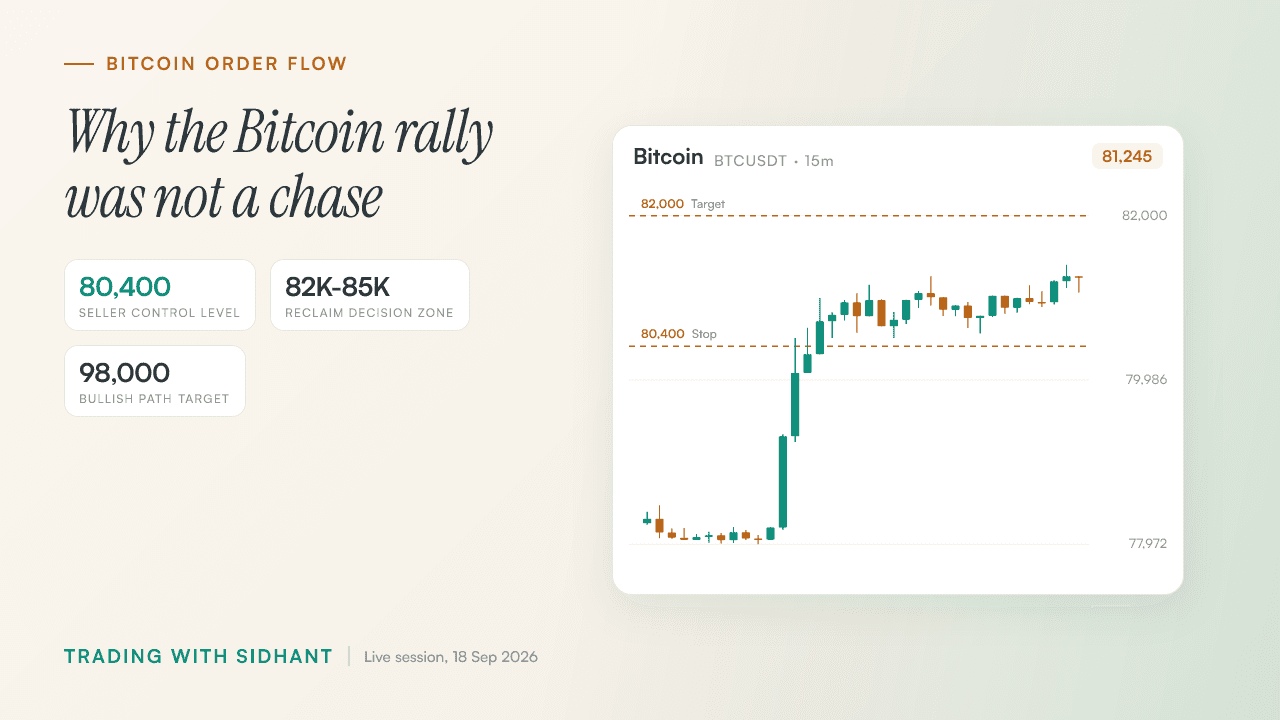
Bitcoin Order Flow Analysis After a Rally
Bitcoin had already rallied, so Fahad used 80,400, delta and seller exhaustion to explain why waiting beat a FOMO entry.
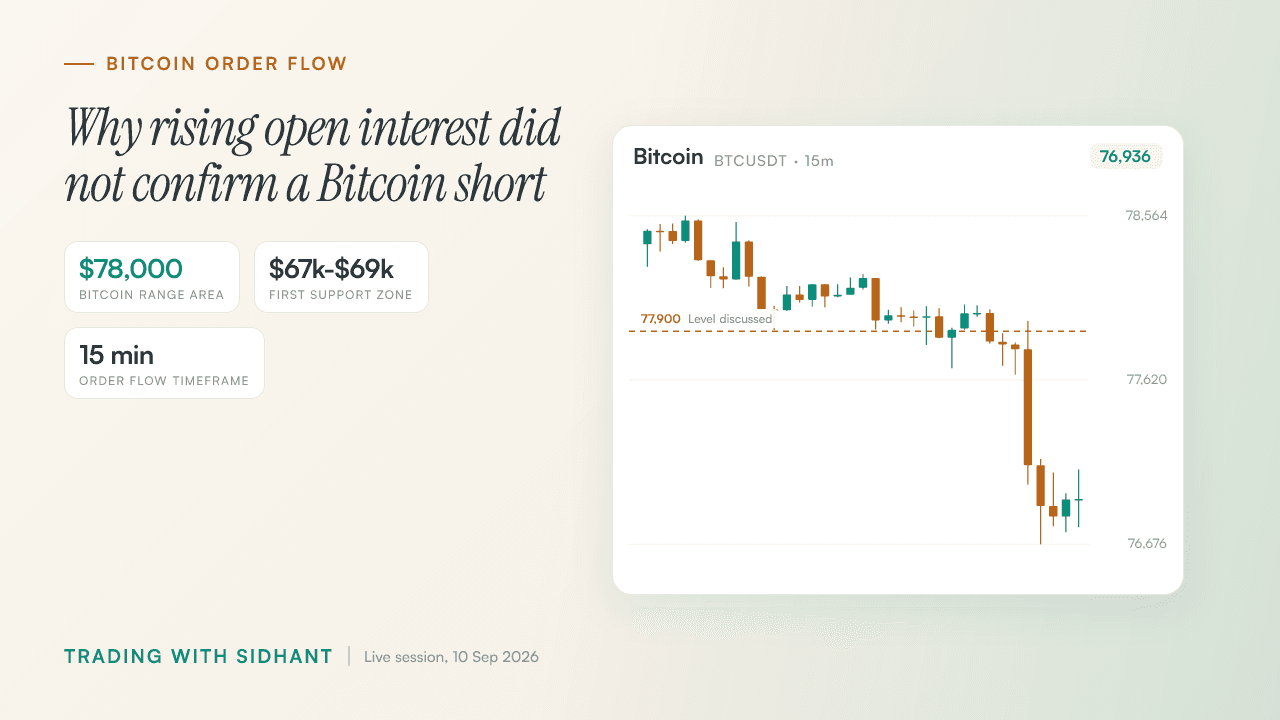
How Bitcoin Open Interest Revealed Trapped Sellers
Bitcoin moved only about $100 near $78,000, but rising open interest revealed why a short could be premature.
Get post alerts in your inbox.
New blog post? We'll email you. No spam, unsubscribe anytime.
Join our Telegram community.
Get post alerts, trading discussions, and market updates.