How to Build a Trading Strategy in India: A Guide
Discover the essential elements to crafting a successful trading strategy, with insights from Fahad at Hitpoint Live.
11 min read

Most traders lose money not because they lack discipline, but because they never actually built a strategy in the first place. They press buy. They press sell. They follow a tip, and then wonder why the account bleeds. On a recent Hitpoint Live session, Fahad broke down exactly how to build a trading strategy in India from scratch, and the room was locked in. The framework he laid out (Volume, Liquidity, Levels) is the kind of thing that sounds obvious once you hear it, but most retail traders completely skip. This post breaks down every piece of that blueprint, so traders can stop guessing and start trading with actual structure.
Key Takeaways
- A strategy only works when entry, exit, and volume confirmation are defined before you place a single trade.
- Volume is the market's conviction meter. Without it, even correct directional calls can bleed traders dry.
- Pre-trade analysis of how and why price moved is the only reliable antidote to emotional decision-making.
- The 1% rule per trade and a hard daily loss limit are what keep you in the game long enough for your strategy to work.
- A good trading community accelerates learning and builds the confidence that solo chart-staring never can.
What are the basics of building a trading strategy?
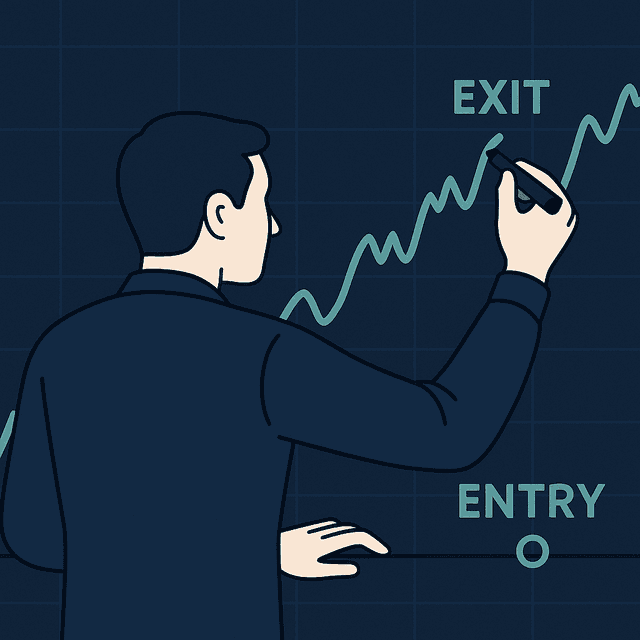
Building a trading strategy means defining clear entry and exit points, understanding market structure, and anchoring every decision to volume and key price levels. Not gut feel, not tips, not random chart patterns from Twitter. A strategy without those three pillars is just a hope dressed up as a plan.
Honestly? Most new traders skip this entirely. They watch a few YouTube videos, open a Zerodha account, and start firing trades. And then they're shocked when it doesn't work.
Fahad put it plainly during the session: "When you build your strategy, you need to be clear about where to enter and where to exit." That sounds obvious. But just think about how many traders we know who couldn't answer that question with a specific number right now.
So basically, here's what a real strategy foundation looks like:
- Entry point: A specific price level or condition, not "when it looks like it's going up"
- Exit point: Pre-defined, both for profit and loss, before the trade is placed
- Market structure: Are we trading with the trend or against it? Higher highs and higher lows vs. lower highs and lower lows
- Volume confirmation: Is there actual participation behind the move, or is it a ghost candle?
- Key levels: Support, resistance, and zones where the market has historically reacted
The teaching moment from the stream was sharp. When deciding to buy or sell, traders aren't just picking a direction. They're picking a context. The market has to be in a state that supports the trade. If the structure is broken, the entry doesn't matter.
(And this is where it gets interesting.) Fahad made the point that "I'm giving you a single blueprint; if you use it, you can literally create the best trading strategy." That's not hype. The blueprint is just Volume + Liquidity + Levels, applied consistently. It's very simple, very simple. The problem isn't the framework. It's that traders want complexity because complexity feels like sophistication.
For anyone building their first real strategy, also look at how institutional order flow shapes market structure. Understanding footprint trading and order flow can add a serious edge to entry timing.
Start simple. Mark your levels. Check volume. Know your exit before your entry. That's the foundation.
Why is volume a critical component in trading?
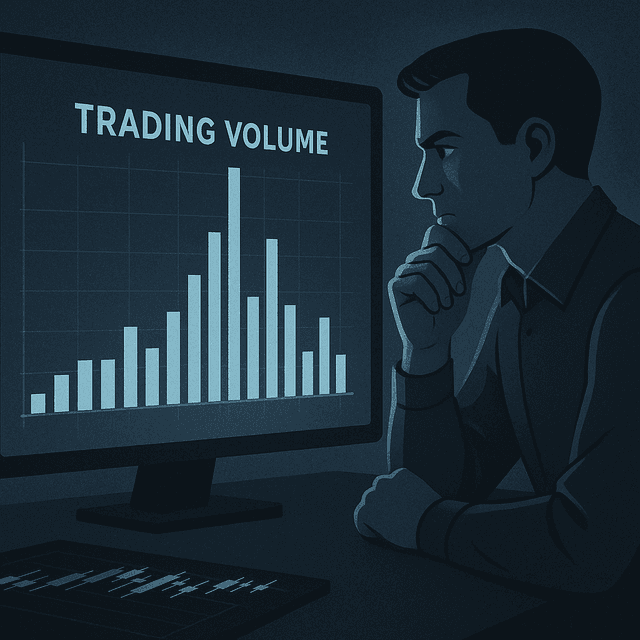
Volume analysis helps traders understand exactly where real buying and selling is happening. High volume can signal genuine market movements, while low volume can turn a perfectly good setup into a losing trade. This is not a minor detail. This is the difference between a clean breakout and a fakeout.
Fahad was direct about it: "If volume is low, even if your trade is right, you will still lose money because it will become a choppy market." Read that again. Your analysis can be correct. Your direction can be right. And you still lose, because the market didn't have enough participation to follow through.
Look, volume basically tells you where buying and selling is happening. Think of it as a vote count. A price move on high volume is the market saying something with conviction. A price move on low volume is a whisper. Easy to reverse, easy to trap traders.
According to Zerodha's volume analysis guide, volume is one of the most reliable indicators of trend strength. High volume confirms trend continuation, while declining volume often precedes reversals. And Motilal Oswal's volume-based strategy breakdown shows how institutional traders use volume spikes to identify high-conviction entry zones.
So what does this look like in practice? Here's how we frame it:
Comparing Trade Outcomes Based on Volume Levels
| Trade Scenario | Volume Level | Outcome |
|---|---|---|
| Breakout above resistance with heavy volume | High | Strong follow-through, trend continuation likely |
| Breakout above resistance with thin volume | Low | Fakeout risk high, price often reverses quickly |
| Pullback to support with declining volume | Low | Healthy correction, buyers likely to step back in |
| Pullback to support with high volume | High | Possible breakdown, support may not hold |
| Ranging market with no volume spike | Very Low | Choppy, avoid trading, no edge here |
| Trend move confirmed by volume surge | High | Momentum entry valid, trend likely to extend |
Traders should enter a buy or sell trade when there is high volume in the market. That's the rule. Not when the candle looks pretty. Not when an indicator crosses. When the market shows real participation.
Want to dig into how this plays out on specific instruments? See how volume and levels interacted during the BankNifty 52000 trap. It's a textbook case of what happens when sellers act without volume backing them up.
How do market movements and psychology interact?
By analyzing how price moved from point A to point B, traders can make genuinely informed decisions and strip out the assumptions that cause most of the damage. The market tells a story in every move. The job is to read it, not invent one.
This was one of the sharpest moments in the stream. Fahad asked the room a direct question: "If this happens, do you still think it's an uptrend?" And the answer isn't always yes, even when the bias was bullish going in. Traders have to analyze why the market moved from point A to point B, not just that it did.
Wait, actually, this is where most traders get wrecked. They see a move up, they assume it continues up, and they chase. They see a drop, they assume reversal, and they fade a trend. Both of those decisions are driven by assumption, not analysis.
Fahad put it clearly: "You have to remove assumptions from your trading, like thinking a reversal will happen just because it did before." The market doesn't owe anyone a pattern repeat. Each session is its own thing.
The psychology side of this is real. When in a trade and price moves against you, the brain starts negotiating. "It'll come back." "This is just a pullback." "The setup was right." And then traders hold too long, or they cut too early because panic sets in. You will feel like you made the perfect setup, but your emotions will ruin your trade.
How do we fight that? By having the analysis done before the trade. If traders understand how price got to where it is (what caused the move, what the structure looks like, where the next significant level is), then they're not reacting emotionally. They're executing a plan.
Right? That's the whole game. Not predicting. Executing with context.
For a real example of how this played out under pressure, check out how Fahad navigated bold short plays during market turmoil. The same A-to-B thinking applied when the market was moving fast and emotions were running high.

What is the importance of risk management in trading?
Risk management means setting hard loss limits and never risking more than a small, fixed percentage of capital on any single trade. It's what separates traders who survive long enough to get good from those who blow up in month two. Full stop.
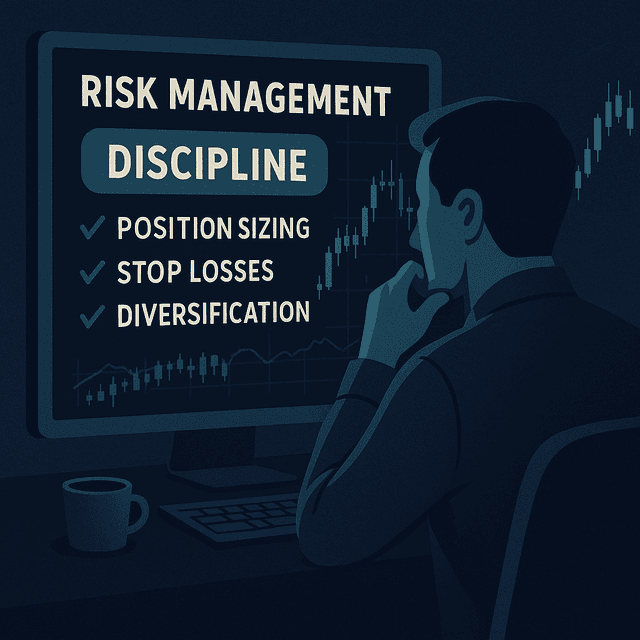
The rule Fahad laid out on the stream is clean: never risk more than 1% of capital on a single trade. And set a daily loss limit. Once you hit it, you stop. No revenge trades, no "one more shot." Done for the day.
Now this is a very important point: most retail traders think risk management is about being cautious. It's not. It's about staying in the game long enough for an edge to play out. If traders blow 30% of an account in a week chasing losses, no strategy in the world can save them, because they won't have the capital or the mental state to execute it properly.
Fahad put it plainly: "This is risk management; a way to follow to minimize losses." Not to maximize wins. Minimize losses first. The wins take care of themselves when the strategy is solid.
Let's say a trader has ₹1,00,000 in the account. At 1% risk per trade, they're risking ₹1,000. That sounds small. But it means they can take 100 losing trades in a row before being wiped out, which gives enough room to learn, adjust, and improve without catastrophic damage.
Here's what the discipline actually looks like in practice:
- Per-trade risk: Max 1% of total capital
- Daily loss limit: Max 2% of total capital. Hit it, you're done for the day
- Position sizing: Calculated from stop-loss level, not from how confident traders feel
- No averaging down: Adding to a losing trade is not a strategy, it's a prayer
- Pre-defined exits: Set before entry, not adjusted mid-trade based on hope
You get me? The math is simple. The discipline is the hard part. And that's exactly why most traders skip it, until they can't afford to anymore.
For how this applies when managing a structured portfolio alongside live trading, the breakdown on automating your Zerodha portfolio is worth a read. Risk parameters matter there just as much as in intraday setups.
How does engagement and community support trading success?
Engaging with a trading community gives traders real-time access to different perspectives, honest feedback on setups, and the kind of accountability that solo trading never provides. All of which compound into faster improvement and genuine confidence over time.
Honestly? Trading alone is brutal. Make a bad call, and there's no one to reality-check you. Make a good call, and there's no one to validate the reasoning. Both situations are dangerous. One leads to overconfidence, the other to self-doubt.
The Hitpoint community exists specifically for this. Fahad wrapped up the session with a direct message: "Make sure you guys subscribe to this channel because this is literally one stop where you can learn everything about trading." That's not just a plug. It's the point. Having a consistent place where concepts get explained, setups get reviewed, and questions actually get answered is genuinely rare.
And the feedback loop matters. When traders see someone else's setup and spot a flaw, they're also sharpening their own eye. When they share a trade and the community points out something they missed, that lesson sticks far harder than reading it in a textbook.
So basically, here's what community engagement actually does for trading:
- Accelerates learning: Concepts click faster when seen discussed in real time
- Reduces isolation: Trading is a lonely game. Shared experience makes it more sustainable
- Builds accountability: Harder to break your own rules when others are watching
- Provides feedback: Real critique of real setups, not theoretical advice
- Builds confidence: "Trading is all about being and feeling confident." Confidence grows in community, not in isolation
The point is, no one figures this out alone. The traders who improve fastest are the ones who plug into a community, ask questions without ego, and keep showing up. You know what I mean?
Join the Hitpoint community for live market coverage and real-time trade alerts. Because the edge isn't just in the strategy, it's in who you learn alongside.

Fahad's blueprint from this session wasn't complicated. It was clear, direct, and built for traders who are serious about actually improving. Here's what we took away:
- Strategy first: Define entry, exit, and context before placing a single trade. Guessing is not a strategy
- Volume is non-negotiable: High volume confirms moves; low volume creates choppy, losing conditions even when direction is right
- Understand the A-to-B story: Know why price moved, not just that it moved. Assumptions are how traders get trapped
- Risk management is survival: 1% per trade, 2% daily max loss. These aren't suggestions, they're the rules that keep you in the game
- Community compounds everything: Learning alongside other traders shortens the curve and builds the confidence needed to execute under pressure
The framework is simple. The application takes work. But the traders who commit to it, who stop pressing random buy-sell buttons and start trading with structure, are the ones who actually get there.
Join the Hitpoint community for live market coverage and real-time trade alerts. The next session might be the one that changes how you trade.
Watch the full stream: How to Build a Trading Strategy in India: A Guide on YouTube
Disclaimer: This article is for educational purposes only and is not investment advice. The price levels, setups and trades described are a review of market events that have already occurred, shared to illustrate a method of analysis rather than to recommend any trade. Trading With Sidhant LLP is not a SEBI-registered Investment Adviser or Research Analyst, and nothing here constitutes a recommendation to buy or sell any security. Investments in securities markets are subject to market risks; read all the related documents carefully before investing. Past performance is not indicative of future results. Please consult a SEBI-registered financial adviser before acting on any information in this article.
Frequently Asked Questions
- What makes a good trading strategy?
- A good trading strategy has three non-negotiable components: clearly defined entry and exit points, volume confirmation, and alignment with market structure. Without all three, traders are guessing. As Fahad put it, traders need to know exactly where they're buying or selling and why, not just a vague directional bias, but a specific, repeatable plan with pre-set conditions.
- Why is volume important in trading?
- Volume shows where real buying and selling activity is concentrated. High volume confirms that a price move has genuine participation behind it, making continuation more likely. Low volume means the move is weak and prone to reversal. According to Zerodha's volume analysis framework, declining volume often precedes reversals, making it one of the most reliable early warning signals a trader has.
- How does risk management affect trading success?
- Risk management determines whether traders survive long enough for their strategy to work. Risking more than 1% per trade or ignoring a daily loss limit means a bad streak can wipe out capital before an edge plays out. The goal of risk management is not to maximize profits but to minimize losses so traders stay in the game and keep improving.
- What role does psychology play in trading decisions?
- Psychology is where most technically sound traders fall apart. Emotions like fear and greed push traders to hold losing positions too long or cut winners too early. The fix is doing analysis before the trade. When traders understand why price moved from A to B and have pre-defined exits, they're executing a plan, not reacting to price action with their feelings.
- How can traders remove assumptions from their strategies?
- Removing assumptions means refusing to trade on the basis that 'it worked last time.' Every session is different. Instead, analyze current market structure, confirm with volume, and identify key levels fresh. Don't overlay last week's bias onto this week's price action. As Fahad said on the stream, traders have to analyze why the market moved, not just assume the pattern repeats.
Share this post

How to Use Direction Area Trigger in Nifty Trading
A Nifty short near 24,000 needed more than a pin bar: daily bias, a defined area and footprint evidence had to agree.
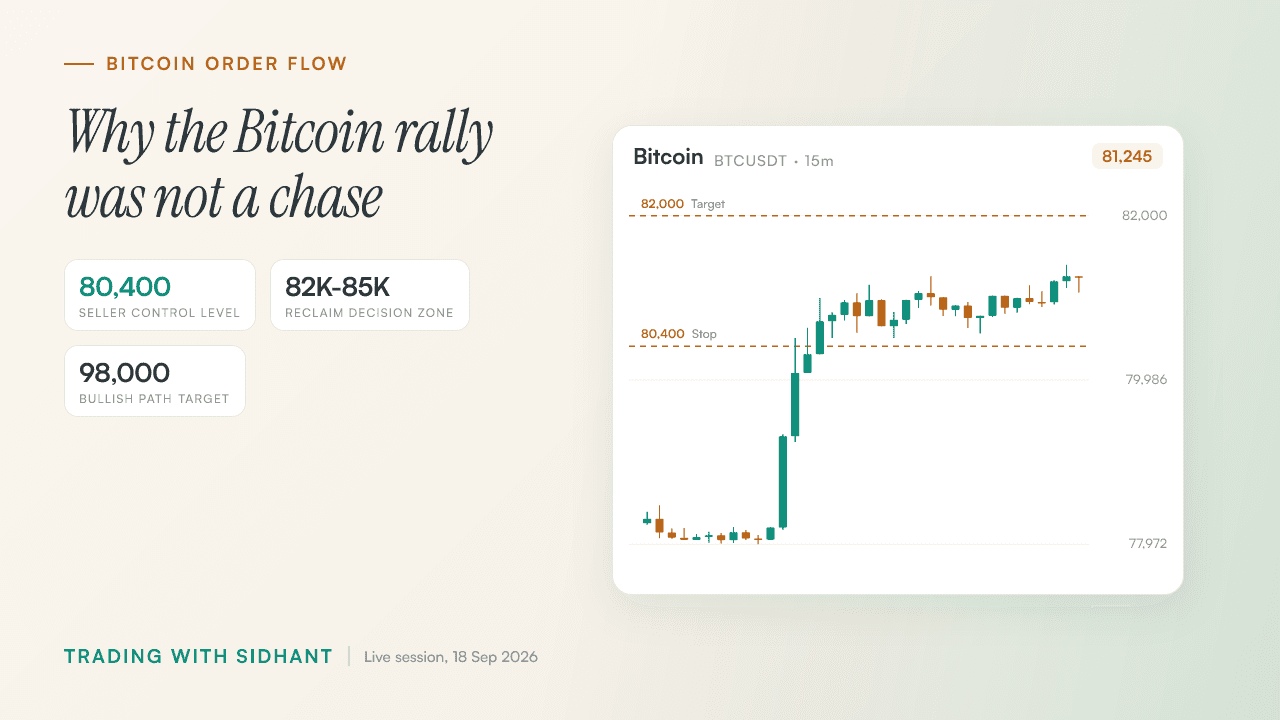
Bitcoin Order Flow Analysis After a Rally
Bitcoin had already rallied, so Fahad used 80,400, delta and seller exhaustion to explain why waiting beat a FOMO entry.

When to Quit a Profitable Intraday Strategy
Rs 12 lakh in profit looked different after Sidhant counted the 1,500 hours and the freedom the strategy had consumed.
Get post alerts in your inbox.
New blog post? We'll email you. No spam, unsubscribe anytime.
Join our Telegram community.
Get post alerts, trading discussions, and market updates.