Bitcoin Liquidity Sweep Trading Strategy: TP1 and Stops
A Bitcoin short reached TP1, but the bigger lesson came from the trailing stop that ended the trade.
7 min read
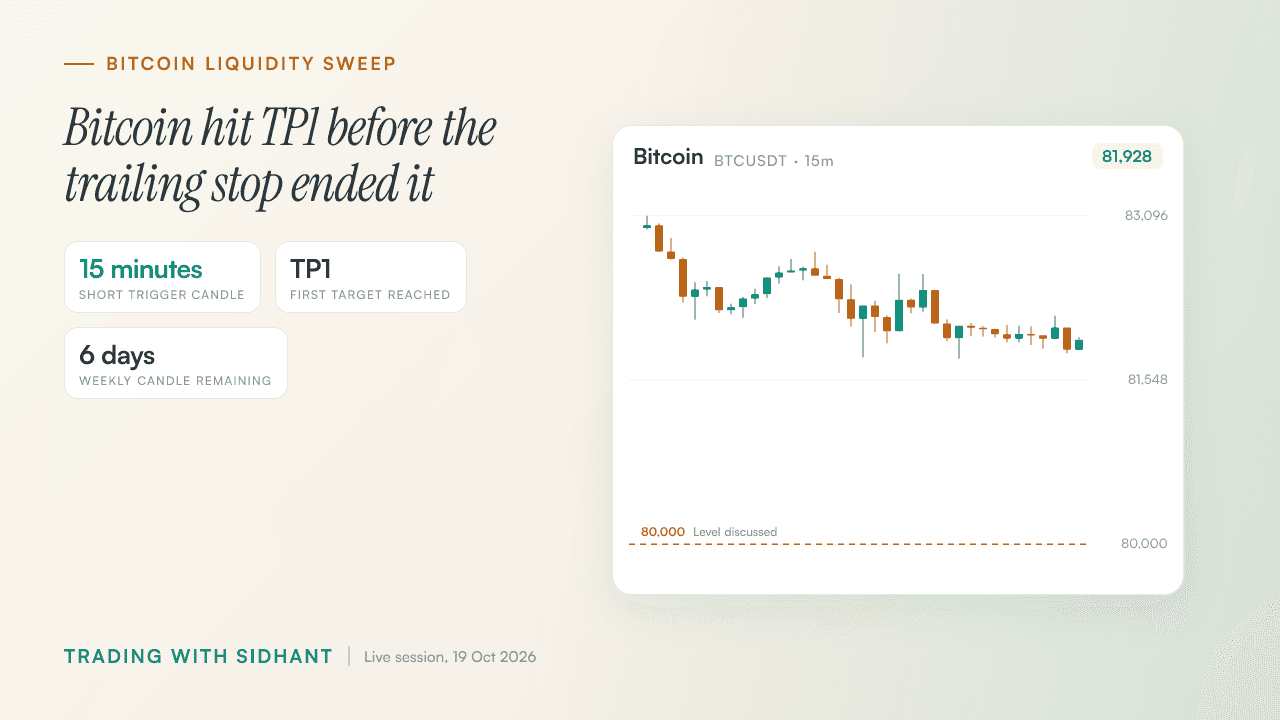
BTC reached TP1 on Fahad's short, then the trailing stop ended the trade. On Monday's stream, the bitcoin liquidity sweep trading strategy started with a break of the weekend low, a push through Friday's high and a reversal. Fahad used a 15-minute trigger for the short, but would not call the weekly chart bearish with six days left in its candle. Gold offered a range without a clean trade entry. Oil reached an earlier TP1, then lost the follow-through Fahad wanted. The exits told as much of the story as the setups.
Key Takeaways
- A local reversal offered a short setup while the weekly candle remained unresolved.
- TP1 changed how Fahad protected the short, and the trailing stop decided where it ended.
- Fahad considered the long after a fresh sweep, but required a 5-minute VWAP reclaim before treating it as active.
- Gold's range explained the grid bot, but Fahad waited for confirmation on his separate short idea.
- Oil's earlier TP1 called for protection, while the stalled continuation made Fahad's exit rule matter.
Bitcoin swept both sides, but the weekly trend was not bearish
BTC broke the weekend low, pushed through Friday's high and reversed. Fahad saw a local short setup, not confirmation of a bearish weekly trend. Six days remained in the weekly candle, and he wanted it to close below the previous candle's close before making that larger call.
His line was direct: 'Until we break the previous week's lows, I'm not bearish.' A sweep gave him a reason to watch for an intraday reversal. It could not finish the weekly candle early.
On the 4-hour chart, Fahad still saw a range after price took liquidity on both sides. He wanted another trap and reversal before treating the move as a larger directional break. Our guide to trading a Bitcoin liquidity sweep with confirmation covers the reaction after a sweep. The 15-minute liquidity-sweep reversal explanation also distinguishes taking a level from confirming a reversal.
80,000 was a discussion level, not the short trigger. Fahad's short depended on the lower-timeframe break. The chart marks 80,000, but not the weekend low or Friday's high, so it cannot show the full sweep sequence on its own.
◆ Interactive Lab
Open in new tab ↗Drive the order book yourself
The 15-minute break reached TP1 before the trailing stop hit
Fahad tied the BTC short to a break below the previous 15-minute candle low. The nearby local low was TP1, with initial invalidation above the week's level. Price reached TP1, so he moved the stop to breakeven and later trailed it. That trailing stop was hit, ending the trade.
The first target changed how he managed the remaining position. Fahad put it this way: 'When TP is hit, we don't hit TP. When TP is hit, we trail SL.' He was explaining his approach after TP1, not claiming the move would keep going.
Bitcoin short: trigger, target and stop progression
| Stage | Chart condition | Trade management |
|---|---|---|
| Trigger | Break below the previous 15-minute candle low | Initial invalidation above the week's level |
| TP1 | Price reached the nearby local low | Move the stop to breakeven |
| After TP1 | The first objective was met | Trail the stop |
| Exit | Price hit the trailing stop | Trade ended |
The trigger and target were chart levels rather than quoted prices. Their order mattered: wait for the break, protect the position at TP1, then let the trailing stop decide the remainder.
Later Fahad acknowledged it plainly: 'Ah, so we got stopped out.' The trade-exit discussion fits this sequence. Protecting the short after TP1 and accepting the eventual stop were parts of the same plan.
A swept low and VWAP reclaim offered a separate Bitcoin long
Later, Fahad considered a BTC long after a local low sweep and VWAP retest. He wanted a 5-minute candle to close above VWAP, with a possible pin bar and money flow confirmation. The proposed objective was the local highs, with invalidation below the swept low. He did not confirm a long entry.
The earlier short had already ended. A fresh sweep gave Fahad a different setup to assess, provided the reclaim actually printed. The Bitcoin VWAP reclaim guide explains why a test of VWAP is different from a close back above it.
Fahad's conditions were specific:
- Sweep: BTC took the local low.
- Retest: Price returned to VWAP, but the test alone was not the trigger.
- Confirmation: A 5-minute close above VWAP, with the pin bar and money flow he discussed, would support the long idea.
- Plan: The local highs were the objective, and the swept low marked invalidation.
There was no reason to keep defending the short bias after that trade ended. Fahad could consider the other side while still waiting for its own candle close.
Gold's 4,071 to 4,219 range suited grids, not a forced short
Gold was moving sideways between 4,071 and 4,219, a range Fahad used to explain a directional grid bot. Buy limits would sit below price and sell limits above it. He also discussed downside toward 4,000, but his bearish lean did not produce a clean short entry on the stream.
Fahad estimated the range at roughly 3% and thought it might last another week or two. A filled limit order can make room for another grid if price keeps moving through the range. If gold breaks a boundary and continues trending, the back-and-forth that the bot relies on disappears.
Gold levels and what each meant for the range idea
| Level or measure | Role in Fahad's plan | What changes the plan |
|---|---|---|
| 4,071 | Lower boundary of the sideways range | A sustained break below it undermines the range setup |
| 4,219 | Upper boundary of the sideways range | A sustained break above it undermines the range setup |
| Approximately 3% | Fahad's estimate of the range | A persistent trend leaves less room for repeated range trades |
| 4,000 | Potential downside level | It was separate from the grid boundaries |
The chart marks 4,071, 4,219 and 4,000. Fahad said gold was not bullish and waited for confirmation after a local sweep rather than forcing the short. His gold market reads offer more context for separating a directional view from a trade entry.
◆ Interactive Lab
Open in new tab ↗Drive the order book yourself
Oil's stalled follow-through reinforced the stop-placement lesson
An earlier oil short reached TP1, and Fahad told anyone still in it to move the stop to breakeven. A continuation short needed a break below a local low followed by movement lower. Oil later failed to move as he expected, making the exit condition more useful than holding to the original bearish read.
Fahad had a rule for a breakdown that went nowhere: 'If the market starts to waste time, I'll exit that trade, for sure.' He also discussed a possible sweep near 99.2, below 100, followed by a reversal that could squeeze shorts. That was a scenario, not an outcome he reported.
The oil decisions served different purposes:
- Earlier short: TP1 was reached, prompting the breakeven-stop call.
- Continuation idea: A local low break needed follow-through.
- Changed read: A sweep near 99.2 and below 100 raised the possibility of a reversal.
The chart marks 99, 99.2 and 100, the area Fahad discussed for the possible sweep. Those marks do not show that a squeeze occurred.
When a viewer asked about stops, Fahad said: 'If it took you 30 minutes to do this entire analysis, then spend another 30 minutes figuring out your stop loss.' He said placement depends on whether the trade is a scalp, day trade or swing, and warned against obvious stop levels. The oil stall showed why that work cannot wait until after entry.
◆ Interactive Lab
Open in new tab ↗Drive the order book yourself
Fahad's Bitcoin short reached its first target, but the trailing stop gave the trade its ending. He kept that intraday result separate from the unfinished weekly candle. The later long idea needed its own VWAP confirmation, just as gold's downside view needed an entry he never found. Oil made the cost of waiting for follow-through easier to see: if the move stalls, the original read is not enough reason to stay. Fahad's stop-placement advice was practical because the stream showed those decisions happening alongside the chart work, not after it.
Join the Hitpoint community for live market coverage and real-time trade discussions.
Watch the full stream: 🔴 BTC & Gold Live Trading | See Where Big Players Buy & Sell (Order Flow) on YouTube
Disclaimer: This article is for educational purposes only and is not investment advice. Crypto assets and virtual digital assets are unregulated in India, are highly volatile, and can lose value rapidly; there is no established regulatory recourse for losses from them. The price levels, setups and trades described are a review of market events that have already occurred, shared to illustrate a method of analysis rather than to recommend any trade. Trading With Sidhant LLP is not a SEBI-registered Investment Adviser or Research Analyst, and nothing here constitutes a recommendation to buy or sell any asset. Income from virtual digital assets is taxable in India at 30% plus applicable cess, with 1% TDS on transfers. Past performance is not indicative of future results. Do your own research before trading.
Frequently Asked Questions
- How did Fahad identify the Bitcoin liquidity sweep?
- Fahad identified it from Bitcoin breaking the weekend low, then pushing through Friday's high before reversing. He treated that sequence as a local trading setup rather than proof of a bearish weekly trend. On the 4-hour chart, he still saw a range and wanted another trap and reversal before making a larger directional call.
- What confirmed the Bitcoin short after the sweep?
- The short was tied to a break below the previous 15-minute candle low. Fahad used the nearby local low as the first objective and placed initial invalidation above the week's level. That lower-timeframe trigger let him trade a local short while the weekly candle, with six days remaining, had not confirmed a bearish trend.
- Why did reaching TP1 not mean closing the whole Bitcoin trade?
- Fahad treated TP1 as the point to change how he managed the remaining position. After Bitcoin reached the nearby local low, he moved the stop to breakeven and later trailed it. Price eventually hit that trailing stop, ending the trade. His rule on the stream was to trail the stop after TP1 rather than treat the first target as the end.
- What would confirm a bearish weekly Bitcoin trend?
- Fahad said the weekly candle needed to close below the previous candle's close before he would call that timeframe bearish. Six days still remained in the candle during the stream, so the intraday reversal could not settle the weekly question. He also said he was not bearish until Bitcoin broke the previous week's lows.
- When does a grid bot stop making sense in a gold range?
- A range-bound grid bot loses its premise when gold breaks beyond the set boundaries and keeps trending. Fahad used 4,071 to 4,219 to explain buy limits below price and sell limits above it, relying on repeated movement within that range. He described the span as roughly 3%, but a sustained move outside it would change the conditions the bot was built for.
Share this post
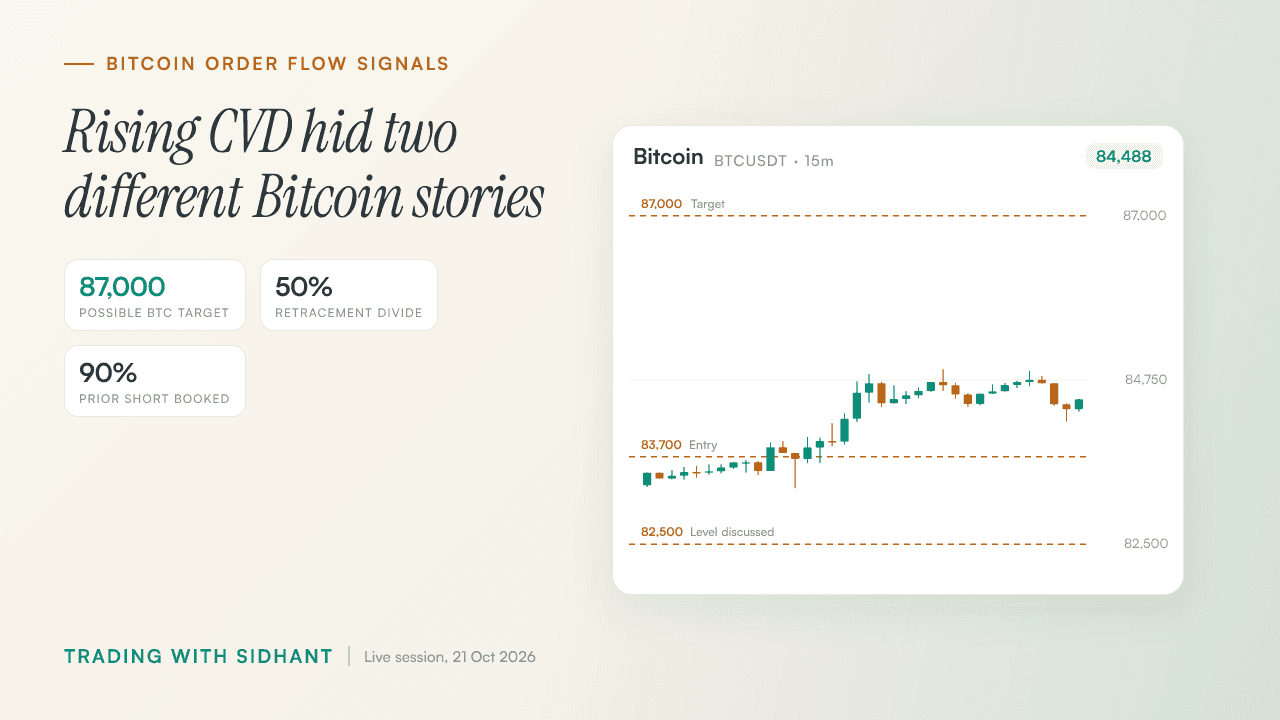
How to Read Bitcoin Open Interest and CVD Before 87,000
Rising CVD supported Fahad's Bitcoin upside bias, but a later drop in open interest changed what the buying meant.
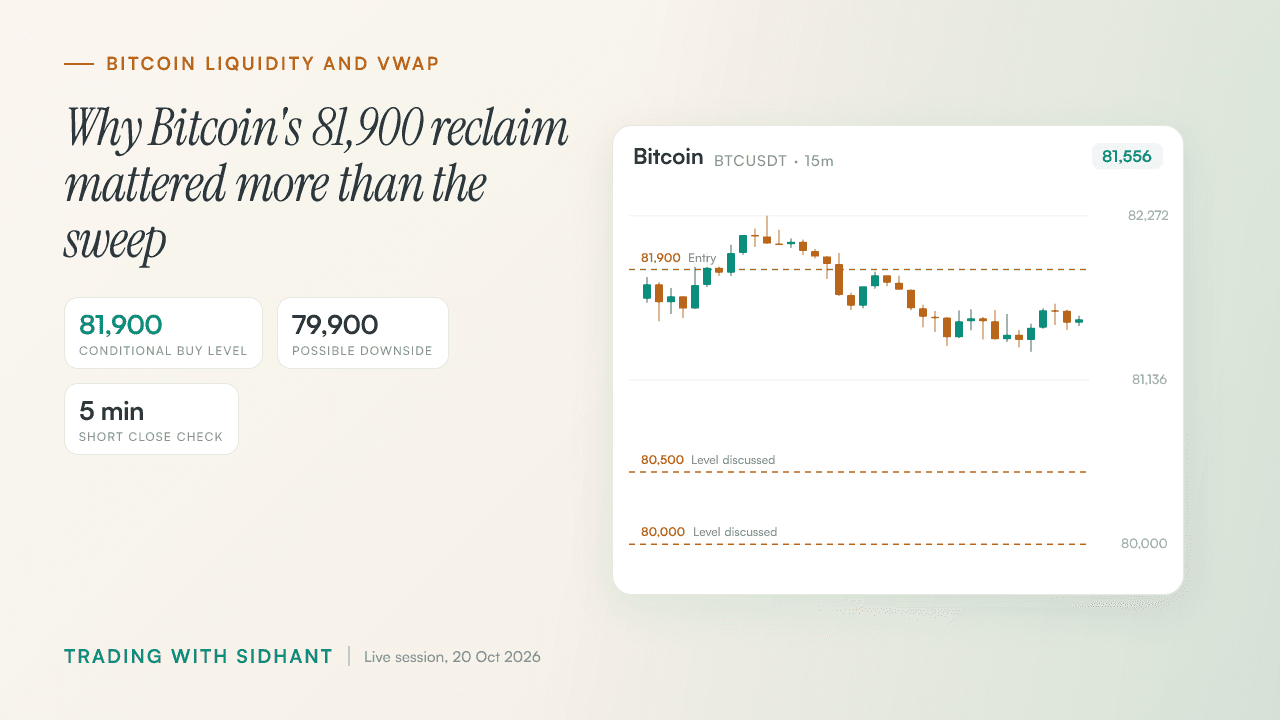
How to Trade Bitcoin Liquidity Sweeps Near 81,900
Bitcoin swept both sides of its range, but Fahad wanted an 81,900 reclaim to buy or a confirmed VWAP loss to short.
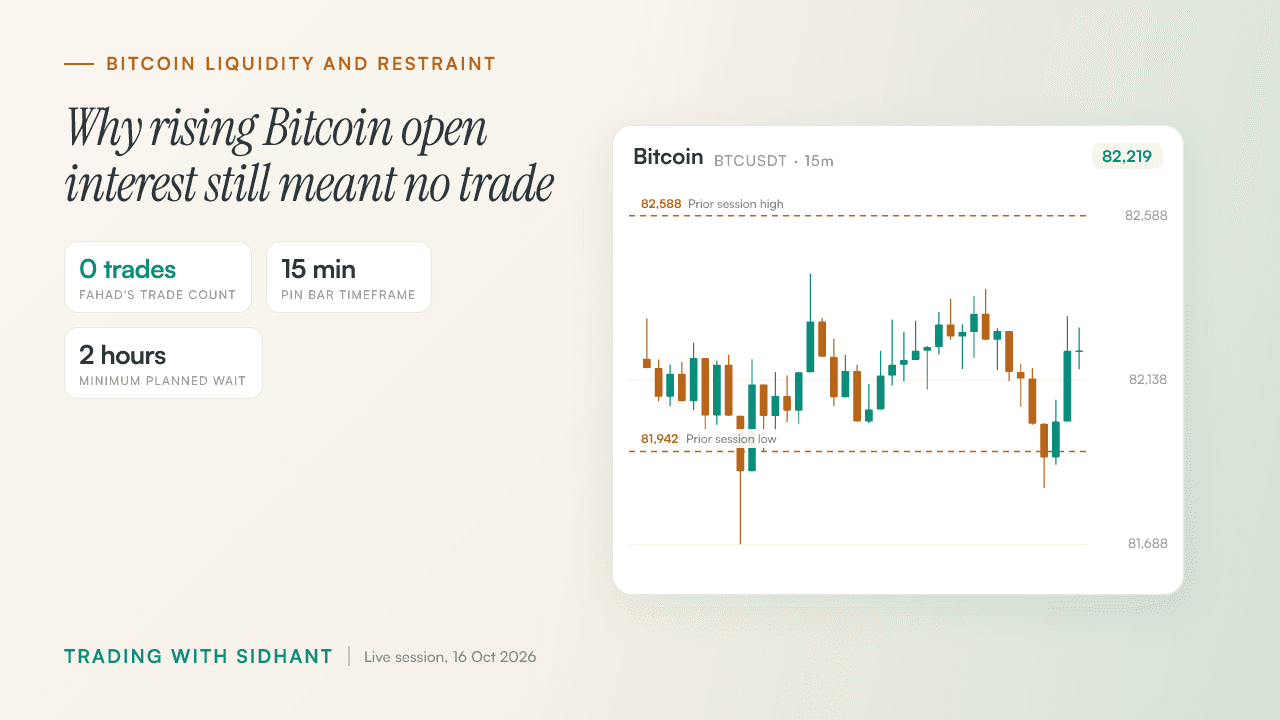
When Not to Trade Bitcoin: Rising OI, Zero Trades
Bitcoin open interest rose as CVD fell, but weak volume and conflicting signals kept Fahad out of the market.
Get post alerts in your inbox.
New blog post? We'll email you. No spam, unsubscribe anytime.
Join our Telegram community.
Get post alerts, trading discussions, and market updates.