How to Trade Gold Market Conditions: Fahad's Insights
Discover Fahad's insights on holding gold and risky entry strategies today.
10 min read

Gold was sitting at a make-or-break zone, and honestly? The signals were anything but clean. On the stream, Fahad pulled up the charts and went straight into it (no fluff, just the hard read on how to trade gold market conditions effectively when everything looks mixed). The week had been frustrating, you know? Price action was choppy, volume told one story while structure told another, and our team was waiting, deliberately, for confirmation before calling anything. This post breaks down exactly what we spotted, what Fahad called, and why patience in gold right now is not weakness. It's the strategy.
Key Takeaways
- Mixed gold signals are themselves a signal. Waiting for structure to clarify is a legitimate and often overlooked trading strategy.
- Marking previous highs and lows before every trade session is non-negotiable. Structure tells you where the market has already decided.
- Exiting because a trade feels uncomfortable is not the same as exiting because structure has broken. Know the difference before touching the close button.
- A risky entry becomes acceptable when risk is clearly defined, a structural level is present, and the macro context provides a logical backstop.
- Confirmation costs you the first few percent of a move but saves you from the majority of false starts. That trade-off is always worth it.
What Are the Current Trends in Gold Trading?
Current trends show mixed signals in gold trading, and that mix demands careful analysis before taking any position. Gold has been oscillating between genuine structural support from long-term buyers and near-term bearish pressure from macro forces. Our team analyzed these dynamics live on the stream, and the picture was not straightforward. Which, honestly, is exactly when discipline matters most.
Here's the thing. Gold has been struggling near the $4,000 support level, with the Federal Reserve's hawkish stance and persistent inflation fears creating a ceiling on any meaningful rally. According to Kitco, technical resistance at $4,230 and $4,300 has not been breached, and near-term momentum remains tilted bearish.
Fahad's read on the session was blunt: "Look, I really don't like how this week is unfolding in gold." That's not a throwaway comment. That's someone who has watched gold structure for years telling you the setup is not clean.
What were we actually seeing in price action?
- Volume trends were inconsistent, with spikes that had no follow-through
- Price action kept rejecting at key overhead levels
- Market structure showed weakness, not the kind of consolidation that precedes a clean breakout
- The $4,000 zone was acting as both magnet and minefield
Wait, actually... the mixed signals here are the signal. When gold can't hold clean structure and volume doesn't confirm directional intent? That's the market telling you to wait. Fahad flagged this clearly: he wasn't bearish enough to short, but he wasn't bullish enough to add either.
So basically, the trend right now is no trend, and trading no-trend markets aggressively is how accounts bleed slowly. Our team's approach was to sit on hands, monitor the price action, and let the structure develop before committing capital. Boring? Maybe. Profitable? Absolutely.
Longer-term, there are real structural tailwinds like central bank buying and de-dollarization themes, but those don't matter if your entry timing is wrong in the short run. Bank of America's analysts have noted gold can still hit $6,000, just not on any immediate timeline. Long-term thesis, short-term caution. That's the balance.
How to Align Trades with Gold Market Structure?
Trades should align with the market structure by marking previous highs and lows. Full stop. Our team emphasizes this constantly, and on the stream, Fahad made it the cornerstone of the entire gold discussion. You cannot trade gold effectively without knowing where the market has already made its decisions.
You know what I mean? Most traders look at a gold chart and see a price. Fahad looks at a gold chart and sees a map of decisions. Where buyers stepped in, where sellers defended, where the market left liquidity behind. That's the difference between reacting and reading.
The practical approach our team uses:
- Mark the most recent swing high and most recent swing low before anything else
- Identify whether price is trading above or below the 50-session mean structure
- Watch how price reacts at those marked levels. Does it slice through or reject?
- Only consider entries when price approaches a marked level with volume confirmation
For gold during this session, the structure was bearish, and price was not holding above key reference points. Fahad was clear: he felt like he was "waiting for some kind of confirmation" before taking any directional stance. That patience is structural alignment in action.
For those who want to understand order flow and how it interacts with market structure, mastering footprint trading gives you a layer of precision that pure price action alone can't match.
Gold Market Structure Levels
| Level | Description |
|---|---|
| $4,300 | Key technical resistance, not yet breached, acts as upper ceiling |
| $4,230 | Secondary resistance, rejection zone on recent rallies |
| $4,000 | Critical support, make-or-break level for near-term direction |
| Previous Swing High | Mark from most recent rally peak, defines bullish invalidation |
| Previous Swing Low | Mark from most recent selloff bottom, defines bearish invalidation |
The point is: structure is not an opinion. Those levels existed before we analyzed them, and our job is to respect them, not fight them.

What Does Fahad Suggest About Holding Gold Trades?
Fahad advises holding gold trades unless confirmed signs suggest otherwise. Our team's consensus on the stream was clear: if you were already in a gold position with a reasonable entry, there was no structural reason to panic-exit just because the week felt choppy.
"If you're trading gold, I don't see any reason you should exit." That was Fahad's position, and it wasn't wishful thinking. It was based on the absence of a confirmed breakdown below key support.
This is where a lot of traders get it wrong. They exit solid positions because the market feels uncomfortable, not because the market has actually broken structure. Feeling uncomfortable and being wrong are not the same thing. (And this is where it gets interesting... the best trades often feel the worst to hold.)
What would actually justify an exit, according to our analysis?
- A confirmed close below $4,000 support with volume
- A break of the most recent swing low on the structure map
- A macro catalyst like a Fed decision or CPI print that changes the fundamental picture materially
- Volume expanding on the downside, not just price drifting lower
Absent those signals? Hold. That was the call.
Fahad also flagged that the current weakness in gold might be a shakeout before a structural move higher. De-dollarization as a structural theme (central banks diversifying away from USD reserves) is not going away. That provides a floor under gold that pure technical analysis sometimes misses.
For context, we've seen similar setups in correlated assets where the team had to hold through uncomfortable chop. Fahad's analysis of gold and Bitcoin short plays during market turmoil covers exactly how these decisions play out under pressure.
The team consensus: hold until structure breaks, not until it feels bad.
When Should I Enter a Risky Gold Trade?
Risky entries are permissible in gold trading when conditions and analysis align, and our team was explicit about when that threshold gets crossed. Not every trade needs to be textbook-perfect, but every risky entry needs a reason.
On the stream, Fahad said it directly: "You guys can take a risky entry right now." That was not reckless. That was a conditional call where conditions at that specific moment aligned well enough to justify a speculative position for traders who understood what they were doing and sized accordingly.
So what makes a risky entry acceptable versus just reckless?
The conditions that justified a risky entry on the stream:
- Price was approaching a known structural level, not random space
- Volume at that level showed absorption. Sellers hitting bids without price accelerating lower
- The broader context (de-dollarization, central bank demand) provided a macro backstop
- Risk was clearly definable, with stop placement below the structural level obvious
The conditions that would have killed the setup:
- Price breaking through the level with momentum and volume
- No clear stop placement. Undefined risk is not a risky trade, it's a gamble
- Entering into a confirmed trend, not against a level
Honestly? The difference between a risky entry and a stupid entry is whether you've done the work. Fahad had done the work. The team had marked the levels, watched the volume, and understood the macro context. The entry was risky, but the decision-making behind it was not.
U.S. JOLTS data showing resilient labor markets gave gold a modest bid even in a challenging macro environment. The kind of nuance that matters when you're deciding whether a risky entry has a macro tailwind or headwind.
For those who want to understand how similar logic applies in crypto setups, the team's breakdown of Bitcoin's bold breakout moves walks through the same decision framework in a different asset class.
Risky entries are fine. Unplanned entries are not. Know the difference before you click.

How Important is Confirmation in Gold Trading?
Confirmation plays a decisive role in gold trading, ensuring that entries are backed by solid data rather than hope or impatience. Our approach on the stream underlined this at every turn. Fahad was not willing to commit directionally until the market gave him something real to trade against.
"Honestly, I don't think so. I don't see any reason for you to short here." That line captures the confirmation mindset perfectly. The absence of a short signal is not the same as a buy signal, and Fahad was waiting (not hesitating, waiting) for the market to show its hand.
Let me clarify what confirmation actually means in practice, because traders throw the word around without defining it:
- Price confirmation: A level holds or breaks with the next candle close, not intrabar
- Volume confirmation: Direction change accompanied by above-average volume, not just a spike
- Structure confirmation: A new high or new low is printed, shifting the swing sequence
- Time confirmation: Price holds a level for multiple sessions, not just one reaction
Waiting for confirmation costs you the first few percent of a move. That's the price of the confirmation premium, and it's almost always worth paying.
The alternative is entering without confirmation, which is how traders get chopped up in exactly the kind of mixed gold market we were analyzing on the stream. You get a candle that looks like a reversal, you enter, and then price continues the original direction and stops you out before the real move happens. Seen it a thousand times.
CPM's trade signal analysis for gold reinforces this. Disciplined entries based on confirmed signals consistently outperform anticipatory entries over any meaningful sample size.
The point is: confirmation is not a crutch for the uncertain, it's a filter for the disciplined. Our team waits for it every time, and that's why the setups we call tend to have follow-through.

Alright, let's quickly pull together what the stream actually taught us about gold this session:
- Mixed signals are a valid read. When structure is unclear and volume is inconsistent, sitting on hands is a position, not a failure
- Mark your levels before you do anything else. Previous highs, previous lows, and key support/resistance define the map you're trading on
- Hold until structure breaks. Uncomfortable chop is not a confirmed breakdown; Fahad's rule was clear on this
- Risky entries need defined risk. The moment you can't place a logical stop, the entry stops being risky and starts being reckless
- Confirmation is the filter. Price, volume, structure, and time all need to align before committing capital in a choppy gold environment
Fahad's approach this session was a masterclass in what disciplined patience looks like in real time. Not passive. Active waiting, with clear conditions for action.
If you want to watch this analysis unfold live (levels called in real time, setups debated openly, and no-holds-barred reads on market structure), join the Hitpoint community for live market coverage and real-time trade alerts.
Watch the full stream: LIVE: Trading BTC, Gold, Silver | Orderflow & Footprint on YouTube
Disclaimer: This article is for educational purposes only and is not investment advice. The price levels, setups and trades described are a review of market events that have already occurred, shared to illustrate a method of analysis rather than to recommend any trade. Trading With Sidhant LLP is not a SEBI-registered Investment Adviser or Research Analyst, and nothing here constitutes a recommendation to buy or sell any security. Investments in securities markets are subject to market risks; read all the related documents carefully before investing. Past performance is not indicative of future results. Please consult a SEBI-registered financial adviser before acting on any information in this article.
Frequently Asked Questions
- What are the current trends in gold trading?
- Gold was showing mixed signals during the session, with price struggling near the critical **$4,000** support level and technical resistance sitting at **$4,230** and **$4,300**. Near-term momentum was bearish due to Fed hawkishness and inflation pressures, but longer-term structural themes like central bank buying and de-dollarization were providing underlying support. The team's read: no clean directional trend, which demanded patience over aggression.
- How can I align my trades with gold market structure?
- Aligning with gold market structure starts with marking previous swing highs and lows before any session begins. From there, watch how price reacts when it reaches those levels. Does it reject cleanly or slice through with volume? Fahad's framework on the stream was simple: trade the levels that already exist on the chart, not the levels you wish existed. Structure is not an opinion.
- What does Fahad suggest about holding gold trades?
- Fahad's position was direct: hold gold trades until confirmed structural evidence says otherwise. A confirmed close below **$4,000** with volume, or a break of the most recent swing low, would justify an exit. Feeling uncomfortable with chop is not sufficient reason to exit a structurally sound position. The team consensus was that absent a real breakdown signal, holding was the correct call.
- When should I enter a risky gold trade?
- A risky gold entry is justified when price reaches a known structural level, volume shows absorption rather than continuation, risk is clearly definable with an obvious stop placement, and the macro context provides at least a partial backstop. Fahad flagged a risky entry opportunity on the stream when these conditions aligned. Without all of them in place, a risky entry is just an unplanned entry.
- How important is confirmation in gold trading?
- Confirmation is the single most important filter in gold trading, especially during mixed market conditions. Fahad explicitly said he was "waiting for some kind of confirmation" before taking any directional position. Price confirmation via candle close, volume confirmation via above-average participation, and structure confirmation via a new swing high or low. Entering without confirmation in a choppy gold market is how traders get repeatedly stopped out before the real move.
Share this post

How to Use Direction Area Trigger in Nifty Trading
A Nifty short near 24,000 needed more than a pin bar: daily bias, a defined area and footprint evidence had to agree.
Bitcoin Order Flow Analysis After a Rally
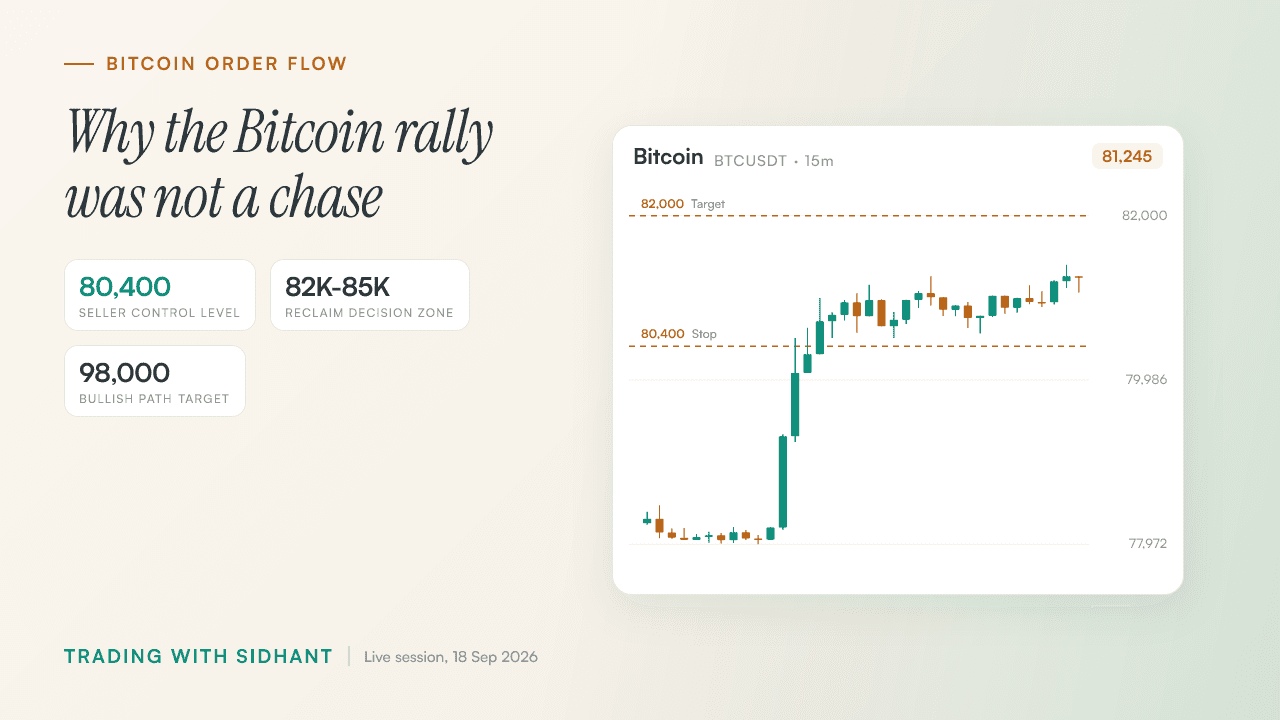
Bitcoin had already rallied, so Fahad used 80,400, delta and seller exhaustion to explain why waiting beat a FOMO entry.

When to Quit a Profitable Intraday Strategy
Rs 12 lakh in profit looked different after Sidhant counted the 1,500 hours and the freedom the strategy had consumed.
Get post alerts in your inbox.
New blog post? We'll email you. No spam, unsubscribe anytime.
Join our Telegram community.
Get post alerts, trading discussions, and market updates.