How to Trade a Bitcoin VWAP Reclaim Without Chasing
Bitcoin's short reached TP1, but Fahad still wanted stronger closes before treating a VWAP reclaim as a long signal.
7 min read
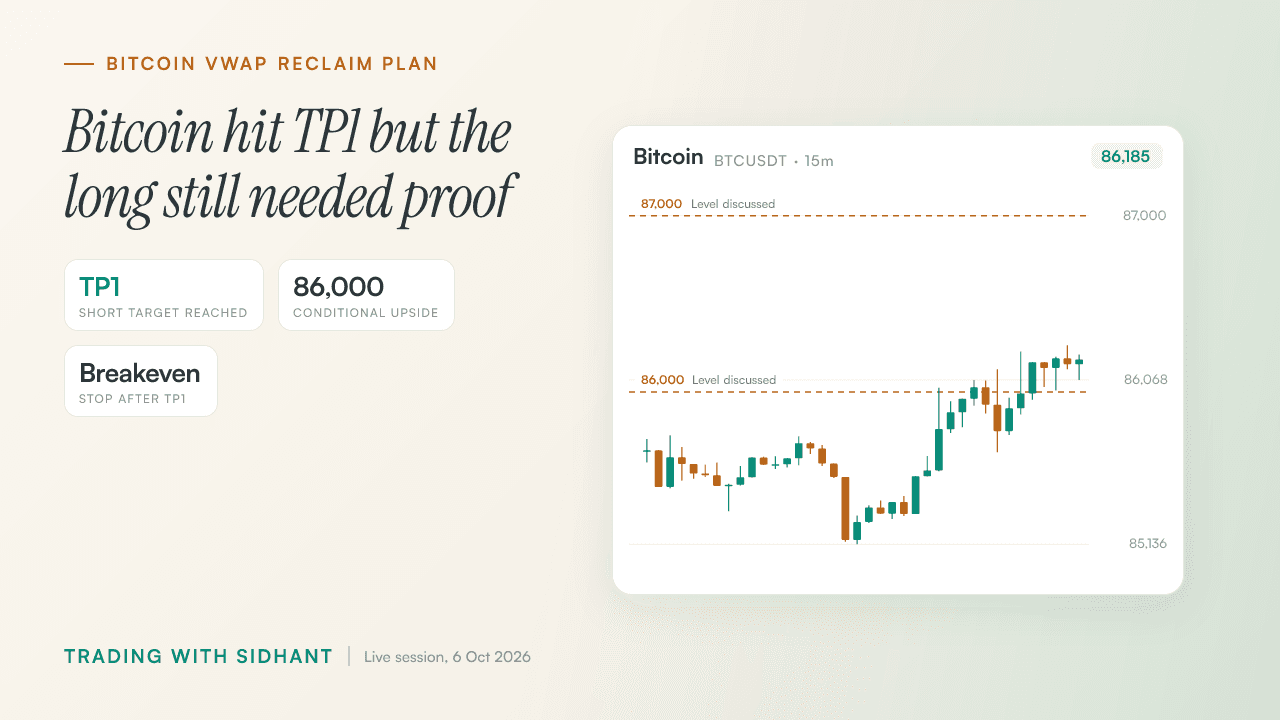
The BTC short reached TP1 on the stream, and Fahad moved the stop to breakeven. Later, Bitcoin reclaimed a level, but he still would not buy it. That distinction is central to how to trade a bitcoin vwap reclaim without chasing: a move above a line needs convincing closes behind it. We had poor local highs and a liquidity sweep supporting the short. 86,000 came into view only if Bitcoin reclaimed VWAP with strength.
Key Takeaways
- A liquidity sweep gave us a reason to inspect the short, but the marked reclaim level defined when that idea lost strength.
- The first cross above VWAP deserved attention; repeated strong closes were the evidence Fahad wanted before entertaining the upside case.
- A footprint imbalance tells us who traded aggressively, not whether those traders were right.
- Moving the stop after TP1 protected an existing position; it did not provide missing entry or risk details for a new one.
- Fahad passed on both the Bitcoin long and SOL because the closes had not earned the bullish interpretation.
Poor highs and a liquidity sweep favoured a Bitcoin short
Fahad began with a bearish BTC bias because the local highs looked poor and Bitcoin had swept nearby liquidity. We treated the possible short as a risky lower-timeframe scalp, not an instruction to sell anywhere. If price reclaimed his marked level, reversal risk would rise and the short would lose strength.
Three parts of the setup mattered:
- Poor highs: Fahad saw a lower-timeframe area worth considering for a short scalp.
- Liquidity sweep: Bitcoin had taken nearby liquidity, so we watched the reaction instead of assuming it would keep climbing.
- Marked level: The short looked strong while price stayed below it. A reclaim would increase the chance of reversal.
A Bitcoin liquidity sweep with confirmation calls for more than selling because price briefly poked above a high. We wanted to see what happened after the sweep.
Fahad did not state the short entry or initial stop on the stream. We cannot fill those gaps from the chart. What we have is his bearish read, a risky scalp discussion and the level that would threaten the idea.
A VWAP reclaim needed strong closes before a Bitcoin long
Fahad wanted a VWAP reclaim before considering a Bitcoin long. A touch or isolated close above it did not establish strength. We looked for multiple good closes around the marked level, including 5-minute or 15-minute candles. 86,000 was a possible upside destination only if the reclaim held up.
A cross drew our attention. The closes decided whether it meant anything.
An intraday VWAP guide describes VWAP as a support and resistance reference. Fahad used the standard settings on his displayed VWAP, apart from changing its colour and hiding the upper and lower bands. He did not treat a single cross as a long signal.
Bitcoin VWAP scenarios discussed by Fahad
| Price behaviour | What it would mean | Trading response |
|---|---|---|
| Price stays below VWAP | The bearish case keeps its reference level. | A bounce alone does not invalidate the downside bias. |
| Price briefly moves above VWAP without strong follow-through | Price has crossed, but strength remains unproved. | Wait for better closes rather than chase. |
| Price reclaims VWAP with multiple strong closes | The upside case has more support. | Consider 86,000 as a possible destination, not a guaranteed target. |
After the local sweep, Fahad also asked viewers to watch whether 5-minute or 15-minute candle bodies closed below his marked level. A wick through it was different from a close that held. That distinction also runs through waiting for confirmation around Bitcoin's value area.
The BTCUSDT 15-minute chart marks the discussed 86,000 and 87,000 levels. Neither mark supplies an entry. For our team, VWAP gave the move context, while the closes still had to show strength.
◆ Interactive Lab
Open in new tab ↗Drive the order book yourself
Footprint buying at the high was not automatically bullish
Fahad challenged a viewer's claim that Bitcoin's bottom candle automatically showed absorption. We needed to compare footprint activity with what price did next. Aggressive buying at a high can leave buyers trapped if price drops. Heavy selling at a low can also come before a rise.
The print showed who traded. Price tested their position.
| Observed activity | Possible interpretation | Needed context |
|---|---|---|
| Buying imbalance at a high, then a drop | Aggressive buyers may be trapped. | Did price hold the high or reject it? |
| Heavy selling at a low, then a rise | Sellers may have pressed into a low that failed to continue down. | Check the price response and other order-flow data. |
| Activity in Bitcoin's disputed bottom candle | Absorption was a proposed label, not an established fact. | Compare volume, CVD, open interest and positioning. |
Fahad brought up footprint, volume bubbles, CVD, open interest and net-long or net-short positioning. He pointed to new money entering and buying as a reason not to label the bottom candle absorption by default. The stream gave no numerical footprint delta or open-interest reading to attach to it.
He compared footprint to an X-ray: an experienced doctor can form an opinion from the outside, while the image gives a closer view. That closer view still needs interpretation. Our guide to footprint delta and false signals develops the same point.
TP1 let us protect the Bitcoin short at breakeven
The BTC short reached TP1 on the stream. Fahad moved its stop to breakeven and looked for a new local low. We can report that adjustment without inventing an entry, initial stop or target price. A reclaim of his marked level could still increase reversal risk.
Fahad managed the position already open:
- TP1 reached: The first target was hit, though Fahad did not state its price.
- Stop moved: He brought the stop to breakeven after that target.
- Next idea: He looked for a new local low without giving its exact level.
Fahad called the existing local low poor and said it could still be taken out. He had not said a new low had printed. At the same time, he warned that reclaiming the level above would make a reversal more likely.
Protecting an open short is different from opening another one. The breakeven stop changed the risk on Fahad's existing position, but it gave nobody arriving late an entry. Our Bitcoin short trade management discussion treats exits and local liquidity as separate decisions.
We did not get an entry price, initial stop price or TP1 price for this short. Without those figures, a risk-to-reward calculation would be made up. Later in the stream, Fahad told traders to decide their worst acceptable loss before entering, rather than rely on a stop adjustment after the trade works.
Neither the level reclaim nor 87,000 liquidity justified chasing
Bitcoin later reclaimed a marked level, but Fahad still saw too little strength for a long. A viewer asked about liquidity at 87,000. Fahad said price had not indicated it would take that area, and he also declined to buy SOL. We kept those possibilities separate from trades we could justify.
The closes had not made the case:
- Level reclaim: Bitcoin moved back above the mark, yet Fahad said the move lacked strength.
- 87,000 liquidity: The viewer raised it, but Fahad saw no indication price would take it.
- SOL: Fahad passed on buying and wanted multiple good BTC closes before considering crypto buys.
That decision matched his earlier VWAP test. Reading Bitcoin open interest and CVD when price rises can add context, but it cannot turn an unconvincing close into a strong one. We had a reclaim to assess, not a confirmed move to 87,000.
Fahad's clearest decision on the stream came after the BTC short hit TP1. He moved the stop to breakeven, then kept asking for stronger closes before considering the other side. We had a short to manage and a possible long condition to watch, not one trade that turned into the other when price crossed a level. Bitcoin later reclaimed a mark, and Fahad still passed. That wait made sense to our team: the crossing was visible, but the strength he wanted was not. Join the Hitpoint community for live market coverage and real-time trade alerts.
Watch the full stream: How to Trade a Bitcoin VWAP Reclaim Without Chasing on YouTube
Disclaimer: This article is for educational purposes only and is not investment advice. Crypto assets are unregulated in India, are highly volatile, and can lose value rapidly; there is no established investor-protection or grievance-redressal mechanism for them. Trading With Sidhant LLP is not a SEBI-registered Investment Adviser or Research Analyst, and nothing here constitutes a recommendation to buy or sell any asset. Income from virtual digital assets is taxable in India at 30% plus applicable cess, with 1% TDS on transfers. Past performance is not indicative of future results. Do your own research before trading.
Frequently Asked Questions
- What confirms a Bitcoin VWAP reclaim?
- Multiple strong closes above **VWAP** were the confirmation Fahad wanted before considering a **BTC** long. He watched **5-minute** or **15-minute** candles around the marked level and judged whether price showed strength beyond a brief cross. On the stream, **86,000** was a possible upside destination under that condition, not proof that the condition had been met.
- Is one candle close above VWAP enough to go long?
- No, one close above **VWAP** did not satisfy Fahad's test. He wanted multiple good closes and a convincing price response because a brief move through the indicator could fade. Bitcoin later reclaimed a marked level on the stream, yet he still called the strength insufficient and did not take the long.
- How can footprint data show trapped Bitcoin buyers?
- Aggressive buying at a high can leave buyers trapped if **BTC** then drops instead of holding that high. Fahad used that example to challenge simple readings of footprint activity. We also considered the price response, volume, **CVD**, open interest and positioning. The stream supplied no numerical footprint delta or open-interest value.
- Why move a Bitcoin short stop to breakeven after TP1?
- Moving the stop to **breakeven** after **TP1** protected the remaining Bitcoin short against a reversal to its entry. That is what Fahad did on the stream before looking for a new local low. He did not state the short's entry, initial stop or TP1 price, so we cannot turn the move into a priced setup.
- Did the 86,000 level become a confirmed Bitcoin target?
- No, **86,000** remained a possible upside destination if Bitcoin reclaimed **VWAP** with convincing closes. Fahad did not treat a touch or isolated move above the indicator as enough. Later, even after Bitcoin reclaimed a marked level, he said the move lacked strength and declined to go long.
Share this post
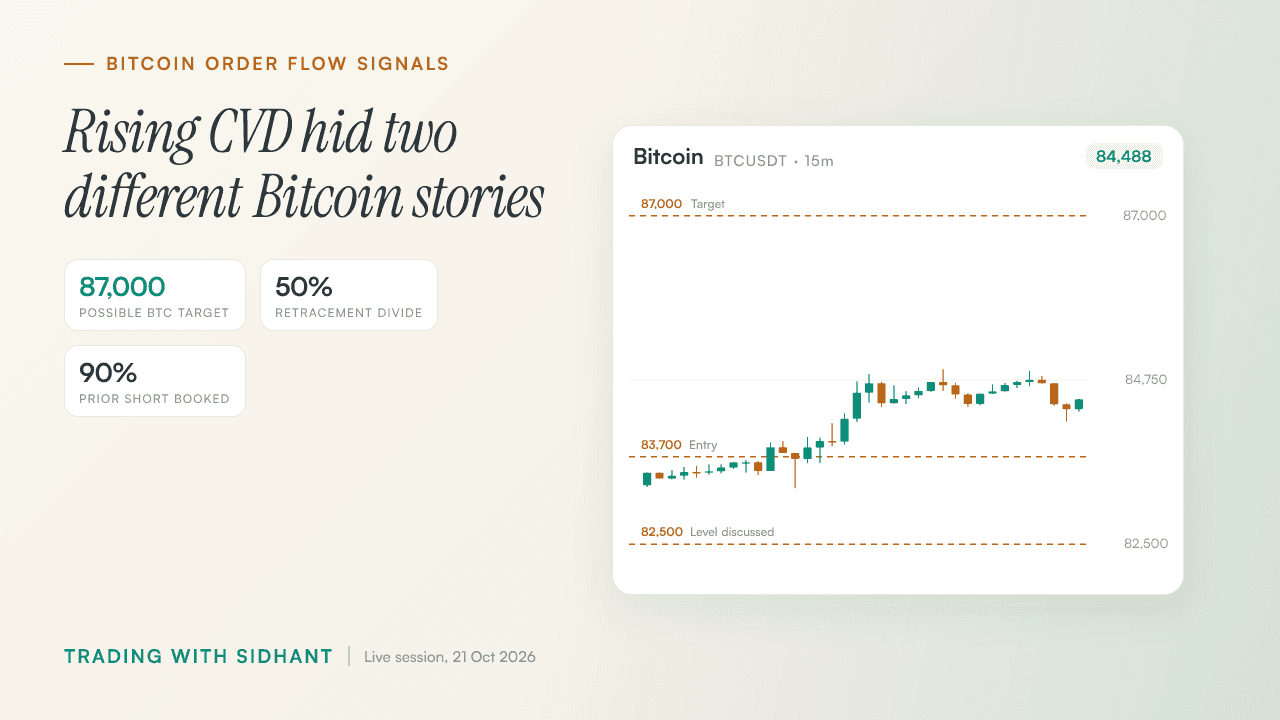
How to Read Bitcoin Open Interest and CVD Before 87,000
Rising CVD supported Fahad's Bitcoin upside bias, but a later drop in open interest changed what the buying meant.
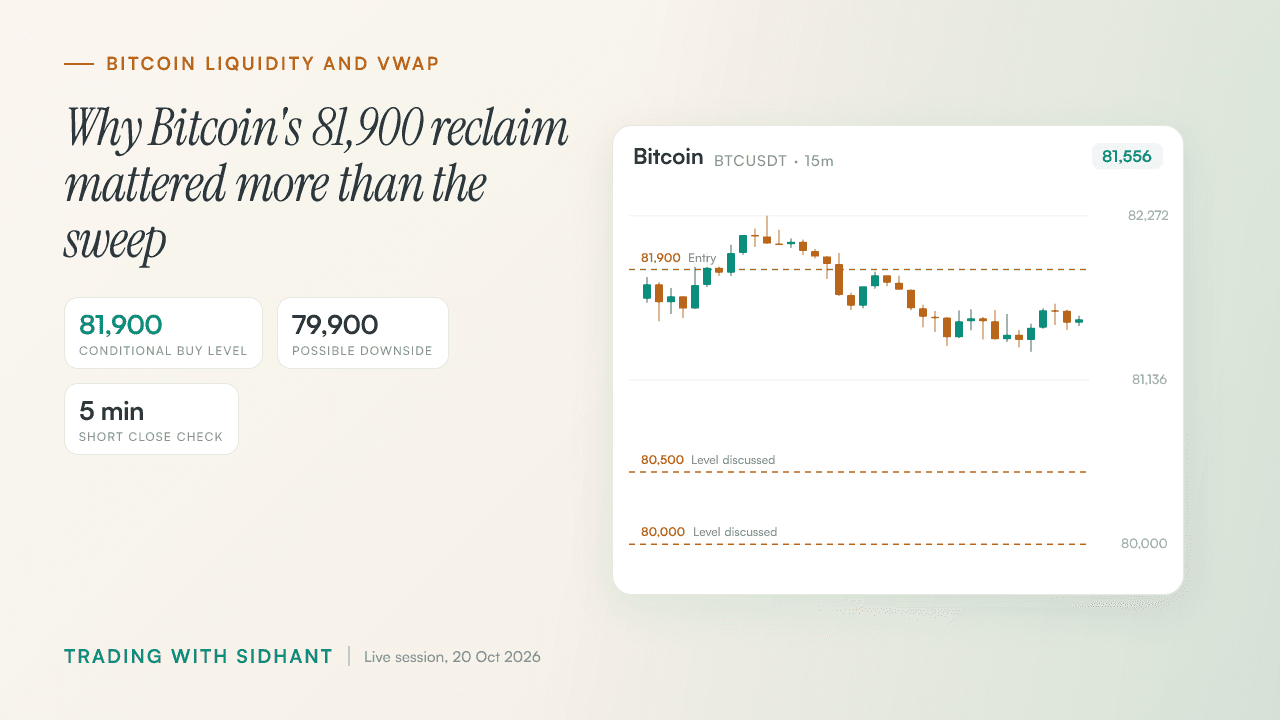
How to Trade Bitcoin Liquidity Sweeps Near 81,900
Bitcoin swept both sides of its range, but Fahad wanted an 81,900 reclaim to buy or a confirmed VWAP loss to short.
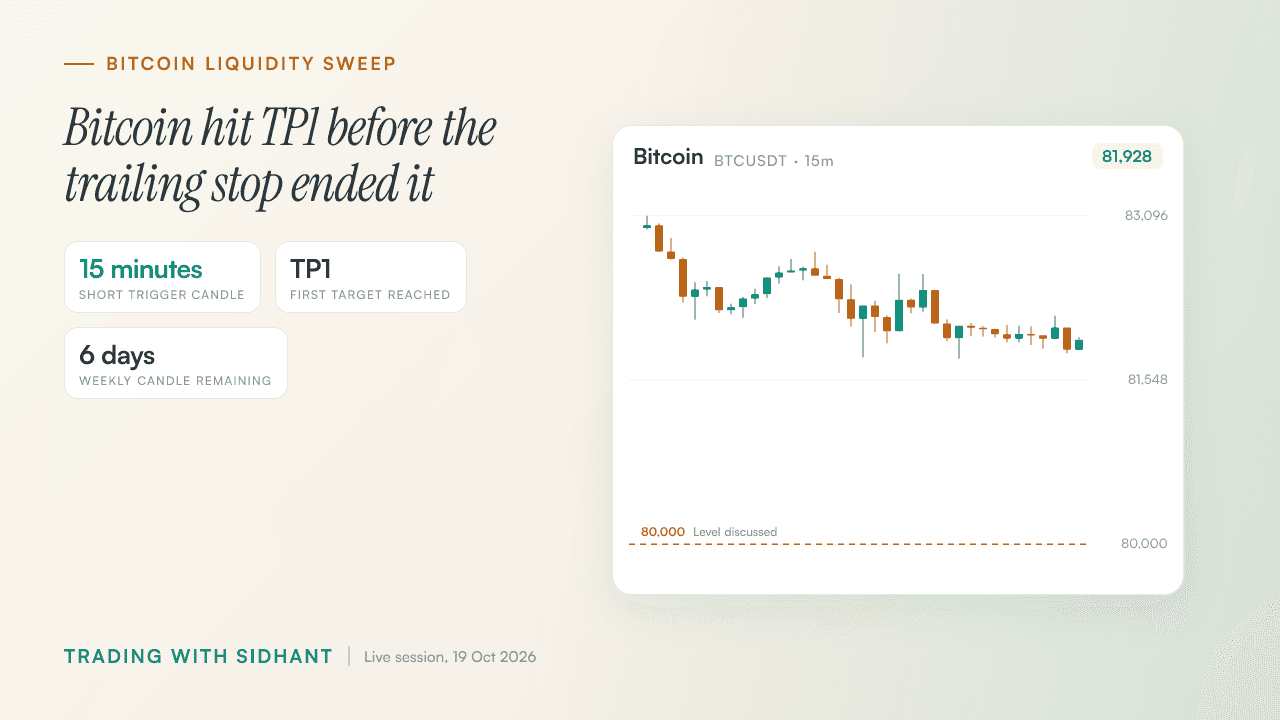
Bitcoin Liquidity Sweep Trading Strategy: TP1 and Stops
A Bitcoin short reached TP1, but the bigger lesson came from the trailing stop that ended the trade.
Get post alerts in your inbox.
New blog post? We'll email you. No spam, unsubscribe anytime.
Join our Telegram community.
Get post alerts, trading discussions, and market updates.