How to Trade Bitcoin Liquidity Sweeps Near 81,900
Bitcoin swept both sides of its range, but Fahad wanted an 81,900 reclaim to buy or a confirmed VWAP loss to short.
7 min read
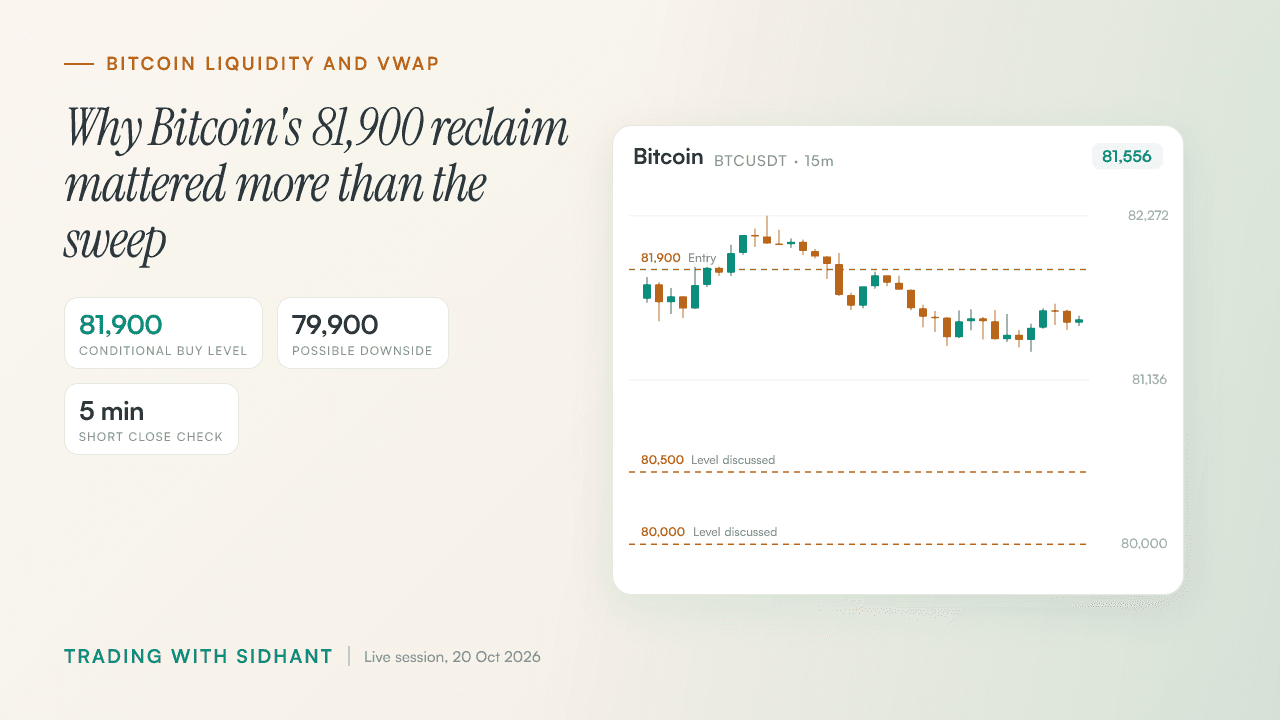
Bitcoin had swept both sides of its range, and Fahad still refused to pick a direction. The stream showed how to trade bitcoin liquidity sweeps when the daily candle gives no clean answer: he marked 81,900 as the reclaim that would interest him in buying, while a short needed confirmation below VWAP or the relevant candle low. Between those conditions, the one-hour volume looked balanced.
There was a plan for either side, but no reason to force one before the chart changed.
Key Takeaways
- A sweep marks a reference point; the candle and volume response decide whether it has become a trade.
- A directional read still needs candle confirmation and a stop that makes sense at the actual entry.
- Short exits can speed up a rising move, but a positioning explanation does not replace a price trigger.
- Protecting an existing position and judging a fresh entry are two different decisions.
- Missing a planned move is better than forcing a short before money flow and the price trigger agree.
Bitcoin swept both sides, but the daily candle stayed indecisive
Bitcoin's weekend low became a strong reference after a sweep, and Monday's high followed a sweep of the weekend high. Neither settled direction. The latest daily candle had broken neither the prior bullish candle's high nor the bearish candle's low, leaving Fahad with what he called 'the market at its most indecisive moment.'
The reaction mattered more than the sweep. 'Forget the days and all that,' Fahad said. 'Just normal price action: sweep of the highs done, sweep of the lows done and dusted.' Price had probed beyond both obvious levels; it had yet to show which side could hold ground.
That is the distinction behind trading a Bitcoin liquidity sweep with confirmation. This explanation of liquidity sweeps also looks at what price does after crossing an obvious level, rather than treating the crossing itself as an entry.
On the one-hour chart, merged volume profiles looked balanced around the TPOC. Fahad marked a volume gap near the current range, but saw no meaningful imbalance to settle the argument. That left him watching price action instead of assigning a direction to the sweep.
The chart below marks 81,900 and a possible return area from 80,000 to 80,700. Fahad also mentioned 80,500 in that area because of the strong low formed over the weekend. On the smaller timeframe, 79,900 was a possible downside move; he called 79,000 ambitious. None of those levels resolved the daily candle's indecision.
◆ Interactive Lab
Open in new tab ↗Drive the order book yourself
An 81,900 reclaim favoured buying; a VWAP loss needed confirmation
Fahad put an aggressive Bitcoin buy behind a reclaim of 81,900. He saw a strong liquidity curve above price and no comparable curve below. A short was a separate plan: he wanted a confirming five-minute close, with a loss of VWAP or the relevant previous candle's low providing the trigger.
The upside liquidity made 81,900 worth watching, but it did not make an early long an executed trade. Fahad was equally blunt about the other side: 'Just thinking that you want to short. That doesn't mean you should just short.'
Fahad's conditional Bitcoin plans
| Plan | Required confirmation | Execution concern |
|---|---|---|
| Long | Reclaim 81,900 | Upside liquidity alone did not confirm the move. |
| Short | Confirming five-minute close below VWAP or the relevant previous candle's low | Selling above VWAP, or arriving late with a wide stop, failed Fahad's test. |
He considered a short on the stream and waited for the candle. While price remained above VWAP, selling made little sense to him; after a break, a late entry could still leave too much distance to the stop. Our Bitcoin order-flow read before a short covers why the trigger matters as much as the directional idea.
Fahad did not treat his higher-timeframe read as fixed. One 15-minute candle could change the picture, so the next close mattered more than defending an earlier view.
Short liquidations can add buying pressure to a sharp move
A short closes through buying, so forced exits can add pressure to a rising market. Fahad used traders at 100x, 50x and 25x use to explain why liquidations might arrive as price moves against them. His point was about the mechanics of a sharp move, not proof that every upward candle came from liquidations.
'When these shorts were liquidated, it pushed even more aggressively,' Fahad said. The sequence is straightforward:
- Price rises against use shorts.
- Forced exits add buy orders as those positions close.
- That buying can push price higher and put more shorts under pressure.
Our Bitcoin open-interest and rising-price explainer examines how price and positioning can tell different stories. On this stream, Fahad had no meaningful volume imbalance around Bitcoin's TPOC to settle the directional read.
That is why he kept returning to the candle close and VWAP. If short exits were helping push price up, selling early would put a trader against that flow. If the pressure faded, he still wanted the chart to show the break before considering the short.
Gold's 4,150 short became a stop-management decision
Fahad discussed a second Gold short opened around 4,150 and reported that position up approximately 97% when he checked it. That was the gain on the trade, not a 97% change in Gold's price. After strong downward momentum, he urged traders to protect gains and identified 4,124 as a trailing stop.
'You do not want to give it back,' he said. Viewers who had taken the trade were told to move their stop to break-even. Managing that short was one decision; opening another after the move required a fresh reason.
Gold levels and trade-management context
| Reference | Level or figure | Role in Fahad's read |
|---|---|---|
| Second short | Around 4,150 | Position discussed during the downward move. |
| Reported position gain | Approximately 97% | Gain on the second trade, not Gold's price change. |
| Trailing stop | 4,124 | Level Fahad gave while discussing trade protection. |
| Resistance | 4,136 area | Later reference near the volume-area high. |
Fahad did not like chasing a fresh short at the top. He preferred a loss of the previous candle's low before considering re-entry, a distinction also explored in our Gold market-conditions breakdown.
Near the end of the stream, Gold was consolidating below VWAP. Fahad allowed for an upward push toward the volume-area high and 4,136 resistance. The chart below marks 4,150, 4,124 and 4,136. The later consolidation did not undo the earlier short; it changed what a new trade would have to prove.
◆ Interactive Lab
Open in new tab ↗Drive the order book yourself
Oil's bullish money flow kept the short conditional
Fahad passed on an immediate Oil short because money flow was strong and he saw hidden bullish divergence. He wanted a sweep of local highs before reassessing momentum and divergence. A strong rejection and five-minute close below the marked range high could then make a short worth considering; selling above it did not.
'Selling doesn't make any sense at all,' he said during the first read. A high on the chart was not enough while buyers still had strength. His conditions were specific:
- Let price sweep the local highs, then judge the reaction.
- Look for a strong rejection and a five-minute close below the range high before considering a short.
- If buying continued after a pullback toward 98.97, the upside case remained in play.
The chart below marks 98.97, the pullback level Fahad discussed. He did not give an exact price for the range high.
Later, the planned Oil move happened while Fahad's attention was elsewhere. He acknowledged missing it rather than claiming a trade because he had described the setup. His closing reminder fit the moment: 'Do not gamble, do not blow your account.'
◆ Interactive Lab
Open in new tab ↗Drive the order book yourself
Fahad spent much of the stream keeping a chart read separate from a trade. Bitcoin's sweeps gave him reference points, while balanced volume and an indecisive daily candle kept him from choosing a side too soon. The 81,900 reclaim and the short conditions below VWAP belonged to different plans. Gold showed how quickly the job changes once a position has momentum: protecting gains takes priority over finding another entry. Oil supplied the less comfortable lesson. Fahad had a plan, but the move came while he was looking elsewhere, and he let the missed trade stay missed.
Join the Hitpoint community for live market coverage and real-time trade discussions.
Watch the full stream: 🔴 BTC & Gold Live Trading | See Where Big Players Buy & Sell (Order Flow) on YouTube
Disclaimer: This article is for educational purposes only and is not investment advice. Crypto assets and virtual digital assets are unregulated in India, are highly volatile, and can lose value rapidly; there is no established regulatory recourse for losses from them. The price levels, setups and trades described are a review of market events that have already occurred, shared to illustrate a method of analysis rather than to recommend any trade. Trading With Sidhant LLP is not a SEBI-registered Investment Adviser or Research Analyst, and nothing here constitutes a recommendation to buy or sell any asset. Income from virtual digital assets is taxable in India at 30% plus applicable cess, with 1% TDS on transfers. Past performance is not indicative of future results. Do your own research before trading.
Frequently Asked Questions
- What does a liquidity sweep mean on a Bitcoin chart?
- A liquidity sweep is a move through an obvious high or low where orders may be clustered. On the stream, Fahad identified a swept weekend low and a Monday high formed after price took out the weekend high. He treated both as reference points, not automatic trade signals, because the daily candle had not confirmed a direction.
- Why did Fahad want Bitcoin to reclaim 81,900 before buying?
- Fahad wanted a reclaim of 81,900 because he saw a strong liquidity curve above Bitcoin without a comparable one below. That made the upside worth watching, but the daily candle was still indecisive. A reclaim was his condition for considering aggressive buying; the liquidity curve alone did not show that buyers had taken control.
- What would confirm a Bitcoin short below VWAP?
- Fahad wanted a confirming five-minute candle close, with a loss of VWAP or the relevant previous candle's low providing the short trigger. He warned against selling while price remained above VWAP. A late entry could also require a wide stop, so seeing a break was only part of the execution decision.
- How can short liquidations push Bitcoin higher?
- A short position closes through buying, so forced exits can add buy orders to a rising market. Fahad used examples of traders at 100x, 50x and 25x use to show how that pressure can build as price moves up. He explained the mechanism without treating every sharp upward candle as proof that liquidations caused it.
- Why did Fahad avoid shorting Oil despite a possible rejection?
- Fahad avoided the immediate Oil short because money flow was strong and he saw hidden bullish divergence. He wanted price to sweep local highs first, then show a strong rejection and a five-minute close below the marked range high. When a planned move happened while he was focused elsewhere, he acknowledged missing it rather than chasing it.
Share this post
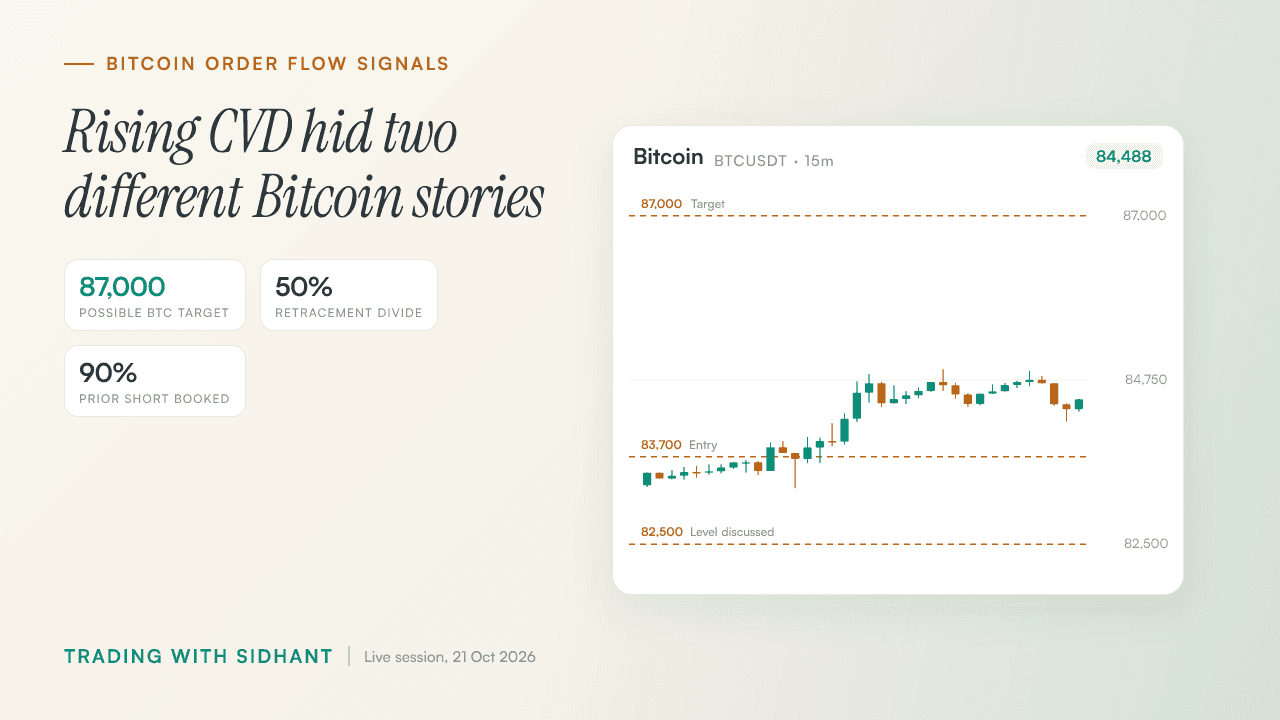
How to Read Bitcoin Open Interest and CVD Before 87,000
Rising CVD supported Fahad's Bitcoin upside bias, but a later drop in open interest changed what the buying meant.
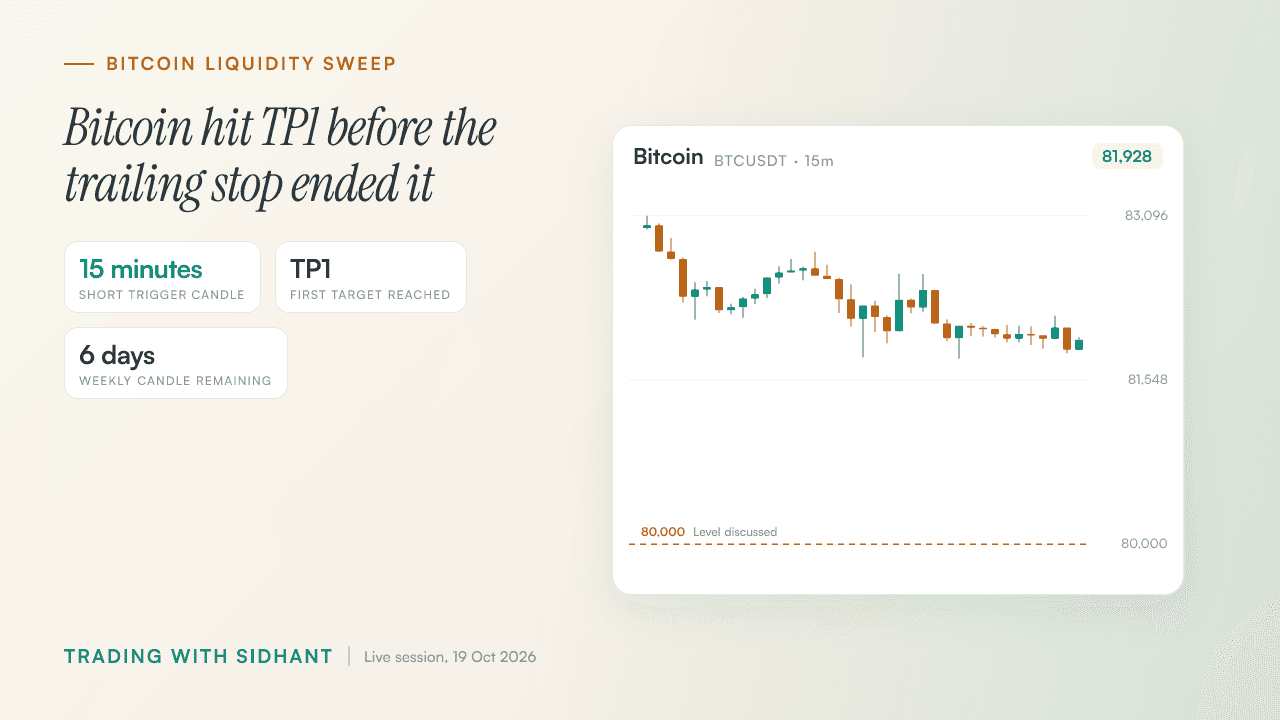
Bitcoin Liquidity Sweep Trading Strategy: TP1 and Stops
A Bitcoin short reached TP1, but the bigger lesson came from the trailing stop that ended the trade.
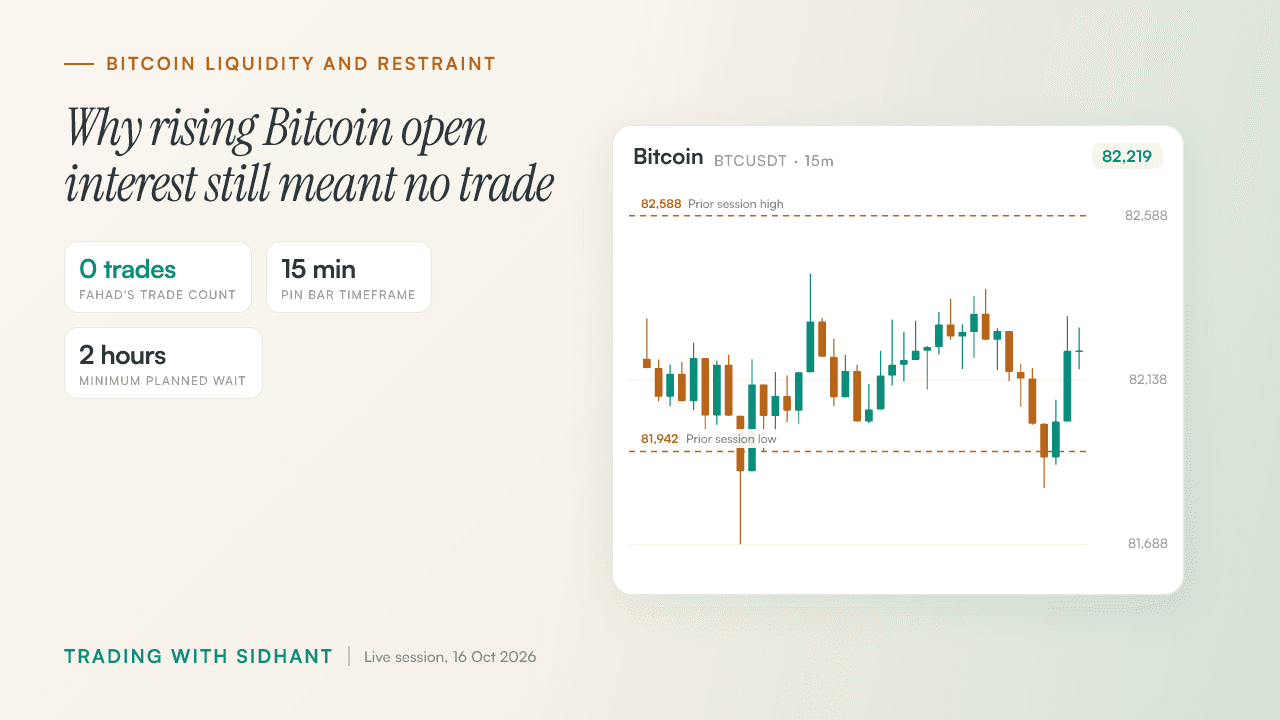
When Not to Trade Bitcoin: Rising OI, Zero Trades
Bitcoin open interest rose as CVD fell, but weak volume and conflicting signals kept Fahad out of the market.
Get post alerts in your inbox.
New blog post? We'll email you. No spam, unsubscribe anytime.
Join our Telegram community.
Get post alerts, trading discussions, and market updates.