How to Trade a Bitcoin Liquidity Sweep With Confirmation
Fahad waited for bearish follow-through after Bitcoin swept local liquidity, then warned that VWAP and a prior low could limit the short.
8 min read
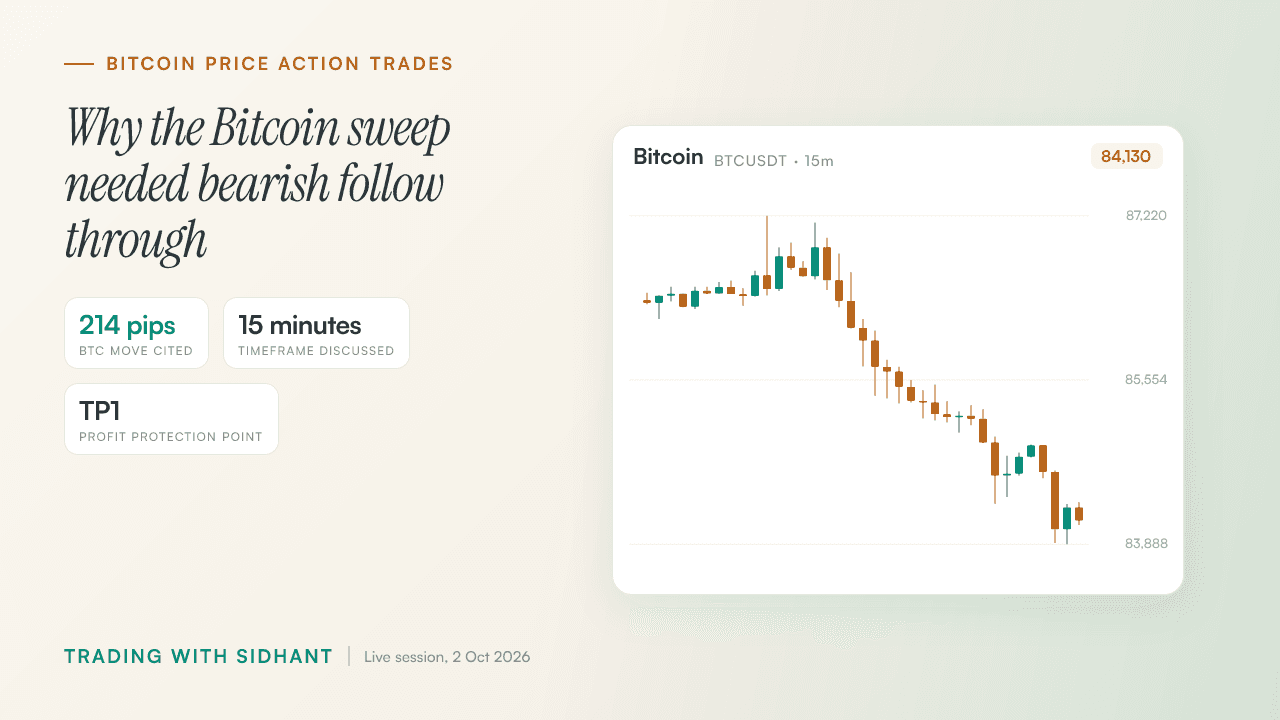
Fahad saw Bitcoin sweep local liquidity, then waited for bearish follow-through before taking a short. The sweep alone was not an entry. That distinction is central to how to trade a bitcoin liquidity sweep. Earlier on 2 October, a separate reclaim-based buy plan had worked as he expected. Later, VWAP and a prior low gave our team reasons to watch the short's exit as closely as its entry. Fahad's rule for the day was 'Data, logic, and zero assumption.' His oil plan, which never triggered, showed what that rule looked like when the answer was no trade.
Key Takeaways
- A plan that worked once gave Fahad no reason to skip confirmation on the next Bitcoin trade.
- The sweep located the idea; the bearish response, candle trigger and nearby obstacles determined whether it was worth acting on.
- Missing confirmation kept Fahad out of the first oil plan; the later stop-out belonged to a separate, valid entry.
- Fahad reported protection on gold; his Bitcoin breakeven and partial-profit options were guidance, not reported completed actions.
- A trade review should record the trigger visible at entry, not an explanation assembled after price has already moved.
Bitcoin's reclaim worked, but the later short needed a new trigger
Fahad had called for Bitcoin to reclaim a level before a buy, and he said price followed that plan. The short he took later was a separate decision. We did not hear a clear reclaim price, entry or target on the stream, so the useful detail was the condition, not a number to copy.
A good call did not authorize the next trade. Fahad's reaction to the reclaim was immediate: 'I got it! Exactly what I wanted.' Later, our team had a different setup to assess.
- Planned reclaim: Fahad had called for Bitcoin to reclaim a level before a buy.
- Observed move: He said the move matched his plan and cited roughly 214 pips captured across Bitcoin moves. That was Fahad's figure, not an independently verified result.
- Later short: It needed its own bearish evidence, regardless of how well the buy plan had worked.
The 15-minute Bitcoin chart below shows candles across the stream window, with its start and end marked. It does not mark Fahad's unstated reclaim level. For another example of why a marked area still needs a condition, our Bitcoin value-area confirmation discussion covers that distinction.
◆ Interactive Lab
Open in new tab ↗Drive the order book yourself
A local liquidity sweep became a short only after bearish follow-through
Fahad described Bitcoin sweeping local liquidity, followed by bearish price action. He then named a further candle trigger for a short. VWAP and a nearby prior low were potential obstacles, so we could not read the setup as an open-ended move lower. He was looking toward local lows and liquidity, without stating a target price.
The trigger was the current candle losing its low. Fahad put it conditionally on the stream: 'One liquidity sweep, a good follow-through. If the current candle loses its low, you can enter short.' The sweep identified a location. The bearish response and candle low gave him something to test before entering.
- Sweep: Bitcoin ran local liquidity.
- Response: Bearish price action followed.
- Trigger: Fahad looked for the current candle to lose its low.
- Obstacles: VWAP and a nearby prior low stood in the way of a cleaner move toward lower liquidity.
We heard no clear Bitcoin short entry or target price. Adding one after the fact would change the account of the stream. Published chart ideas can combine a liquidity sweep with order blocks and Fibonacci, but Fahad's call depended on the candle response and the nearby levels.
Late arrivals faced a different decision. Fahad said, 'The Bitcoin train left a little early. It left on time for us.' Our team took that as a warning against chasing after the entry condition had passed, particularly on Friday. The Bitcoin pullback and liquidity-sweep discussion also separates where a move occurs from when a trader enters.
Oil showed why a level break is not the same as an entry
Fahad had marked an oil short that required a bearish candle close. That close never came, so he did not take the planned entry. He later took a separate short, described its setup as legitimate and said it was stopped out. We have to keep those decisions apart: one never triggered, while the other became a losing trade.
A marked level was a plan, not permission. 'If the entry doesn't get triggered, you can't enter the trade,' Fahad told viewers. A level break without the required close did not satisfy his first plan, even while price was moving.
The two oil short decisions
| Setup | Required or observed trigger | Outcome |
|---|---|---|
| Planned oil short | Required bearish candle close did not occur | No entry on that plan |
| Separate oil short | Fahad described a later setup as legitimate; exact entry was not clear | Trade taken and stopped out; exact stop price was not clear |
Fahad mentioned three take-profit levels for oil, but their prices were not audible. We also heard no clear entry or stop price for the trade he took. That leaves us with his decision process and the outcome he reported, not a priced trade record.
The 15-minute oil chart below shows the stream window with start and end marked. It does not supply the missing trade prices. Our guide to confirmation in trading explains the difference between a planned level and an entry condition. A stopped-out trade can still have followed its rules. An untriggered plan was never a trade.
◆ Interactive Lab
Open in new tab ↗Drive the order book yourself
Gold reached TP1 while Bitcoin still faced nearby obstacles
Fahad reported that his gold short reached TP1 and that its stop was at breakeven. For Bitcoin, he offered two choices after TP1: move the stop to breakeven, or take partial profit and retain the original stop. Silver looked shortable to him, but he did not announce or take a trade. We kept reported actions separate from his advice.
Friday made profit protection more pressing. With the weekend approaching, Fahad cautioned against getting greedy. On Bitcoin, VWAP and a nearby prior low gave him specific reasons to question how far the short could travel without interruption.
Trade status and risk decisions discussed on Friday
| Instrument | Reported status | Risk decision or constraint |
|---|---|---|
| Gold | Short reached TP1 | Stop moved to breakeven; no exact entry, target or stop price was given |
| Bitcoin | Fahad took a short | After TP1, he advised breakeven or partial profit with the original stop; VWAP and a prior low remained obstacles |
| Silver | Possible short discussed | No trade announced or taken |
Fahad initially wanted candle confirmation on gold because the higher-timeframe picture looked strange. Later, he reported that the short was active and TP1 had been reached. The stream did not give exact gold prices, and we cannot tell from the chart where he entered.
The 15-minute gold chart below shows candles across the stream window, with start and end marked. It does not mark Fahad's entry or TP1. Our trading exit strategies discussion goes further on the choice between securing a partial profit and adjusting a stop.
◆ Interactive Lab
Open in new tab ↗Drive the order book yourself
Trend, strategy and trigger mattered more than extra indicators
Fahad said the trades shown came from price action, although he also uses footprint and order-flow tools. His pre-trade checks were the market trend, a logical or proven strategy, and the actual entry trigger. We can use volume data to add context, but it cannot stand in for the candle confirmation he required on the setups discussed.
Simple did not mean entering without a condition. Fahad gave viewers his sequence: 'First, check the market trend. Secondly, confirm that you have an effective or proven strategy. And third, identify the trigger.' His example of a 30-minute range with 15-minute confirmation split the chart read into decisions a trader could make before the move.
FRVP helped him locate where volume had concentrated, pointing to potential support, resistance or buyer and seller interest. Footprint, CVD and open interest needed context as well. Fahad compared those inputs to ingredients in a dish: one ingredient alone would not tell him how it would taste. Our footprint delta discussion covers the risk of reading an isolated figure.
Other market commentary has considered deleveraging alongside Ethereum strength and Bitcoin scenarios. That broader context did not provide the trigger for Fahad's trade. For practice, he recommended reviewing 50 to 100 trades to find repeated entry patterns and weaknesses.
- Trend: Record the direction visible before the decision.
- Setup: Mark the range, sweep or other strategy condition.
- Trigger: Record the candle confirmation that appeared, or note that none did.
Fahad waited through the Bitcoin sweep for bearish follow-through, then named the candle condition for a short. We also had to account for VWAP and the prior low, neither of which disappeared because the entry looked good. The oil decisions made the distinction harder to miss: one planned short lacked its required close, while a separate trade was taken and stopped out. On Friday, protecting an open trade mattered more to Fahad than holding out for an unstated target. As he put it, 'No fancy stuff, no pink-circle strategy, no blue-box strategy.' Join the Hitpoint community for live market coverage and real-time trade alerts.
Watch the full stream: How to Trade a Bitcoin Liquidity Sweep With Confirmation on YouTube
Disclaimer: This article is for educational purposes only and is not investment advice. The price levels, setups and trades described are a review of market events that have already occurred, shared to illustrate a method of analysis rather than to recommend any trade. Trading With Sidhant LLP is not a SEBI-registered Investment Adviser or Research Analyst, and nothing here constitutes a recommendation to buy or sell any security. Investments in securities markets are subject to market risks; read all the related documents carefully before investing. Past performance is not indicative of future results. Please consult a SEBI-registered financial adviser before acting on any information in this article.
Frequently Asked Questions
- What confirmed Fahad's Bitcoin short after the liquidity sweep?
- Bearish follow-through after the local liquidity sweep supported Fahad's Bitcoin short, and he named the current candle losing its low as a further trigger. He did not treat the sweep alone as enough. The stream did not clearly state an entry price, so we can describe the candle sequence but cannot give an exact-price entry.
- Why did VWAP and the prior low matter for the Bitcoin short?
- VWAP and a nearby prior low mattered because Fahad identified them as obstacles between his short and lower liquidity. Even after the bearish response, we could not assume price had a clear path down. He described the intended direction toward local lows and liquidity, but did not state an exact target price.
- When should a trader move a stop to breakeven after TP1?
- Fahad presented moving the stop to breakeven after TP1 as one choice for managing the Bitcoin short, not as an action he reported taking on it. His alternative was to take partial profit and keep the original stop. On gold, he reported that TP1 had been reached and the stop was at breakeven. Friday's approaching weekend informed his caution.
- Why was the planned oil short invalid without a bearish candle close?
- The planned oil short was invalid because its required bearish candle close never happened. Fahad had marked a level, but that level alone was not his entry trigger, so he did not take the planned trade. He later took a separate oil short and said it stopped out. We keep that loss separate from the earlier, untriggered idea.
- Do you need footprint or order-flow tools to trade a liquidity sweep?
- No, Fahad said the trades shown on the stream came from price action rather than footprint or order-flow tools. He still uses volume-based data for context. Our read of his Bitcoin example starts with the sweep, the bearish response and the candle trigger. An extra data point would not replace confirmation that never appeared.
Share this post
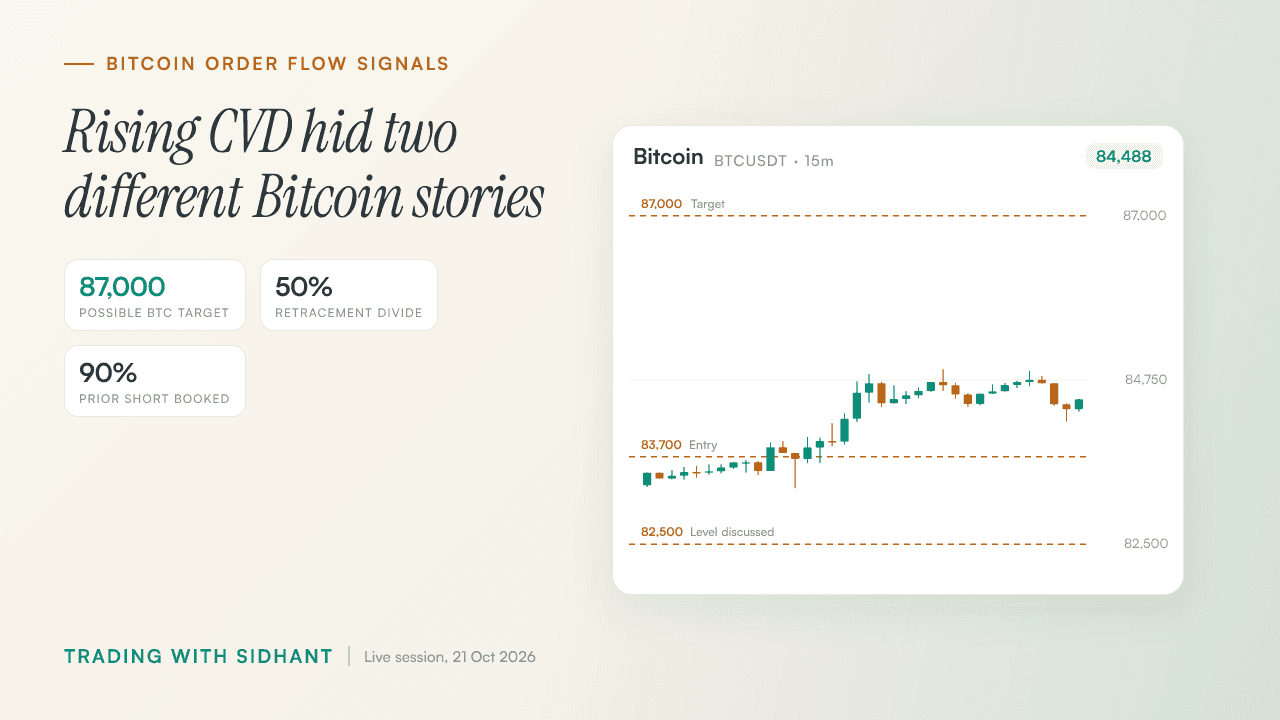
How to Read Bitcoin Open Interest and CVD Before 87,000
Rising CVD supported Fahad's Bitcoin upside bias, but a later drop in open interest changed what the buying meant.
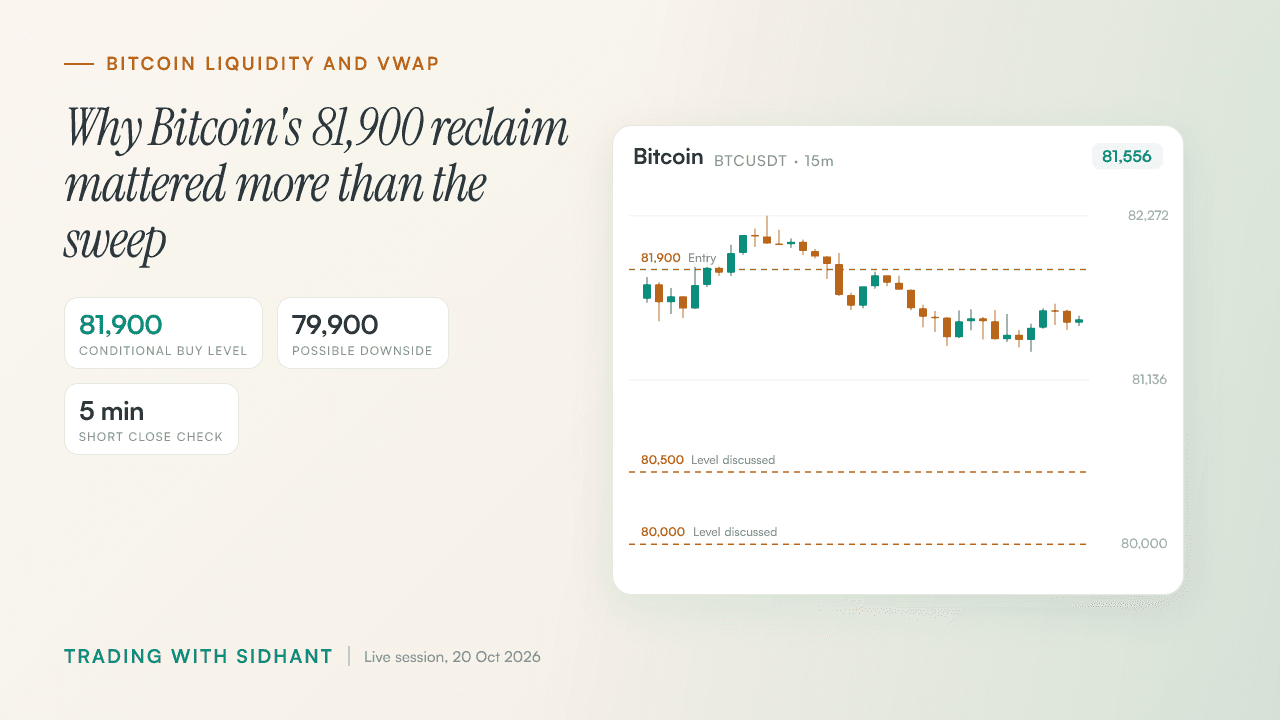
How to Trade Bitcoin Liquidity Sweeps Near 81,900
Bitcoin swept both sides of its range, but Fahad wanted an 81,900 reclaim to buy or a confirmed VWAP loss to short.
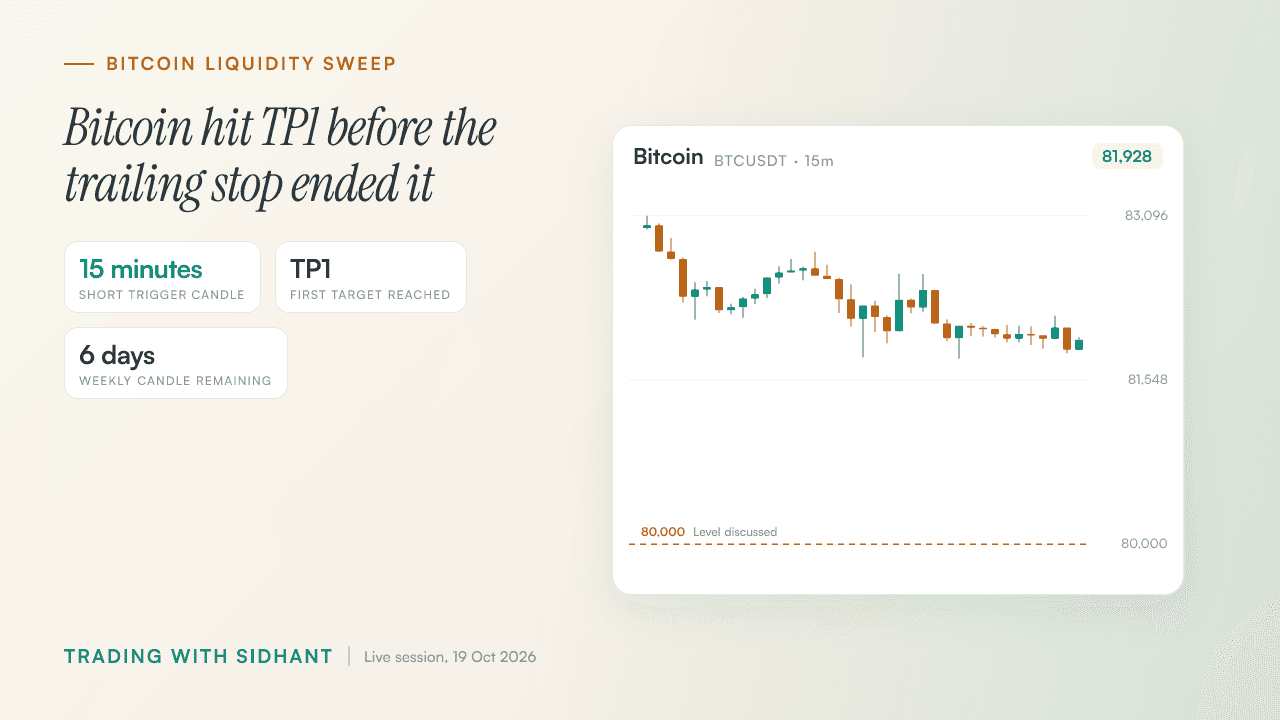
Bitcoin Liquidity Sweep Trading Strategy: TP1 and Stops
A Bitcoin short reached TP1, but the bigger lesson came from the trailing stop that ended the trade.
Get post alerts in your inbox.
New blog post? We'll email you. No spam, unsubscribe anytime.
Join our Telegram community.
Get post alerts, trading discussions, and market updates.