Bitcoin Market Outlook for Indian Traders: Key Insights
Discover our team's analysis on Bitcoin's potential decline and how Indian traders can manage risks effectively.
10 min read

Bitcoin tested the $59,000 level and the Bitcoin market outlook for Indian traders is not pretty right now. On our last stream, Fahad called it straight. 'Honestly? This looks like it can further dump.' And the data backed him up. Bitcoin captured almost 2.5% movement to the downside in a single session, stablecoin dominance was spiking, and the technicals were screaming caution. We watched the $60,000 level act as a hard ceiling. Price kept grinding lower. No real buyer conviction anywhere on the chart. This post breaks down exactly what we saw, what the setups looked like, and how Indian traders can think about managing risk in this kind of environment.
Key Takeaways
- When every bounce at $59,500 gets sold and $60,000 acts as a ceiling, the path of least resistance is clearly lower.
- A clean short setup (entry $59,500, target $57,000, stop above $60,000) required conviction but the technicals made the case without ambiguity.
- Small, predefined stop-losses protect your capital AND your psychology. Breaking that rule even once starts a dangerous pattern.
- Over-calculating kills more trades than bad analysis. Trust your defined process and execute, then review.
- Confluence of rising stablecoin dominance, repeated rejection at $60,000, and macro risk-off rotation made the bearish case undeniable.
What is Bitcoin's market sentiment among Indian traders?
The sentiment for Bitcoin among Indian traders is currently cautious due to predictions of a potential downturn, as discussed by our team during the stream. With Bitcoin testing $59,500 and showing zero strength above that level, the bias was clearly to the downside. Fahad flagged a potential move toward the $57,000 zone if sellers maintained control.
This was not a surprise call. The setup had been building for days.
When we looked at price action around $59,500, the structure was weak. Every bounce was getting sold. There was no accumulation, no base forming. Just distribution and lower highs. Fahad noted during the session that gold was also under pressure (and this is where it gets interesting), which meant the broader macro risk-off trade was in play. Not just a crypto-specific move.
For Indian traders specifically, Monday markets can be brutal when sentiment is already fragile going into the week. The session opened with that exact energy.
- BTC entry level flagged: around $59,500
- Target discussed: around $57,000
- Hard resistance: $60,000 (sellers showed up every time price approached it)
- Bitcoin movement captured on the session: nearly 2.5% to the downside
Managing your mental state during these shifts matters as much as the setup itself. Oh man, that was sad to watch. Traders who had been long since the previous week sitting in drawdown, refreshing their screens, hoping for a bounce that never came. Fahad was direct about it: you cannot let that emotional weight push you into bad decisions. The market does not care about your average entry price.
For context on how the $60,000 level has historically played out as a battleground, our earlier breakdown on Bitcoin breaking the 60K barrier covers the psychology on both sides of that level in detail. The sentiment picture right now is a mirror image of that breakout moment. Only this time, bulls are the ones getting squeezed.

How does technical analysis suggest Bitcoin will perform?
Based on technical analysis, our team predicts a bearish trend for Bitcoin, pointing to resistance around $60,000 and a potential target near $57,000. The setup was clean. The kind of setup where you do not need to force a read. It just presents itself.
Fahad's call on the stream was confident. No hedging, no 'let's see what happens.' The read was simple: resistance at $60,000 is firm, entry around $59,500 makes sense for a short, and the realistic target sits near $57,000. Stop-loss? Just above $60,000. Tight, logical, and protecting against the one scenario where sellers lose control of that level.
So, think of it this way. The $60,000 level is not just a round number. It's where sellers have consistently shown up. Bitcoin's technical no-man's land between support and resistance has been well-documented. CoinDesk noted that major support levels sit miles away and the path of least resistance appears to be downward. That aligns exactly with what we were reading on the chart.
What does the short setup look like in practice?
- Entry: Around $59,500 (where price showed weakness and failed to hold higher ground)
- Target: Around $57,000 (the next meaningful demand zone)
- Stop-loss: Just above $60,000 (keeps risk defined and manageable)
- Direction: Short
- Reasoning: 'Honestly? This looks like it can further dump.'
And the broader market was confirming the read. According to Kitco's analysis of the Bitcoin bear flag pressure building at $59,000, the bear flag formation was already in play before our session even started. Altcoins were also getting hit. Ether, XRP, Dogecoin all extending the risk-off theme simultaneously.
I mean, that was a pretty big candle when the breakdown hit. The kind of move that makes the setup obvious in hindsight but requires conviction to trade in real time.
For Indian traders wanting to understand how Bitcoin trading sessions structure these moves, a solid reference is our guide on Bitcoin trading sessions and how crypto traders can use them. Understanding session overlaps explains a lot about why certain levels break when they do.
What risk management strategies should Indian traders adopt?
Effective risk management includes setting small stop-loss orders and maintaining emotional resilience against market fluctuations. This is not complicated in theory. It gets complicated the moment you are sitting in a losing trade and your brain starts bargaining with the chart.
'Small SL is also a good thing.' Fahad said it plainly on the stream, and it is worth sitting with that for a second. Most retail traders think a tight stop-loss is a weakness. Like they are admitting they might be wrong. The reality is the opposite. A small stop-loss is a sign of precision. It means you have identified your entry well enough to know exactly where the setup is invalid.
Look, if you lose consistently on a string of small losses, it does not blow up your account. It does not blow up your strategy either. What it does is test your psychology. And that is where most traders fall apart. Not because the strategy failed, but because they abandoned it.
The rules are simple:
- Define your stop before you enter. Always.
- 'You can't break your own trading rules for sure.' Not once. Not even when you are convinced the setup is perfect.
- If consecutive losses are affecting your decision-making, step back. The market will still be there.
- Emotional resilience is a skill. It is trained, not inherited.
You know what I mean? The traders who survive long term are not the ones who never lose. They are the ones who lose small and stay disciplined enough to keep executing. That is the actual edge. Not some magical indicator or secret level.

What are the psychological challenges in trading Bitcoin?
The psychological challenges of trading Bitcoin include managing mindset during losses and avoiding over-calculating, which can hinder trading effectiveness. Fahad addressed this directly mid-stream, and it was one of the most honest moments of the session.
'The only problem is you're over-calculating everything.' That line landed. Because every trader in the chat had been there. Staring at a setup that checks every box, then talking themselves out of it because of some scenario they imagined three levels away.
You know, honestly, let me explain what over-calculating actually looks like in practice. You see the setup. You know the entry. You know the stop. Then you start asking: but what if there's a wick above resistance first? What if the news drops before the move? What if this is a fake breakdown? And by the time you have answered all those questions, the trade is already running without you. You missed out on that move.
Execution is what separates the traders who grow from the ones who stay stuck. Not analysis. Execution. Fahad's teaching on this was clear: you can have the best read in the room and still walk away with nothing if you cannot pull the trigger when the setup presents itself.
(And this is where it gets interesting.) The traders who over-calculate are often the most knowledgeable ones. They have read the books, they understand the levels, they know the theory. But they freeze. Because they are optimizing for being right rather than trading well.
The fix is not to think less. It is to trust your process more. Define the rules, execute the rules, review the results. Repeat. That is it. For a deeper look at how Fahad handled similar short plays under market pressure, our recap of Fahad's bold short plays during Bitcoin and gold market turmoil shows exactly how execution discipline plays out in real sessions.

What are the indicators for a potential Bitcoin downturn?
Indicators for a potential Bitcoin downturn include bearish patterns, technical resistance levels, and cautious market sentiment highlighted in our analysis. This was not a one-signal call. Multiple indicators were aligning at the same time, which is exactly when we pay attention.
Fahad's excitement late in the stream was real. 'This looks like it can further dump.' And it was grounded in what the data was showing across multiple timeframes. Stablecoin dominance was rising, confirming that money was rotating out of risk assets. Kitco's report on Bitcoin testing $59,000 as stablecoin dominance confirmed risk-off pressure documented this shift in real time. And the broader crypto market was not isolated. Gold, silver, and Bitcoin all tumbled as the debasement trade unwound, pointing to a macro-level rotation rather than a crypto-specific problem.
Ah, that's crazy. When gold and Bitcoin sell off together, that is the macro trade reversing. That is not a dip to buy. That is a trend to respect.
Bitcoin Potential Downturn Indicators
| Indicator | Current Observation | Implication |
|---|---|---|
| Stablecoin Dominance | Rising sharply | Risk-off rotation confirmed, capital leaving crypto |
| Resistance at $60,000 | Price rejected multiple times | Sellers in control above this level |
| Bear Flag Formation | Identified on daily chart | Pattern suggests continuation lower toward $57,000 |
| Altcoin Selloff | ETH, XRP, DOGE all declining | Broad market weakness, not isolated BTC move |
| Macro Debasement Trade | Unwinding across gold, silver, BTC | Institutional rotation out of inflation hedges |
| Session Price Action | 2.5% downside movement captured | Short-term momentum firmly bearish |
Right? When you stack all of these together, the picture is not ambiguous. Each indicator on its own might be noise. All of them pointing the same direction at the same time? That is signal.
The point is: waiting for one perfect indicator is a trap. The edge comes from confluence. Multiple signals, multiple timeframes, all telling the same story. That is when Fahad commits. That is when we commit as a team.
This session was a masterclass in reading a market that is telling you exactly what it wants to do and having the discipline to listen.
Here are the lessons that actually matter:
- The $60,000 level was the line in the sand. Every rejection there confirmed seller control. Entry at $59,500, stop just above $60,000, target at $57,000. The setup was clean because the level was clear.
- Small stop-losses are a feature, not a weakness. Tight risk management keeps you in the game long enough to catch the moves that matter.
- Over-calculating kills trades. The setup either meets your criteria or it does not. If it does, execute. Full stop.
- Confluence beats single signals every time. Stablecoin dominance, bear flag, altcoin selloff, macro unwind. When everything aligns, that is when you act with conviction.
- Emotional resilience is the real edge. Losing streaks happen. The traders who survive are the ones who do not let losses rewrite their rules.
We cover setups like this live, in real time, every session. Join the Hitpoint community for live market coverage and real-time trade alerts and be in the room when the next clean setup presents itself.
Watch the full stream: LIVE: Trading BTC, Gold, Silver | Orderflow & Footprint on YouTube
Disclaimer: This article is for educational purposes only and is not investment advice. Crypto assets are unregulated in India, are highly volatile, and can lose value rapidly; there is no established investor-protection or grievance-redressal mechanism for them. Trading With Sidhant LLP is not a SEBI-registered Investment Adviser or Research Analyst, and nothing here constitutes a recommendation to buy or sell any asset. Income from virtual digital assets is taxable in India at 30% plus applicable cess, with 1% TDS on transfers. Past performance is not indicative of future results. Do your own research before trading.
Frequently Asked Questions
- What is the current outlook for Bitcoin in India?
- Bitcoin's outlook for Indian traders is bearish in the near term. Our team identified resistance at $60,000 holding firm, with price action suggesting a move toward $57,000 is likely if sellers maintain control. Stablecoin dominance rising and broad altcoin weakness confirm the risk-off environment. Indian traders should approach long positions with significant caution until a clear structural shift emerges.
- How can Indian traders manage risks in Bitcoin trading?
- Indian traders can manage risk by setting small, predefined stop-losses before entering any trade and committing to those levels regardless of emotional pressure. Fahad's rule is clear: you cannot break your own trading rules. Keep position sizes manageable so that a string of losses does not force you to abandon your strategy. Emotional resilience and consistent execution matter more than any single trade outcome.
- What are the key support and resistance levels for Bitcoin?
- The key resistance level our team flagged is $60,000. Price has been rejected there repeatedly, confirming seller control. Entry for a short setup was identified around $59,500. The next meaningful support and downside target sits near $57,000. Below that, major support levels are significantly further away, meaning a breakdown could accelerate with limited cushion on the way down.
- Is Bitcoin set for a downturn according to recent analysis?
- Yes, based on our team's analysis and external data, Bitcoin shows strong signs of a downturn. A bear flag formation on the daily chart, rising stablecoin dominance confirming risk-off pressure, repeated rejection at $60,000, and a broader macro selloff across gold, silver, and crypto all point in the same direction. Fahad called it directly on stream: 'Honestly? This looks like it can further dump.'
- What strategies do expert traders use for Bitcoin?
- Expert traders focus on confluence, waiting for multiple indicators to align before committing to a position. Fahad's approach combines technical levels, momentum signals, and macro context before entering. Stop-losses are set before entry, not after. Position sizing keeps any single loss manageable. Most importantly, execution discipline (acting when the setup is there rather than over-calculating) is what separates consistent traders from the rest.
Share this post

How to Use Direction Area Trigger in Nifty Trading
A Nifty short near 24,000 needed more than a pin bar: daily bias, a defined area and footprint evidence had to agree.
Bitcoin Order Flow Analysis After a Rally
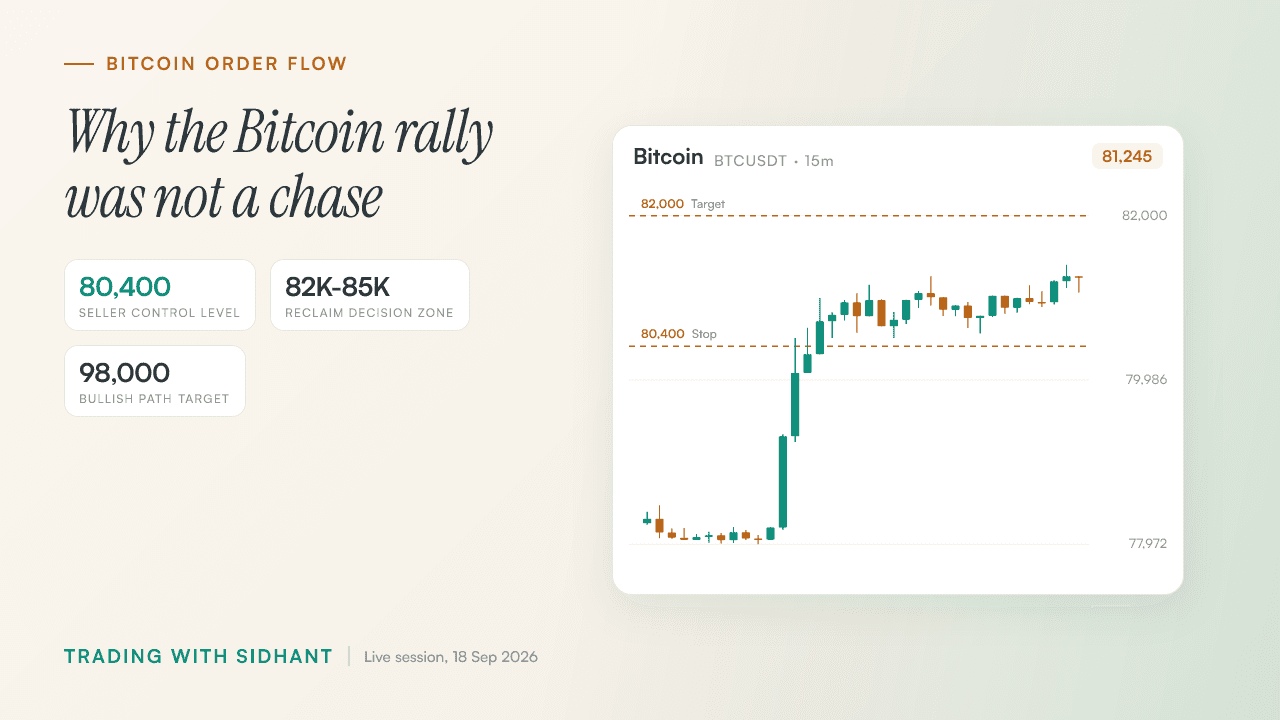
Bitcoin had already rallied, so Fahad used 80,400, delta and seller exhaustion to explain why waiting beat a FOMO entry.

When to Quit a Profitable Intraday Strategy
Rs 12 lakh in profit looked different after Sidhant counted the 1,500 hours and the freedom the strategy had consumed.
Get post alerts in your inbox.
New blog post? We'll email you. No spam, unsubscribe anytime.
Join our Telegram community.
Get post alerts, trading discussions, and market updates.