Quality vs Quantity: Crafting Your Trading Strategy
Discover why focusing on quality trades can enhance your market approach.
8 min read

The quality vs quantity trading strategy debate sounds simple until you watch someone blow up their account trading 40 times a day with zero edge. On a recent Hitpoint Live stream, Fahad made it plain: 'My goal as a trader is not how much can I trade. Your goal is just to see how much you can trade quality.' That sentence belongs on every monitor. Our team watched traders grind through 15 positions in a session and walk away with less than the person who took two clean setups and called it a day. This post breaks down what we covered: the philosophy behind quality trading, why emotions cost money, how liquidity shapes every trade, and why a trading mantra is strategy.
Key Takeaways
- A trade you cannot justify in one sentence is a trade you should skip.
- Pre-defining your entries, exits, and size before the session removes most of the emotional decision points.
- A liquidity sweep followed by a sharp reversal is a signal, not noise, and it is one of the cleaner setups to trade.
- In a bear market, capital preservation is the strategy, and selectivity is how you execute it.
- Your mantra should be the direct opposite of your most repeated mistake, short enough to fire before the order does.
What is Quality vs Quantity in Trading?
Fewer, well-planned trades that align with your edge will outperform a high volume of random entries. The quality vs quantity trading strategy recognises each trade carries a cost: cognitive load, capital at risk, emotional wear. Reduce the noise and good setups become obvious.
Fahad said it on stream: 'My goal as a trader is not how much can I trade. Your goal is just to see how much you can trade quality.' A systems observation. High-frequency entries without a consistent edge accelerate losses without creating opportunities to win.
Our team watched this repeatedly. Traders who chase every candle end up emotionally drained by noon, making decisions on the fifth trade they'd never make on the first. The quality trader enters with a plan, waits for confirmation, exits cleanly. Two trades, done.
What quality trading looks like:
- Define entry criteria before the session starts
- Wait for price to reach your level instead of chasing
- Know your invalidation point before you enter
- Sit on your hands when the setup isn't there
That last point is hardest. Doing nothing feels like failure when staring at a moving chart. As building a trading strategy in India makes clear, patience is a strategy.
The mantra we keep coming back to: if you can't explain why you're in a trade in one sentence, you shouldn't be in it. Research from JustMarkets backs this. Quality trading reduces emotional stress and builds discipline that compounds. More trades doesn't mean more profit.

Why Emotional Balance Matters in Trading
Emotions don't just influence bad trades, they actively prevent good ones. Trader gets rattled from a previous loss and either overtrades to recover or freezes up and misses the next clean setup. Both outcomes are expensive.
Fahad put it simply: 'Trading is something which makes me very happy.' A trader who enjoys the process (rather than chasing adrenaline) operates from a different emotional baseline. Joy is in the system working, not the dopamine hit of a fast profit.
We've seen the opposite. Trader enters a position angry at the market, convinced they're owed a recovery. They're gambling with extra steps. Market doesn't care about your previous loss, price action is indifferent.
Common emotional traps we flagged:
- Revenge trading: Doubling size after a loss to get it back faster
- FOMO entries: Jumping into a move that already ran 80 percent of its range
- Premature exits: Cutting winners short because you fear giving back profit
- Ignoring the plan: Adjusting your stop mid-trade because the position feels uncomfortable
Fix isn't to feel nothing (unrealistic). Build a process that doesn't require calm to execute correctly. Pre-defined entries, exits, size. Those three things set before market opens and emotions have less surface area to damage.
For more on how trader accountability structures reinforce this, we covered it separately.
The PIP Penguin breakdown of trading psychology makes a point worth repeating: mantras like 'the market is random' are active reminders that no single trade defines your edge, keeping emotional balance intact across a full session.

Understanding Market Liquidity for Better Trades
Liquidity is where your trade gets filled. Understanding it separates traders who get good prices from traders who get run over. Liquidity sweeps aren't random spikes, they're engineered moves to trigger stop-losses and fill large orders before the real directional move.
Price sweeps a key level and immediately reverses. Market clearing liquidity sitting above or below a structural level. Know where liquidity clusters and you know where traps are set.
Fahad read it directly: 'You can't expect that now I will enter and the market will range from here. Breaking will give a bigger move.' Range compresses liquidity, break of that range (whichever direction) is the market hunting stops that built up during consolidation. Entering before the break is guessing, waiting for confirmation after is reading.
For how we apply this to BTC, the bitcoin liquidity levels strategy post covers the framework.
Liquidity impact on trade execution.
| Scenario | Impact on Liquidity | Trade Outcome |
|---|---|---|
| High-volume session open | Deep liquidity, tight spreads | Smoother fills, less slippage |
| Low-volume consolidation range | Thin liquidity, wide spreads | Increased slippage risk on breakouts |
| Liquidity sweep below key support | Stops triggered, liquidity absorbed | Potential reversal setup if price reclaims level |
| News-driven spike | Liquidity gaps form instantly | Fills at unexpected prices, avoid market orders |
| End-of-session low volume | Liquidity dries up | False breakouts more common, reduce position size |
Pattern we watch: price sweeps a well-known level, volume spikes, then price reverses sharply. That sequence is a liquidity sweep in real time. Medium's analysis on trade quality makes the same point: fewer trades at genuine liquidity levels beat a dozen placed at random.

Crafting a Strategy for Bear Markets
In a bear market, primary job is keeping capital intact. Profits are secondary. Our approach during the stream: fewer positions, tighter risk, bias toward short setups aligned with the broader downtrend.
Fahad flagged a BTC short at 63,300 during the session. Price action showed weakness, expectation was a pullback, stop placed just below the previous low to give the trade room without excessive risk. Specific level, specific reason, specific exit.
Bear market strategies we apply:
- Short only at resistance: Wait for price to rally into a defined level
- Smaller position sizes: Volatility is higher, same size carries more risk
- Faster exits on winners: Bear market bounces reverse quickly
- Avoid catching falling knives on the long side: Trend is your context
- Liquidity sweep shorts: Sweeps of highs in a downtrend often precede the next leg lower
For traders who want to go deeper, the bearish trading strategies for Bitcoin in 2026 post covers the framework.
Fahad made a bigger point on stream. Quality over quantity matters more in a bear market because cost of a bad trade is higher. Choppy market fakes you out repeatedly if you trade every swing. Traders who survive bear markets waited for obvious setups and skipped everything else. Selectivity is the strategy.

How to Create Your Own Trading Mantra
A trading mantra is a short statement that keeps you anchored when the market tries to pull you off your process. Functional rule you've tested and believe in.
Fahad called it out with energy: 'This is a mantra, you should insert it into your mind.' Context was balance between buying and selling, between acting and waiting. Markets create confusion. Price moves, narratives shift, everyone on Twitter has a hot take. Your mantra is what you return to when that gets loud.
Our favourite examples from the stream:
- 'Breaking will give a bigger move' (don't enter the range, wait for the break)
- 'Quality, not quantity' (if the setup isn't clean, skip it)
- 'Unfinished business' (price returns to untested levels)
- 'Buy high, sell low' (as a warning, reminder of what happens when you chase)
Building yours is straightforward. Take the biggest mistake you repeat. Write the opposite as a short statement. Test it for thirty sessions. If it keeps you from making that mistake, it's your mantra. If not, revise.
Mantra is a pattern interrupt. Feel the urge to revenge trade and your mantra fires before the order does. Want to size up on a mediocre setup and the mantra fires. Over time it becomes automatic.
For traders building a complete approach, confirmation in trading is closely related. Mantra that includes 'wait for confirmation' has saved more accounts than any indicator.
Mantra isn't about sounding wise. It's about having something specific to say to yourself in the moment you're about to make your worst trade.

The quality vs quantity trading strategy isn't a philosophy for passive traders. It's the operating system of every trader who lasted long enough to build real consistency. Here is what we took from this session:
- Fewer trades, better trades. Market doesn't reward effort, it rewards accuracy. Two clean setups beat fifteen mediocre ones every week.
- Your emotions have a cost. Revenge trades, FOMO entries, premature exits aren't personality flaws, they're predictable patterns. Build a process that doesn't require calm to execute.
- Liquidity is the map. Know where stops cluster, watch for sweeps, let the market show its hand before you commit.
- Bear markets demand selectivity. When conditions are difficult, answer isn't more trades, it's better ones.
- A mantra is a tool. Build one from your actual trading mistakes, not from someone else's Instagram caption.
Join the Hitpoint community for live market coverage and real-time trade alerts. Fahad and the team break this down session by session, with specific levels and live analysis.
Watch the full stream: Quality vs Quantity: Crafting Your Trading Strategy on YouTube
Disclaimer: This article is for educational purposes only and is not investment advice. The price levels, setups and trades described are a review of market events that have already occurred, shared to illustrate a method of analysis rather than to recommend any trade. Trading With Sidhant LLP is not a SEBI-registered Investment Adviser or Research Analyst, and nothing here constitutes a recommendation to buy or sell any security. Investments in securities markets are subject to market risks; read all the related documents carefully before investing. Past performance is not indicative of future results. Please consult a SEBI-registered financial adviser before acting on any information in this article.
Frequently Asked Questions
- What is the difference between quality and quantity in trading?
- Quality trading means taking fewer positions that meet a strict set of criteria: clear entry, defined risk, genuine edge. Quantity trading means entering frequently without that filter. The distinction matters because each trade has a cost: capital at risk, cognitive load, emotional wear. Research consistently shows that traders who reduce trade frequency but tighten their criteria perform better over time than those who maximise entry volume.
- How can emotional balance impact my trading strategy?
- Emotional imbalance directly degrades decision quality. A trader recovering from a loss tends to overtrade to break even or freezes and misses the next clean setup. Both responses are expensive. The fix is structural: pre-define entries, exits, position size before the session starts. When those decisions are made in advance, your emotional state during the session has fewer decision points to corrupt.
- Why is market liquidity important for traders?
- Liquidity determines where your order gets filled and at what price. In thin liquidity environments, spreads widen and slippage increases, meaning you pay more to enter and receive less when you exit. Beyond execution, liquidity sweeps (where price briefly spikes through a key level before reversing) are among the most reliable signals in price action. Knowing where liquidity sits tells you where the traps are.
- What strategies work best in a bear market?
- Capital preservation comes first. In a bear market, we focus on shorting into resistance rather than buying dips, reducing position sizes to account for higher volatility, exiting winners faster because bear market bounces reverse quickly. The Fahad-flagged BTC short at 63,300 during the stream is a clean example: a specific level, a specific reason, a stop placed with discipline rather than hope.
- What does it mean to have a trading mantra?
- A trading mantra is a short, specific statement built from your own repeated mistakes, not a generic motivational phrase. It fires in the moment before you make your worst trade, acting as a pattern interrupt. For example, 'wait for the break' stops you from entering a range prematurely. The mantra works because markets create noise and confusion. You need something personal and tested to return to when that happens.
Share this post

How to Use Direction Area Trigger in Nifty Trading
A Nifty short near 24,000 needed more than a pin bar: daily bias, a defined area and footprint evidence had to agree.
Bitcoin Order Flow Analysis After a Rally
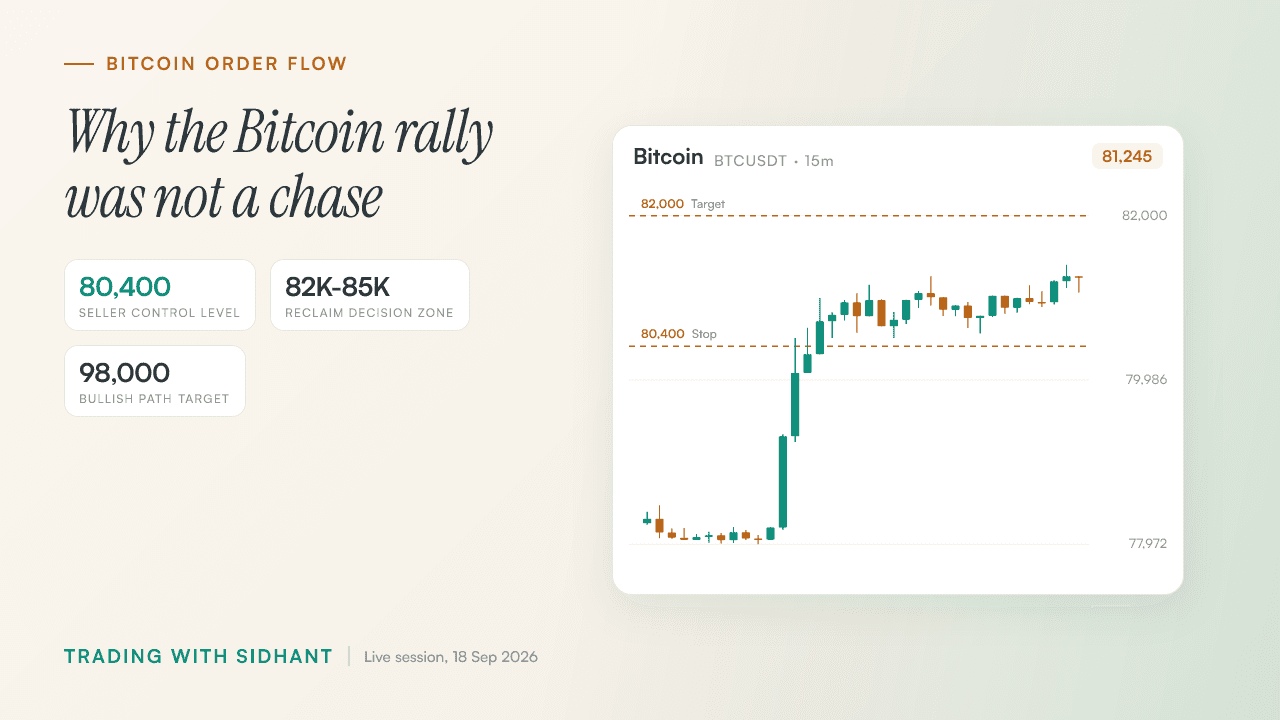
Bitcoin had already rallied, so Fahad used 80,400, delta and seller exhaustion to explain why waiting beat a FOMO entry.
When to Quit a Profitable Intraday Strategy
Rs 12 lakh in profit looked different after Sidhant counted the 1,500 hours and the freedom the strategy had consumed.
Get post alerts in your inbox.
New blog post? We'll email you. No spam, unsubscribe anytime.
Join our Telegram community.
Get post alerts, trading discussions, and market updates.