Exploring Bitcoin Short Trade Strategy for May 2026
Discover the secrets behind our Bitcoin short trade strategy for May.
9 min read

The Bitcoin short trade strategy May 2026 session Fahad ran had one rule. Price above 74,700, or no short. The broader range was 74,000 to 76,000, and within that window, every move mattered. Fahad walked through the entry mechanics, the stop above 75,700, and why patience in conditions like these separates traders who compound from traders who blow up. This breakdown covers how that session played out, what we spotted, and the thinking behind every level.
Key Takeaways
- Never short BTC below 74,700; the entry trigger is the strategy, not an optional guideline.
- A 530-point risk (entry to stop) against a 530-point reward (entry to target) made this a 1:1 trade with defined structure, not a gamble.
- A trade plan only works if it is followed completely; partial discipline is just indiscipline with better excuses.
- Automation works best as execution support for a manual strategy, not as a replacement for the thinking that creates the strategy.
- News moves price short-term; market structure determines where price goes when the noise fades.
What is our Bitcoin short trade strategy for May 2026?
We don't short BTC unless it's trading above 74,700. Below that? Setup doesn't exist. Chasing entries below the trigger is how you get caught on the wrong side of a liquidity sweep, and we've all seen that movie.
Fahad initiated this short on May 27, with BTC oscillating inside a 74,000 to 76,000 range. That's tight. In a market where 2% moves happen in minutes, a 2,000-point corridor creates its own traps for impatient traders. And there's always someone who can't wait.
Fahad kept repeating one thing: "If you have patience, if you can show that discipline, your strategy will make a lot of money." Not a motivational poster. A description of how we managed the trade. We watched price grind through the range. Ignored the noise (and there was plenty). Held the position against its parameters.
What we kept front of mind during this trade:
- Entry condition: Price must be above 74,700 to validate the short
- Range ceiling: 76,000 acted as the upper boundary of the trading corridor
- Range floor: 74,000 was the lower edge, where short pressure could face absorption
- Trade origin: Short initiated May 27, based on market structure deterioration at the upper range
For traders who want to understand how this kind of range-bound short setup is constructed from first principles, the breakdown in Bitcoin shorting strategy targeting local liquidity zones covers the mechanics in detail.
Discipline not optional. The temptation in a choppy market is to close early or flip direction when price bounces. We did neither. The setup had a plan. We followed it.

How do we determine Bitcoin price levels of interest?
Key BTC price levels come from reading market structure, not from picking round numbers off a chart. Our entry focus sat above 74,700, the target was 74,170, and the stop was placed above 75,700. Those three numbers defined the entire trade's risk profile.
Why 74,170 as the target? That level represented a prior area of liquidity concentration. Price had visited it before, left orders behind, and we expected a return. This is what Fahad means when he talks about "price action speaks." The chart was already telling you where price wanted to go (if you were paying attention).
The stop above 75,700 gave the trade room to breathe without invalidating the thesis. A stop too tight in a 74,000 to 76,000 range gets hunted. A stop too wide destroys the risk-reward. 75,700 sat just beyond the range where the short thesis would break down structurally.
Here's what we traded against:
| Parameter | Level |
|---|---|
| Entry condition | Above 74,700 |
| Target | 74,170 |
| Stop | Above 75,700 |
| Trading range floor | 74,000 |
| Trading range ceiling | 76,000 |
Bitcoin's price has since moved significantly, by the way. Current market conditions for Bitcoin give context on how conditions shifted after this session. According to Kitco's analysis of Bitcoin's recent rally, BTC extended well above the range we discussed here, which is exactly why the stop placement mattered.
We waited for structure, not for a feeling.

Why is discipline crucial in trading Bitcoin?
Setting clear entry and exit points and then actually following them, regardless of what the market throws at you in the meantime, is what separates a trading strategy from a trading wish. We saw this play out in real time during the May session.
Fahad said it plainly: "If you have patience, trading will make a lot of money." Sounds simple, right? It's not. Crypto markets are designed, structurally, to shake you out. Volatility is the mechanism. News spikes, liquidity sweeps, fake breakouts. All of it exists to make you deviate from your plan.
Our approach during this BTC session was to treat the trade plan as non-negotiable once the entry triggered. Price dipped, bounced, dipped again. The stop above 75,700 was never touched. We held. And honestly, that's the hard part.
Three things we avoid because they destroy discipline:
- Reacting to news in real time. Fahad's view: "News just pushes the price, that's all." It's not a signal. It's a catalyst that the market uses to hunt stops and trigger FOMO entries. React to price, not to headlines.
- Moving the stop to avoid a loss. If the stop is wrong, the position sizing was wrong. Moving the stop is not risk management, it's hope management.
- Closing early because the trade feels uncomfortable. Discomfort in a live trade is not information. The levels are the information.
Fahad also flagged something that traders rarely admit: trading is addictive. "It's so addictive, this trading." That addiction is what makes impulsive decisions feel justified in the moment. The fix is a written plan with hard numbers, not willpower. (Willpower doesn't survive a 3% move against you.)
For traders building that kind of structured approach, mastering price action through Fahad's trading insights is a useful companion read. The Forbes report on Standard Chartered's $126,000 Bitcoin price prediction is a perfect example of exactly the kind of headline that triggers emotional trading. Big numbers, big excitement, and a strong reason to abandon your plan. Don't.

How do we balance manual and automated Bitcoin trading?
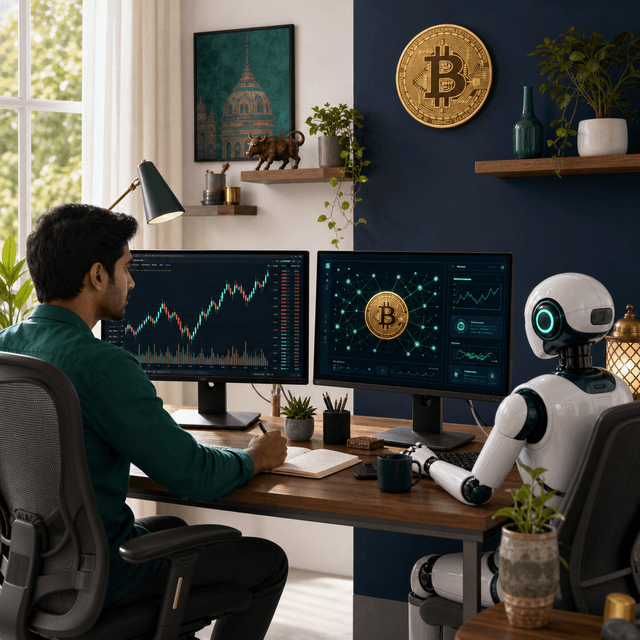
Manual setups handle the entry logic. Automation handles position management when the trader is not watching the screen. That's the split we actually use, not the one that sounds good in theory.
Fahad's take from the session: "My automation does it for me when I'm busy." More specifically, the bots run DCA (dollar-cost averaging) on defined parameters while Fahad handles the higher-conviction directional trades manually. The automation doesn't decide direction. It executes within a pre-set framework.
He also said something that stuck: "If you sit in front of the chart screen, automation is also trading." Meaning, having a bot running while you stare at the chart and override it constantly defeats the purpose. Either trust the system or turn it off. Fahad found his own answer: "I personally think I found profiting with my automation was to turn it off and on." That's not a joke. Knowing when your automated system has an edge and when it doesn't is a skill most traders underestimate.
How we structure the split:
- Automated: DCA bots handle accumulation and averaging during range-bound conditions
- Manual: Directional shorts and longs, like the May 27 BTC short, are entered and managed by hand
- Override rule: If the manual thesis conflicts with the bot's position, the manual thesis wins and the bot gets paused
- Monitoring: We don't set and forget. Automation gets checked, not babysat
For traders curious about how AI tools fit into this kind of framework, using AI in trading strategies covers the practical side. The key point from the session: automation amplifies a good process and amplifies a bad one equally. Get the process right first.
What are the current sentiments in the cryptocurrency markets?
Cautious optimism describes the surface. Underneath it, we see a market that's news-driven, sentiment-driven, and prone to violent reversals. That combination demands long-term strategy over reactive positioning.
Fahad didn't hide his skepticism during the session. "Crypto is a damned place" is not a throwaway comment. It reflects something real: crypto markets attract participants who trade on emotion, on news, on social media sentiment. That creates opportunity, because emotional traders make predictable mistakes. But it also creates danger for anyone who gets pulled into the same emotional current. You know what I mean?
The broader market picture at the time of this session showed BTC in a 74,000 to 76,000 range. Since then, conditions have shifted considerably. Kitco's analysis of Bitcoin entering Phase 4 suggests the market structure has changed, with Bitcoin pushing significantly higher. CoinDesk's live coverage tracked BTC holding above $65,000 during an earlier consolidation phase, which gives context for how fast these ranges can expand.
What we watch for in terms of sentiment signals:
- Open interest changes: Rising OI with falling price confirms short pressure. Falling OI with falling price means long liquidations, a different beast entirely.
- News reaction quality: If price barely moves on big news, the market has already priced it. If it moves hard on small news, sentiment is fragile.
- Liquidity sweeps: We treat these as information. A sweep below a key level that immediately recovers is a signal, not a breakdown.
Fahad's consistent message: "Focus on long-term strategies rather than reacting to news." The traders who got shaken out of positions by short-term noise during this session were the ones who didn't have a plan written down before the trade opened. For a deeper look at how we've handled sentiment-driven BTC volatility in the past, Bitcoin and gold short plays during market turmoil is worth reading alongside this session breakdown.

The May 2026 BTC short trade session came down to a few things that we kept returning to throughout the stream:
The entry rule was absolute. No short below 74,700. Rules without exceptions are the only rules that work.
Price levels are not opinions. The target at 74,170 and the stop above 75,700 were derived from market structure, not from hope.
Discipline is the strategy. Fahad said it multiple times in different ways. Patience and adherence to the plan are not soft skills, they're the edge.
Automation supports, not replaces. DCA bots handled the mechanical work. Fahad handled the directional thinking. That division of labor is intentional.
Sentiment is a trap if you trade it directly. News pushes price. Structure tells you where price goes next. Trade structure.
If this kind of live, specific, numbers-first analysis is what you've been looking for, the Hitpoint community does this every session. Join the Hitpoint community for live market coverage and real-time trade alerts.
Watch the full stream: Exploring Bitcoin Short Trade Strategy for May 2026 on YouTube
Disclaimer: This article is for educational purposes only and is not investment advice. Crypto assets are unregulated in India, are highly volatile, and can lose value rapidly; there is no established investor-protection or grievance-redressal mechanism for them. Trading With Sidhant LLP is not a SEBI-registered Investment Adviser or Research Analyst, and nothing here constitutes a recommendation to buy or sell any asset. Income from virtual digital assets is taxable in India at 30% plus applicable cess, with 1% TDS on transfers. Past performance is not indicative of future results. Do your own research before trading.
Frequently Asked Questions
- What is the current Bitcoin trading range in May 2026?
- During the May 2026 session covered here, Bitcoin was trading in a range between 74,000 and 76,000. Fahad's team used this corridor to frame the short trade, with the entry trigger set above 74,700. Since this session, Bitcoin has moved significantly higher, with analysts at Kitco noting the price extended well above $71,000 and continued rallying into new territory.
- How do I decide my entry and exit points for Bitcoin?
- Entry and exit points should come from market structure analysis, not from round numbers or gut feel. Our approach: identify where liquidity sits, find the level where the short thesis breaks down (that becomes the stop), and target the next significant liquidity zone below. For this trade, entry was above 74,700, target was 74,170, and the stop sat above 75,700. Structure determines levels.
- Why is discipline important in cryptocurrency trading?
- Crypto markets are structurally designed to shake traders out of good positions. Volatility, news spikes, and liquidity sweeps all create pressure to deviate from a plan. Fahad's direct view: if you have patience and can show discipline, your strategy will make money. Without discipline, even a correct market read becomes a losing trade because the position gets closed at the wrong moment, usually right before it works.
- How can market structure influence Bitcoin trades?
- Market structure tells you where price has been, where orders are sitting, and where the path of least resistance runs. Our 74,170 target was not arbitrary. It represented a prior liquidity zone that price was likely to revisit. When structure aligns with a directional thesis, the trade has a reason behind it. When it doesn't, we wait for a setup that does. Structure over speculation.
- What are the risks of shorting Bitcoin in 2026?
- Shorting Bitcoin carries significant risk in any market condition, especially when broader sentiment is shifting bullish. Our May short was initiated at a specific structural level with a defined stop above 75,700. Since that session, Bitcoin has rallied substantially, demonstrating exactly why stop placement is non-negotiable. Short squeezes in crypto can be fast and brutal. Position sizing and hard stops are not optional, they're survival tools.
Share this post

How to Use Direction Area Trigger in Nifty Trading
A Nifty short near 24,000 needed more than a pin bar: daily bias, a defined area and footprint evidence had to agree.
Bitcoin Order Flow Analysis After a Rally
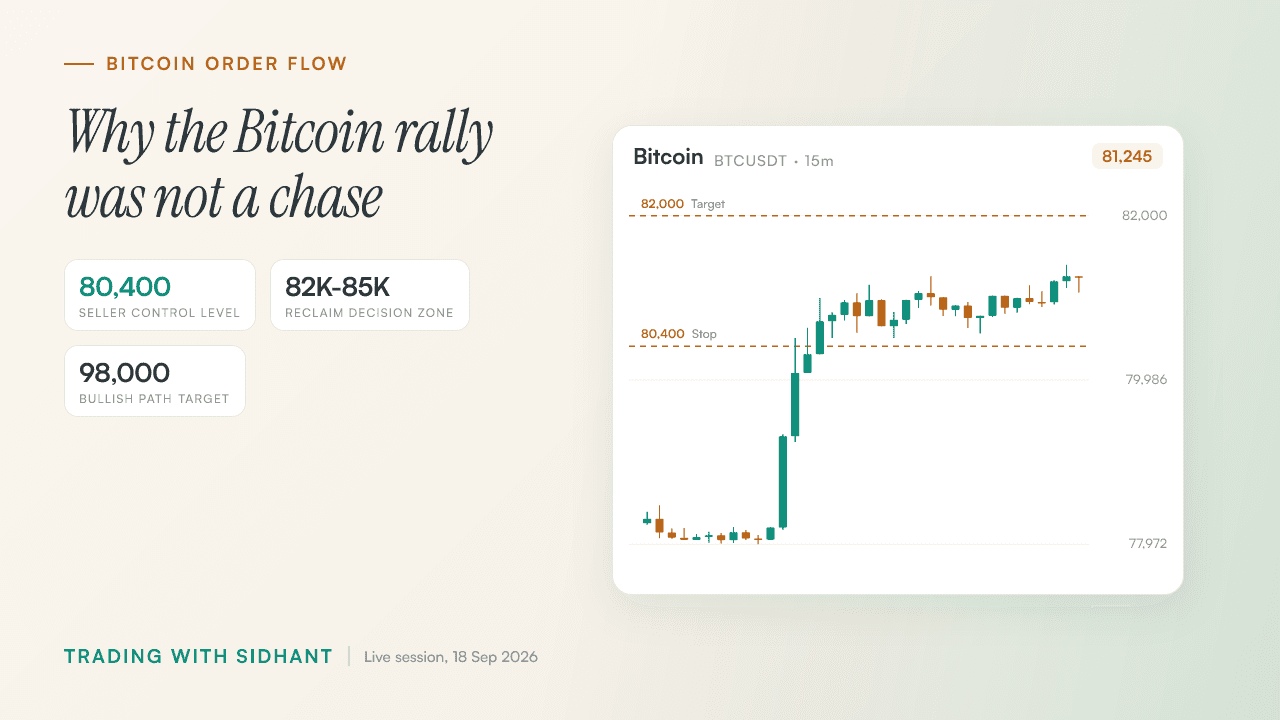
Bitcoin had already rallied, so Fahad used 80,400, delta and seller exhaustion to explain why waiting beat a FOMO entry.
When to Quit a Profitable Intraday Strategy
Rs 12 lakh in profit looked different after Sidhant counted the 1,500 hours and the freedom the strategy had consumed.
Get post alerts in your inbox.
New blog post? We'll email you. No spam, unsubscribe anytime.
Join our Telegram community.
Get post alerts, trading discussions, and market updates.