Learn Bitcoin and Ethereum Trading Strategies for 2026
Explore our team's insights on Bitcoin and Ethereum strategies to enhance your trading this year.
10 min read

Bitcoin and Ethereum trading strategies 2026 were front and center on the latest Hitpoint Live stream. The energy was high from minute one. Fahad opened with his signature "Let's freak and go!" and got straight into it: BTC range analysis, an ETH short thesis with specific entry levels, and a hard conversation about why chasing trades wrecks accounts. No fluff. No lifestyle posturing. Just setups, levels, and the reasoning behind every call. If you missed the stream, here is what our team covered.
Key Takeaways
- Adaptable position management beats fixed targets every time in Bitcoin trading.
- A conditional ETH short at $2.2K-$2.3K only makes sense with confirmation of weakness, not just the price level.
- Moving your stop to breakeven as soon as a trade allows it is the single most protective habit in crypto trading.
- Market structure and range boundaries give more reliable context than any single indicator or price prediction.
- Pattern recognition and knowing when to stay out are skills built through education, not instinct.
What are proven strategies for trading Bitcoin?
Avoiding fixed targets and staying adaptive to current price action separates disciplined Bitcoin traders from the ones who get chopped up. A fixed target sounds organized, but in a volatile market it just leaves money on the table or keeps you in a losing position longer than you should be. Fahad has said it many times, and he said it again on stream: "You are never supposed to have a fixed target."
What does adaptable actually look like?
Our team was watching BTC from the bottom of its established range during this session. The long thesis was based on confidence from prior trading patterns. Simple read: if Bitcoin holds range structure, you ride it toward the top. If it dumps and breaks down, you reassess. No ego, no attachment to a number you wrote down before the session opened.
Fahad's specific level on the radar was 5758 as a potential downside target if BTC broke range to the downside. Not a prediction of doom. Just a reference point. Our approach is to map out where price could go in either scenario, then wait for the market to show its hand.
Confidence matters. Fahad called it the biggest element in trading success, and we agree. Not blind confidence, but conviction built from reading the chart correctly. Our BTC long had its stop moved to breakeven once the trade was in profit. Active risk control, not passive hope.
Missing a move is fine. Fahad admitted he sat out for two days and missed a move, and his take was direct: "It is not that this is the last move. Absolutely not." There is always another setup.
For a deeper breakdown of how we read Bitcoin in difficult market conditions, the guide to trading BTC effectively in choppy markets covers the same structural thinking in detail.
The broader lesson: Bitcoin trading is not about being right on a number, it is about being right on the process. Map the range. Know your invalidation level. Move your stop when the trade gives you room.

How to short Ethereum effectively?
Shorting Ethereum with a defined plan means targeting entry around $2,200 to $2,300, watching how price reacts at those levels, and knowing exactly where the trade is wrong before you enter. That was the framework Fahad laid out on stream, and the logic behind it was tied directly to Bitcoin's behaviour. ETH tends to follow BTC's lead, sometimes with more violence on the downside.
The thesis: if ETH was trading in the $2.2K to $2.3K range and showing weakness, the potential downside Fahad was watching was a move toward $1,400 to $1,500. That is a significant drop, and this was a conditional setup, not a guaranteed outcome.
Ethereum's Golden Triangle pattern has been a talking point among analysts, with the $1,950 level identified as a key support. If that support holds, the short thesis loses its legs. If it breaks, the move toward the lower targets Fahad mentioned becomes more plausible. Our team always frames ETH shorts as conditional, not automatic.
Here are the specific levels from the stream:
Ethereum Short Strategy Levels
| Entry Level | Target Level | Stop Loss |
|---|---|---|
| $2,200 | $1,500 | Slightly above $2,300 |
| $2,300 | $1,400 | Slightly above $2,350 |
Stop placement is deliberately tight. Fahad's standard practice is to put the stop just above the entry zone, then bring it to breakeven as soon as the trade moves in your favour. That way, worst case scenario on a confirmed entry is a scratch trade, not a loss.
One thing we were clear about: do not short ETH blindly at these levels. Wait for confirmation. Price action at the entry zone matters more than the entry zone itself. If ETH is showing strength at $2.2K, that is not a short. If it is stalling and rolling over with volume, that is a different conversation.
For context on how we think about Fahad's price action reading methodology, the process is the same across assets: structure first, confirmation second, entry third.

What are common crypto risk management practices?
Sound crypto risk management starts with two things: knowing where you are wrong before you enter, and moving your stop to breakeven the moment a trade gives you enough room. Everything else is detail.
Fahad's exact words on stream: "I usually bring it at SL and leave SL at breakeven." That single habit eliminates the scenario where a winning trade turns into a loss. Sounds obvious, but most retail traders either forget to do it or move their stop too late.
Our team's risk-reward standard on this stream was a minimum of 5:1. For every dollar at risk, the potential gain needs to be five dollars. At that ratio, you can be wrong more than you are right and still come out ahead. The math works.
Here is how we structure risk on a typical crypto trade:
- Define the stop before entry. Not after. Not "I'll figure it out when it moves against me."
- Size the position based on the stop distance. The stop distance determines position size, not the other way around.
- Move to breakeven early. Once the trade is up a meaningful amount, the stop comes up. The trade becomes free.
- Review what went wrong. After any trade that did not work, Fahad's process is to "figure out every single thing you did wrong." Not to punish yourself, but to close the gap between what you planned and what you did.
One thing we flagged as a common mistake: building large positions in uncertain market conditions. The phrase on stream was direct: "It makes no sense to build any major position right now." When the market structure is unclear, smaller size is the right call. Patience is a position.
For traders who want to go deeper on the accountability side of risk management, the Hitpoint Live accountability framework covers how we track and review trades systematically.

How does our team approach crypto market analysis?
We build our crypto analysis from trading history and market structure, not from headlines or social media sentiment. The process is methodical: identify the range, map the key levels, and wait for price to interact with those levels before making a call.
On this stream, the Bitcoin and Ethereum trading strategies 2026 discussion centered on range analysis for BTC. We identified the current range boundaries, noted the 5758 level as a significant downside reference, and tracked how BTC was behaving relative to prior session highs and lows. Fahad described market structure as a "secondary price" reference, meaning the structure of where price has been tells you more than any single indicator.
For ETH, our analysis was connected to BTC's potential path. Our read was that Ethereum's downside scenarios depend heavily on whether Bitcoin confirms a breakdown or holds its range. That interconnected view is how we avoid tunnel vision on a single asset.
Data points we tracked on stream:
- BTC range boundaries and the 5758 downside reference level
- ETH behaviour relative to BTC movement
- Volume and VWAP setups (Fahad called one a "crazy VWAP setup" during the session)
- Prior session opens as reference points for oil and other assets
Bitcoin has broken above $75,000 in recent sessions, which adds context to the range analysis. Our approach accounts for macro momentum while still respecting the short-term structure being traded.
We also flagged that missed trades are part of the process. Fahad sat out for two days and acknowledged it openly. That transparency is part of how we build trust with our community: showing the real picture, including the gaps.
For traders interested in how Bitcoin liquidity levels factor into our analysis, that post walks through the same structural framework we apply on every session.

Why is it essential to stay educated in crypto trading?
Crypto markets do not wait for anyone to catch up. Strategies that worked in 2023 need updating for 2026 because the market structure, the participants, and the volatility patterns have all shifted. Staying educated is not optional. It is the baseline requirement for not getting destroyed by a market that evolves faster than most traders adapt.
Fahad made this point in a practical way on stream. He referenced Monday's session for context, then walked through why certain setups that looked obvious in hindsight required specific knowledge to spot in real time. The gap between watching a trade work and actually taking it at the right moment? That is education. Pattern recognition built over hundreds of hours of screen time.
A few areas where continuous learning pays off:
- Reading evolving market structure. BTC and ETH are not the same assets they were two years ago in terms of liquidity, derivatives market size, and institutional participation.
- Updating stop-loss methods. Fixed stop strategies get hunted. Learning to place stops at logical structure levels rather than round numbers is a skill that develops over time.
- Understanding VWAP and order flow. Fahad's "crazy VWAP setup" call on stream was not a gut feeling, it was pattern recognition from studying these setups repeatedly.
- Knowing when NOT to trade. This is the hardest skill. We explicitly said it makes no sense to build major positions in unclear conditions. That discipline comes from experience and study.
The crypto space also changes at the product and regulatory level. Keeping up with how exchanges handle margin, how liquidation cascades work, and how funding rates affect perpetuals is part of the education stack for any serious trader.
For traders building their foundational knowledge, the importance of confirmation in trading is a good starting point. For those exploring how technology fits into the process, using AI in trading strategies covers how we think about that layer.
The market will always have another setup. But only prepared traders will recognize it when it arrives.

Here is what the Hitpoint Live stream made clear this session:
- No fixed targets. BTC and ETH positions need to be managed dynamically based on what price is actually doing, not what you hoped it would do before the session started.
- ETH short levels of $2.2K to $2.3K were our focus, with $1,400 to $1,500 as the potential downside scenario, conditional on BTC confirming weakness.
- Stop-loss at breakeven is the single most protective move you can make once a trade is working in your favour. Do it early, not late.
- 5:1 risk-reward minimum keeps the math on your side even when your win rate is below 50%.
- Missed trades are not disasters. Another setup always comes. Our discipline is to wait for the right conditions rather than chase the last move.
If you want to be in the room when these setups are being called live, not reading about them after the fact, join the Hitpoint community for live market coverage and real-time trade alerts. The analysis happens in real time. Come be part of it.
Watch the full stream: Learn Bitcoin and Ethereum Trading Strategies for 2026 on YouTube
Disclaimer: This article is for educational purposes only and is not investment advice. Crypto assets are unregulated in India, are highly volatile, and can lose value rapidly; there is no established investor-protection or grievance-redressal mechanism for them. Trading With Sidhant LLP is not a SEBI-registered Investment Adviser or Research Analyst, and nothing here constitutes a recommendation to buy or sell any asset. Income from virtual digital assets is taxable in India at 30% plus applicable cess, with 1% TDS on transfers. Past performance is not indicative of future results. Do your own research before trading.
Frequently Asked Questions
- What are the best Bitcoin trading strategies for 2026?
- The strongest Bitcoin trading strategies for 2026 center on range analysis, adaptive position management, and avoiding fixed price targets. Fahad and our team focus on identifying range boundaries, moving stops to breakeven once trades are in profit, and maintaining a minimum 5:1 risk-reward ratio. The key is staying flexible: let market structure guide decisions rather than anchoring to a predetermined number.
- How can I effectively short Ethereum?
- Shorting Ethereum effectively requires a confirmed entry, not just a price level. We identified $2,200 to $2,300 as the short entry zone, with downside targets around $1,400 to $1,500 if BTC confirms weakness. Stop placement goes slightly above the entry zone, then moves to breakeven once the trade moves in your favour. Wait for price action confirmation before entering, never short blindly at a level.
- What are common stop-loss methods in crypto trading?
- The most reliable stop-loss method we use is placing the stop at a logical structure level before entry, then moving it to breakeven as soon as the trade allows. Fahad's exact approach: define the stop first, size the position based on that stop distance, and never adjust the stop downward to avoid taking a loss. That last habit is where most traders get into serious trouble.
- How does Fahad approach crypto market analysis?
- Fahad's analysis starts with market structure and range identification, not indicators or news. He maps key levels, tracks how price interacts with prior session highs and lows, and uses VWAP setups as confirmation tools. ETH analysis is always connected to BTC's behaviour since the two assets are closely correlated. He also reviews trades that did not work, specifically to close the gap between planned execution and actual execution.
- What are the risks involved in crypto trading?
- Crypto trading carries significant risks including rapid price swings, liquidation cascades in leveraged positions, and the temptation to chase missed moves. We manage these by capping position size in unclear market conditions, maintaining strict 5:1 risk-reward minimums, and using breakeven stops to eliminate the possibility of a winning trade turning into a loss. Building large positions when market structure is ambiguous is explicitly something we avoid.
Share this post

How to Use Direction Area Trigger in Nifty Trading
A Nifty short near 24,000 needed more than a pin bar: daily bias, a defined area and footprint evidence had to agree.
Bitcoin Order Flow Analysis After a Rally
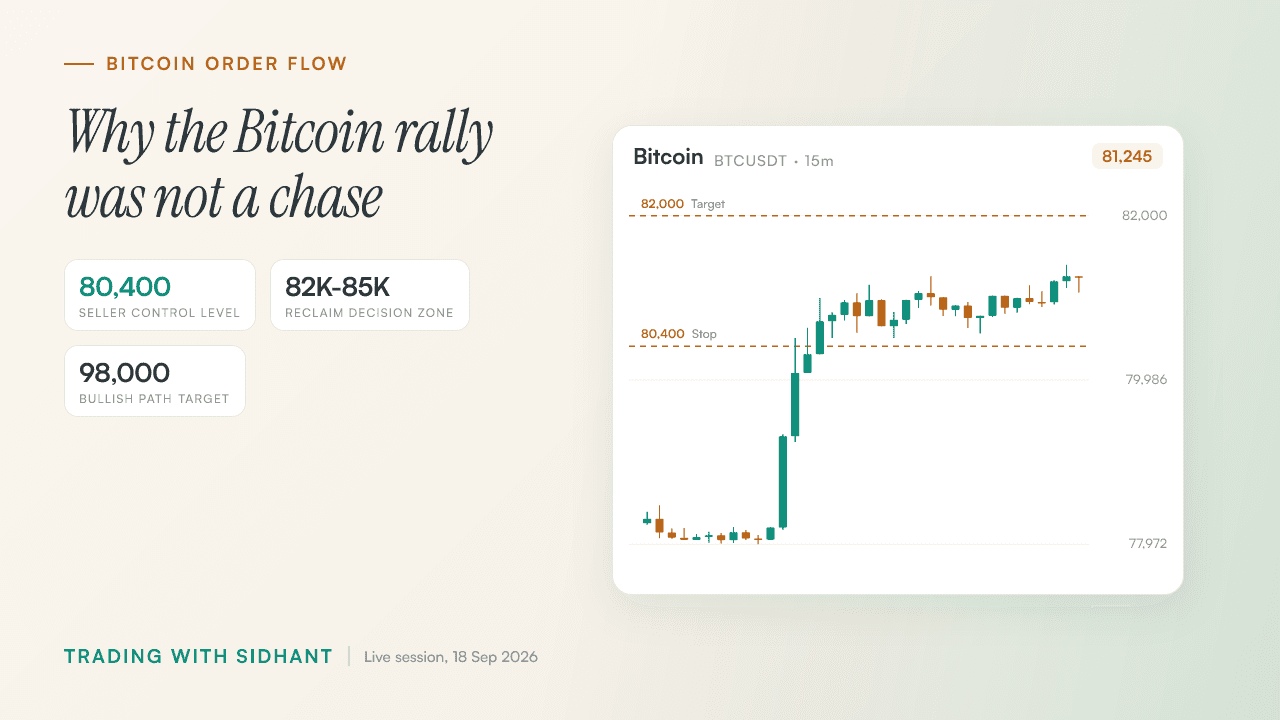
Bitcoin had already rallied, so Fahad used 80,400, delta and seller exhaustion to explain why waiting beat a FOMO entry.

When to Quit a Profitable Intraday Strategy
Rs 12 lakh in profit looked different after Sidhant counted the 1,500 hours and the freedom the strategy had consumed.
Get post alerts in your inbox.
New blog post? We'll email you. No spam, unsubscribe anytime.
Join our Telegram community.
Get post alerts, trading discussions, and market updates.