Bitcoin No Trading Zone Strategy Explained
Discover why Bitcoin is in a no trading zone and learn effective strategies from our team insights.
11 min read

Bitcoin hit a wall. On the stream, Fahad called it straight: "this is a no trading zone for Bitcoin." That one line summed up everything happening right now. The bitcoin no trading zone strategy isn't about sitting on your hands. It's about understanding WHY you're not trading. Completely different skill. We were watching price hover around $63,960, resistance sitting stubbornly at $62.9, liquidity stacking up above $63K like a coiled spring. The 4-hour structure? Bearish. EMA200? Acting as a ceiling. The signals were genuinely contradictory. So we stepped back. Not out of fear. Out of discipline. Here's what we saw, what we planned, and why reading a no-trade situation correctly is often the most profitable thing you can do.
Key Takeaways
- When every signal contradicts the next, the most profitable decision is often no decision at all.
- Shorting Bitcoin works when you wait for the liquidity grab to complete, not when you anticipate it.
- In meme coins, market cap and community momentum are the real fundamentals. Price alone tells you almost nothing.
- Gold needs to backtrack to fix its current low before a clean long setup becomes available. Forcing a trade here is the mistake.
- The traders who improve fastest are the ones who treat missed trades as data, not disasters.
Why is Bitcoin in a no trading zone?
Bitcoin's in a no trading zone because market signals are unclear and resistance at significant levels makes it tough to predict price movements with any real confidence. When price is sandwiched between competing forces (bearish 4-hour structure on one side, building MACD golden cross on the other), the honest answer is that neither bulls nor bears have control. That ambiguity? That's the zone.
Here's the thing: most traders see a flat market and feel the urge to do something. Anything. That's exactly how accounts bleed out slowly on choppy days.
Fahad flagged resistance at $62.9 as the key level to watch. Price was hovering around $63,960, which sounds bullish on the surface. But the 4-hour candles were hugging the EMA200 while the EMA50 was capping every push to the upside. Bitcoin's liquidation clusters were stacking above $65K, meaning any aggressive long from here would be walking into a liquidation minefield.
What does a no trading zone actually look like on the chart?
- Resistance at $62.9, a level we'd been watching for multiple sessions
- Liquidity sitting above $63K, not a clean breakout, just bait
- EMA200 acting as dynamic resistance on the 4-hour timeframe
- Price action without follow-through, moves up that immediately got faded
The MACD golden cross was the one interesting signal. It hinted at building momentum that could eventually push toward the upper Bollinger Band at $65,009. But (and this is where traders get trapped) a signal building momentum isn't the same as momentum that's arrived. Don't fall for that trap. Understand it.
A no trading zone isn't a failure of analysis. It's the output of good analysis. When we look at a chart and every signal contradicts the next, the correct read is: wait. Brother, you need to wait.
Missed a setup while sitting out? As Fahad put it on stream, "if you did not sell, then don't worry, it is not that this was the last trade." Markets always come back. The traders who blow up? The ones who can't tolerate sitting still.
For a deeper look at how we approach these structural reads, the Bitcoin market outlook breakdowns cover the framework we use session to session.

How to identify Bitcoin shorting opportunities?
Identifying shorting opportunities means analyzing market liquidity and resistance levels, focusing on capturing brief price corrections where liquidity above current price acts as fuel for a reversal. Not every short is a conviction play. Sometimes the setup is simply: price runs up to grab liquidity, then rolls over. Clean. Mechanical. Repeatable.
Fahad was specific on stream: "this is going to be the area where I would like to plan a shorting opportunity." That area? Around current levels taking out liquidity above $63K, with the stop sitting above recent highs and the target pointing toward the next support cluster.
Why does liquidity create shorting opportunities? So basically, when price hunts stops above a key level, it triggers a wave of buy orders from squeezed shorts. That's the fuel. Once the fuel's burned, price has no reason to keep going. That's when the reversal happens. Not magic. Mechanics.
Geopolitical pressure had already pushed Bitcoin below $63K in the recent session, which meant the market was already sensitive at these levels. More confirmation the zone was real.
Alright guys, here's the actual setup breakdown:
Bitcoin shorting opportunities at different levels.
| Entry Level | Target | Stop Level |
|---|---|---|
| Current levels (~$63,960) taking out liquidity | Next support cluster (~$63,260) | Above recent swing highs |
| Liquidity grab above $63K | Lower Bollinger Band (~$63,260) | Above $65,009 resistance |
| EMA200 rejection on 4H | Prior session lows | Above EMA50 dynamic resistance |
The logic's consistent across all three rows: you're not chasing price. You're waiting for price to come to a level where the risk is defined and the liquidity story makes sense.
Our team's firm on this: it's not a "short everything" environment. Bitcoin ETFs were still seeing extended inflows and institutional accumulation was happening in the background. Shorting here means shorting a specific structure, not betting against the entire trend.
Want to understand how we build these short setups from first principles? Our guide on trading Bitcoin liquidity levels breaks down the exact mechanics.
Patience is the edge here. "It's not that if you think about it today, it will happen tomorrow." That quote from the stream applies perfectly. The setup needs to develop on its own timeline, not yours.

Exploring the dynamics of meme coin trading
Meme coin trading means high community engagement and moves driven by market sentiment, not traditional price fundamentals. That distinction matters more than most new traders realize. When Fahad explained this on stream, he put it simply: "when you trade meme coin you don't trade on the basis of what is the price." You trade on market cap. Community heat. Momentum.
Honestly, I don't even know what's going on half the time with meme coins. That's kind of the point. Nobody does. That's what makes them work the way they work.
Here's the actual dynamic at play:
- Market cap, not price, is the real number. A coin at $0.000001 isn't cheap; a coin with a $5B market cap is expensive regardless of dollar price.
- Community hype is the fundamental. Social media volume, influencer attention, viral moments move meme coins more than any chart pattern.
- Buy and sell dynamics are extreme. As Fahad said on stream, "this means that there is buy and sell in this also," meaning even in a meme coin frenzy, the same market structure rules apply.
- Liquidity is thin, which means moves are fast, violent, often have no warning.
The Dubai influencer culture reference from the stream was relevant here. Meme coins and influencer culture operate on the same fuel: attention. When a coin gets picked up by a creator with a large audience, market cap can 10x in hours. Then it can drop 90% the next morning. Not a bug. That's the product.
How do you trade something that moves on vibes? You trade it like any volatile instrument: with defined risk, small size, no emotional attachment to the outcome. The mistake most people make? Treating meme coins like investments. They're not. They're momentum vehicles with a very short shelf life.
(And this is where it gets interesting.) Traders who do well in meme coins are usually the ones who have strong fundamentals in regular crypto trading first. They understand when a move's real versus when it's a pump-and-dump dressed up as a community moment. That pattern recognition? It separates the profitable ones from the ones left holding a bag.
For anyone building their approach to crypto markets more broadly, understanding how to build a complete trading strategy gives you the foundation that makes meme coin entries and exits actually systematic rather than random.

Gold market analysis for strategic trading
Trading gold depends on waiting for a reversal near target lows. Understanding price action patterns will sharpen your decision-making far more than any indicator overlay. Our team's stance on gold during the stream? Neutral. Not because gold was uninteresting, but because the setup wasn't complete yet.
Fahad's read was direct: "if gold has to reverse, then it will have to move downwards once again to fix the current low." That's not a bearish call on gold. It's a structural observation. For a clean long to set up, price needs to backtrack to the previous low and create a proper base. Otherwise any upside move risks becoming what he called a "poor low," a weak structure that gets taken out later.
Look, gold's in a similar position to Bitcoin in some ways. Competing signals. The right move? Patience. We identified a few key points:
- Wait for price action confirmation before committing to a direction
- Previous lows are the target area for a potential reversal setup
- Neutral stance maintained until the market shows its hand
- Stop levels remain undefined until the reversal pattern confirms
"The only thing that allowed gold to push so high from this bottom is because you just have a look at this." Fahad said this while pointing to the structure of the prior move. The implication? That kind of push needs a proper pullback before it can happen again.
For traders who want to go deeper on gold setups, Fahad's gold market trading insights cover exactly this kind of price action read in more detail.
Patience on gold isn't weakness. It's the whole strategy.

How to cultivate a growth mindset in trading?
A growth mindset means continuous learning and resilience. In trading, especially in an environment as fast-moving as 2026 crypto markets, it's the single biggest edge most people ignore. Fahad made this point on stream not through a motivational speech, but through a real observation about life in Dubai: "mindset is the biggest edge that people here have."
The Dubai context matters. The city operates at a pace where being passive means getting left behind. "You have to be out, you have to speak, you have to find opportunities." That energy translates directly to trading. Waiting for the perfect setup? Good. Waiting passively and never preparing for when it arrives? Not good.
Right, so what does a growth mindset actually look like in practice for a trader?
- Proactive preparation, studying setups before the session, not during it
- Self-correction without ego. "I changed my mind there" is a strength, not a weakness.
- Engagement with the community. The best traders we've seen improve fastest are the ones asking questions, not the ones pretending they already know.
- Long-term thinking. One missed trade isn't a disaster; a pattern of emotional decisions is.
(And this is where it gets interesting.) The influencer culture in Dubai that Fahad referenced is actually a useful mirror for trading psychology. People who move to Dubai and succeed? The ones who show up, stay visible, keep building. The ones who fade? They expected the city to do the work for them. Markets operate the same way.
If you're shy, if you're waiting for the market to come to you on your terms every single time, that approach will eventually break. The market doesn't negotiate. You adapt.
"If you did not sell, then don't worry, it is not that this was the last trade." That quote from the stream is the growth mindset in one sentence. Miss a trade? Fine. Learn from it. The next one's already forming.
For traders looking to pair mindset work with accountability structures, the Hitpoint Live accountability strategies are a solid starting point.

So basically, here's what the session gave us:
- Bitcoin's no trading zone is a real signal. When resistance at $62.9 and contradictory momentum indicators collide, the discipline move is to wait, not guess.
- Shorting opportunities exist but require precision. Liquidity grabs above $63K set up the mechanical reversal; entry without that confirmation is just gambling.
- Meme coins run on market cap and community heat, not price. Size appropriately and never hold them like investments.
- Gold needs to backtrack to its prior low before a clean reversal setup appears. The neutral stance was the right call.
- Mindset is infrastructure. The traders who last are the ones who treat every missed trade as a lesson and every session as preparation.
The stream wrapped with Fahad saying "thank you so much for sharing your time with me." That energy's exactly what the Hitpoint community is built on. Real analysis. Real levels. Real conversation.
Join the Hitpoint community for live market coverage and real-time trade alerts. The next setup's already forming.
Watch the full stream: Bitcoin No Trading Zone Strategy Explained on YouTube
Disclaimer: This article is for educational purposes only and is not investment advice. Crypto assets are unregulated in India, are highly volatile, and can lose value rapidly; there is no established investor-protection or grievance-redressal mechanism for them. Trading With Sidhant LLP is not a SEBI-registered Investment Adviser or Research Analyst, and nothing here constitutes a recommendation to buy or sell any asset. Income from virtual digital assets is taxable in India at 30% plus applicable cess, with 1% TDS on transfers. Past performance is not indicative of future results. Do your own research before trading.
Frequently Asked Questions
- What does a no trading zone mean for Bitcoin?
- A no trading zone means the market lacks a clear directional bias, making risk-reward unfavorable for new positions. For Bitcoin, this happens when resistance at key levels like $62.9 conflicts with mixed momentum signals. The 4-hour structure is bearish while the MACD hints at building bullish momentum. The correct response? Patience, not forced trades.
- How should traders react to liquidity above current levels?
- Liquidity above current levels signals a potential short setup, not a breakout opportunity. When price hunts stops above a key zone like $63K, it triggers buy orders from squeezed shorts, burning fuel for the move. Once that liquidity's consumed, price often reverses sharply. The play is to wait for the grab to complete, then enter the short with a defined stop above the recent high.
- What are the key support and resistance levels for Bitcoin?
- Resistance sits at $62.9 and the EMA200 on the 4-hour chart, with the upper Bollinger Band at $65,009 as the next significant ceiling. Support's found near the lower Bollinger Band at $63,260, with liquidation clusters stacking above $65K. These levels defined the no trading zone during the stream and remain the key structural markers to watch.
- How do meme coins impact trading decisions?
- Meme coins don't impact your core crypto strategy directly, but they reveal how community sentiment and market cap dynamics work. These are lessons that apply across all speculative assets. Trading meme coins requires shifting your evaluation framework from price to market cap and social momentum. Keep position sizes small, define your exit before entry, never treat them as long-term holdings.
- What mindset is needed for successful trading in 2026?
- Successful trading in 2026 demands proactive preparation, fast self-correction, and the ability to sit out setups that don't meet your criteria without feeling like you're missing out. As Fahad put it on stream, missing one trade isn't a problem; a pattern of emotional, reactive decisions is. Build your system, trust the levels, treat every session as preparation for the next one.
Share this post

How to Use Direction Area Trigger in Nifty Trading
A Nifty short near 24,000 needed more than a pin bar: daily bias, a defined area and footprint evidence had to agree.
Bitcoin Order Flow Analysis After a Rally
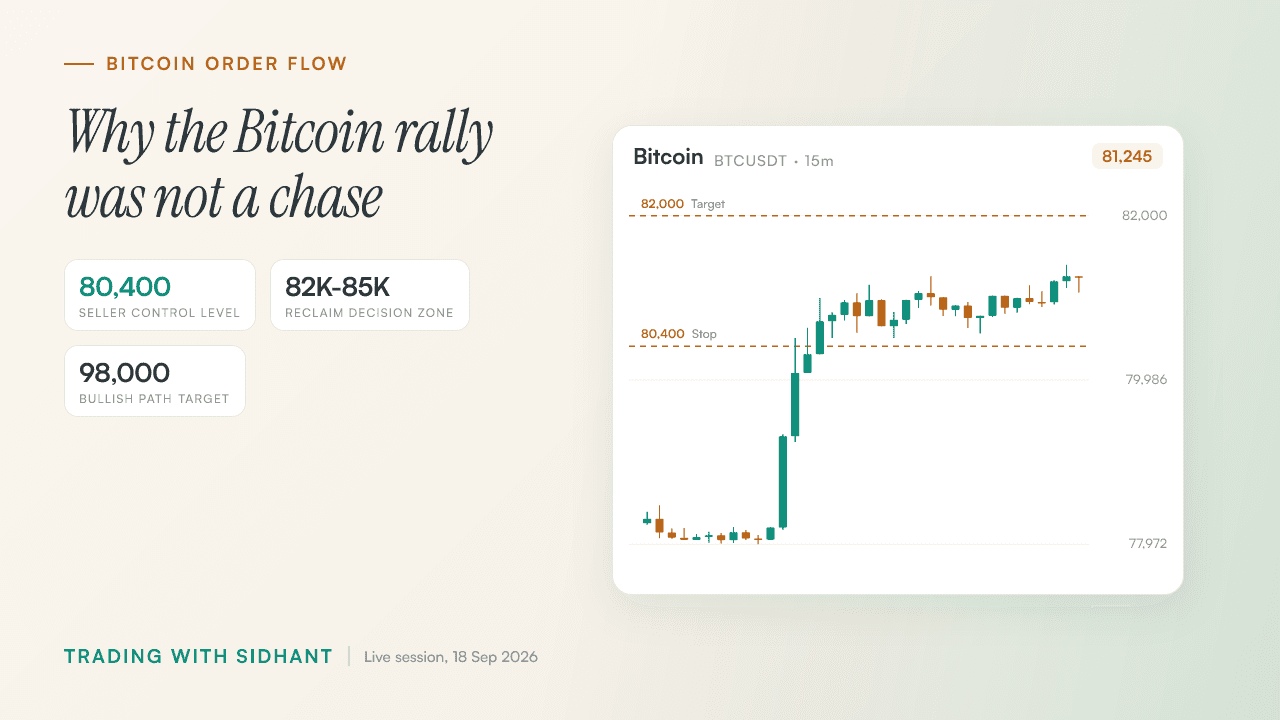
Bitcoin had already rallied, so Fahad used 80,400, delta and seller exhaustion to explain why waiting beat a FOMO entry.

When to Quit a Profitable Intraday Strategy
Rs 12 lakh in profit looked different after Sidhant counted the 1,500 hours and the freedom the strategy had consumed.
Get post alerts in your inbox.
New blog post? We'll email you. No spam, unsubscribe anytime.
Join our Telegram community.
Get post alerts, trading discussions, and market updates.