How to Build a TradingView Indicator With AI
Claude produced an indicator, but Pine Script errors showed why copying fixes is no substitute for understanding the code.
7 min read
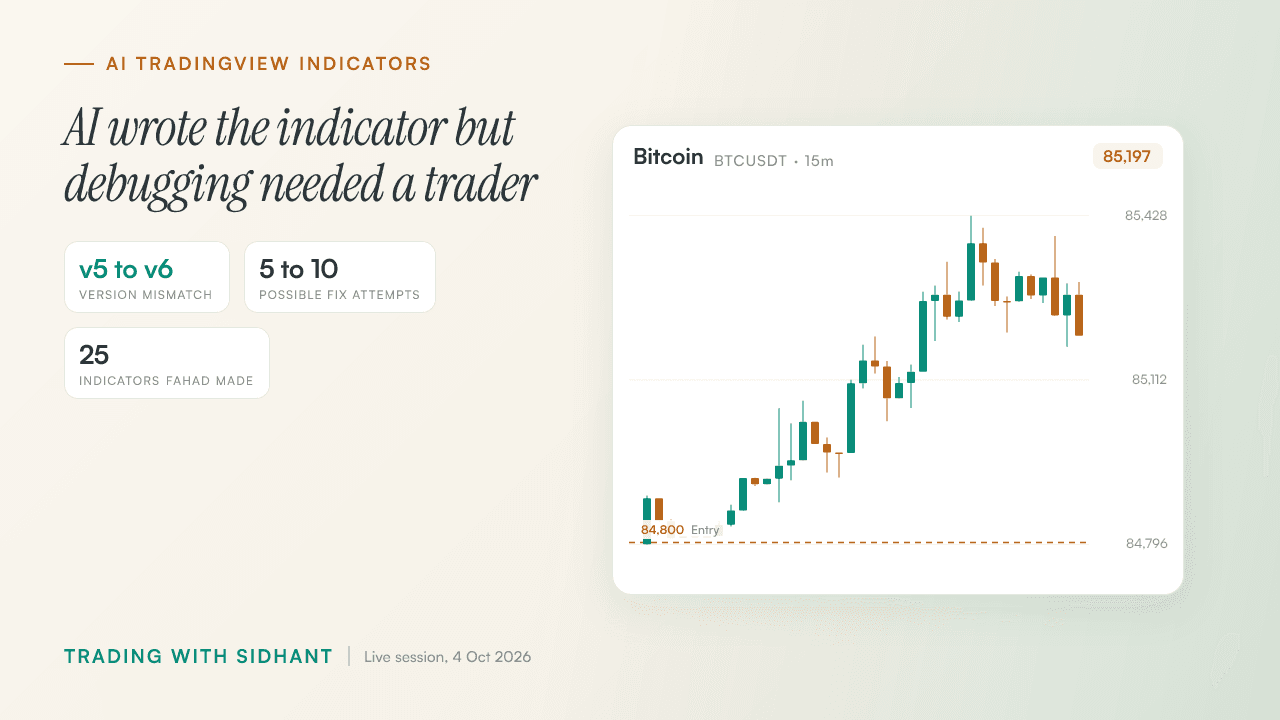
Claude generated a TradingView indicator on the Sunday stream. Then Fahad ran into Pine Script errors. He spotted a version mismatch, tried to correct the code and found a change he could not explain. That is where how to build a TradingView indicator with AI gets harder than asking for a script. We can describe a signal in a prompt, but we still need to know what the code measures and what a proposed fix changes. Fahad put the risk plainly: 'If you don't understand the errors, you'll just keep doing copy, paste, copy, paste.'
Key Takeaways
- If a signal cannot be described as a testable market event, a precise prompt is not ready yet.
- Treat the reported error as evidence, then inspect the changed logic before accepting a script that runs.
- A correction attempt only counts as progress when you know what changed and why.
- Judge an indicator by the decisions it helps explain, not by whether its code compiles or its signals look tidy.
- A marked level is a conditional observation; weak volume was Fahad's reason not to force a BTC trade.
AI can draft an indicator, but the trading rules must come first
AI can write a TradingView script, but we have to define the event each signal marks. On the Sunday stream, Fahad asked Claude to generate an indicator and explained that vague prompts produce vague outputs. Volume, liquidity and market structure need rules the code can test, not labels that merely look convincing on a chart.
Write the rules before the prompt. We would settle these questions first:
- Volume: Which data and period matter, and what counts as a meaningful change?
- Liquidity: Should the script mark obvious highs and lows, or an internal sweep before price reaches them?
- Market structure: What price behavior confirms the event we want marked?
These are questions for a trader to answer, not settings Fahad prescribed. He explained that price can reverse before reaching an obvious liquidity level. A prompt that recognizes only sweeps of major highs or lows would miss the distinction he was making.
The guide to building TradingView indicators with Claude also starts with describing the intended indicator to the AI. We would go further and write a rule we can check against a chart. Our earlier discussion of Bitcoin liquidity levels shows why naming a level differs from explaining how price interacts with it.
The Pine Script version mismatch was only the first debugging problem
Claude generated a Pine Script version 5 indicator, while Fahad said TradingView usually runs version 6. We could identify that mismatch on the stream. We could not attribute every later error to it, especially after Fahad noticed an unexpected change during his attempts to correct the script. Checking the version was a start, not a full diagnosis.
Observed issue: v5 versus v6. Other errors: not identified on the stream. Fahad encountered code errors, requested corrections and then asked, 'What changed? I don't even know.' We cannot give that moment a tidy resolution the demonstration did not provide.
We would read the reported error and locate the line TradingView identifies. Before pasting a revision into the editor, we would compare it with the previous script and check whether it still measures the event in the prompt. Quieting the editor does not help if the signal has changed.
Pine-specific AI coding tools can help generate and revise scripts, as LuxAlgo's Pine Script coding guide describes. Fahad's demonstration showed the limit of that help. Claude could revise the code, but Fahad still had to decide whether the revision preserved his idea.
Repeatedly pasting errors back into AI can hide the real cause
Copying each Pine Script error into a chatbot can trap a beginner in repeated corrections without resolving the cause. Fahad estimated that the loop could take 5 to 10 attempts. We took a simpler lesson from the demonstration: read the fault, inspect the last change and establish what a suggested repair does before requesting another one.
'If you don't understand the errors, you'll just keep doing copy, paste, copy, paste,' Fahad said. An earlier edit had changed something he did not expect. Pasting the next error back to Claude would not, by itself, explain that change.
- Read the error: Note its message and the line TradingView identifies.
- Find the cause: Inspect the surrounding code and the last revision, not only the named line.
- Check the revision: Compare the scripts and see whether the original signal rule still holds.
Fahad compared debugging to diagnosing a medical problem. Removing something near the pain does not prove you found its cause. Likewise, an error line tells us where to investigate, not necessarily which code to replace.
That is how we approach using AI in trading strategies. The tool can speed up drafting. The trader still has to understand what the code does.
A working script still needs realistic signal expectations
A script that compiles has passed a code check, not a trading test. Fahad said he had made around 25 indicators and excluded many because they lacked practical use. He called Hit Point Wave his best current creation because it automates parts of his CMM process. We would judge a new script's signals separately from whether it runs.
Compiling script: The editor accepts the code. Useful signal: We can explain what it marks and assess whether that information helps with a market decision. Those are different checks.
Fahad described Hit Point Wave as assessing momentum, buyer and seller aggression, absorption, divergence and possible continuation or reversal. He also distinguished an internal sweep from a sweep of an obvious major high or low. The difficult part is deciding which behavior matters before asking code to mark it.
He said indicator accuracy can vary from 60 to 65% to 90 to 95%. He did not present those figures as verified results for an AI-generated script. 'Six months of 100% accuracy? Never,' he said. That is a sound reason to question a signal history that looks too clean.
Our footprint delta guide on false signals deals with the same problem. We want to know what an alert detects, when it can mislead us and what it adds to the chart.
Bitcoin's quiet Sunday range showed why context outranks a signal
A signal would not have changed the conditions Fahad described in BTC on Sunday. Bitcoin was grinding sideways with low volume and little liquidity, so he favored planning over forcing a trade. We kept his downside levels conditional: 77,000 if the discussed volume range failed, then 74,000 if 77,000 also failed.
'The market is missing its two drivers here: liquidity and volume,' Fahad said. He gave no fresh BTC entry, despite discussing where price might go if the range gave way.
Fahad's conditional Bitcoin read from the Sunday stream
| Condition | Level | Implication |
|---|---|---|
| Low-volume Sunday range | No fresh entry | Plan rather than force a trade. |
| Discussed volume range fails | 77,000 | Fahad marked the next downside level. |
| 77,000 fails | 74,000 | Fahad marked the subsequent downside level. |
Fahad thought momentum was more likely to develop on Monday or Tuesday. He gave no precise boundary for the volume range, or an entry and stop for either downside scenario. The chart below marks a viewer's 84,800 long entry on BTCUSDT 15-minute candles. That was the viewer's position, not a fresh entry Fahad endorsed.
Our earlier look at Bitcoin range trading with small risk covers the patience a range demands. On this stream, Fahad chose to leave a quiet Sunday alone.
◆ Interactive Lab
Open in new tab ↗Drive the order book yourself
The code error told us more than a clean AI-generated script would have. Fahad could ask Claude for an indicator, but an unexplained revision made him stop and inspect the work. We would rather define one signal carefully and understand one correction than keep a folder of scripts nobody can explain. His Bitcoin read called for the same restraint. He had conditional levels in mind, yet low Sunday volume and liquidity gave him no reason to force an entry. Join the Hitpoint community for live market coverage and real-time trade alerts.
Watch the full stream: How to Build a TradingView Indicator With AI on YouTube
Disclaimer: This article is for educational purposes only and is not investment advice. Crypto assets are unregulated in India, are highly volatile, and can lose value rapidly; there is no established investor-protection or grievance-redressal mechanism for them. Trading With Sidhant LLP is not a SEBI-registered Investment Adviser or Research Analyst, and nothing here constitutes a recommendation to buy or sell any asset. Income from virtual digital assets is taxable in India at 30% plus applicable cess, with 1% TDS on transfers. Past performance is not indicative of future results. Do your own research before trading.
Frequently Asked Questions
- Can AI build a TradingView indicator without coding knowledge?
- Yes, AI can draft a TradingView indicator without the trader writing code from scratch, as Fahad demonstrated with Claude. The difficulty comes when the script errors or produces a signal different from the one requested. If we cannot inspect a revision, we may accept code that runs but no longer expresses the trading rule we intended.
- Why does AI generated Pine Script show a version error?
- A version mismatch can occur when AI generates code for a different Pine Script version from the one the trader expects to use. In Fahad's demonstration, Claude generated **version 5** code while he said TradingView usually runs **version 6**. That was one visible issue. We cannot attribute all the later errors on the stream to that mismatch.
- What should I include in a prompt for a trading indicator?
- Include testable definitions of the market behavior you want the indicator to mark. We would specify what counts as a volume change, which liquidity levels matter, what confirms a market-structure event and what the script should display. Fahad's point was that vague requests produce vague outputs. A signal name alone cannot tell Claude how to calculate it.
- How do I avoid repeatedly pasting Pine Script errors into a chatbot?
- Read the reported error and inspect the affected code before asking the chatbot for another fix. Compare its proposed revision with the previous script, then check whether the signal still follows your original rule. Fahad warned that beginners might spend **5 to 10 attempts** in a correction loop. A disappearing error does not establish that the indicator works as intended.
- Should an indicator signal be traded when Bitcoin volume is low?
- No, we would not treat an indicator signal as an automatic trade when volume is low. On the Sunday stream, Fahad described **BTC** as grinding sideways without much volume or liquidity and gave no fresh entry. He preferred planning, with **77,000** and **74,000** discussed only as conditional downside levels if the stated price conditions occurred.
Share this post
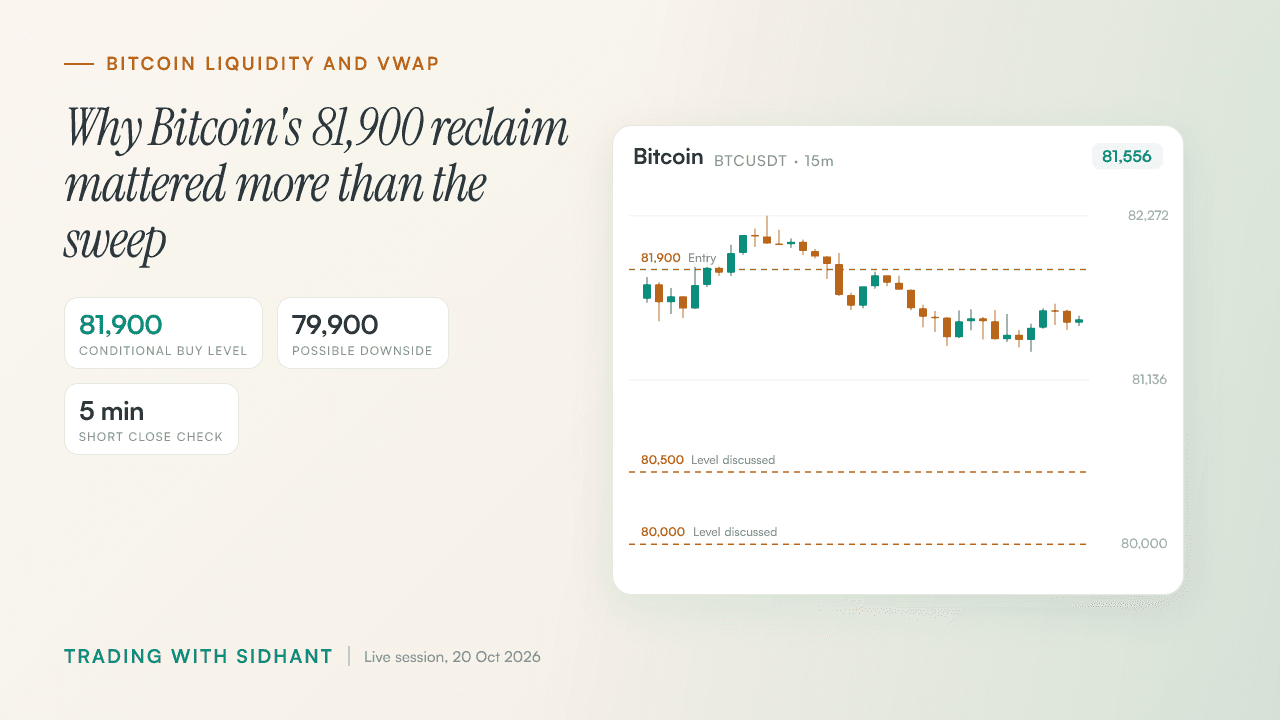
How to Trade Bitcoin Liquidity Sweeps Near 81,900
Bitcoin swept both sides of its range, but Fahad wanted an 81,900 reclaim to buy or a confirmed VWAP loss to short.
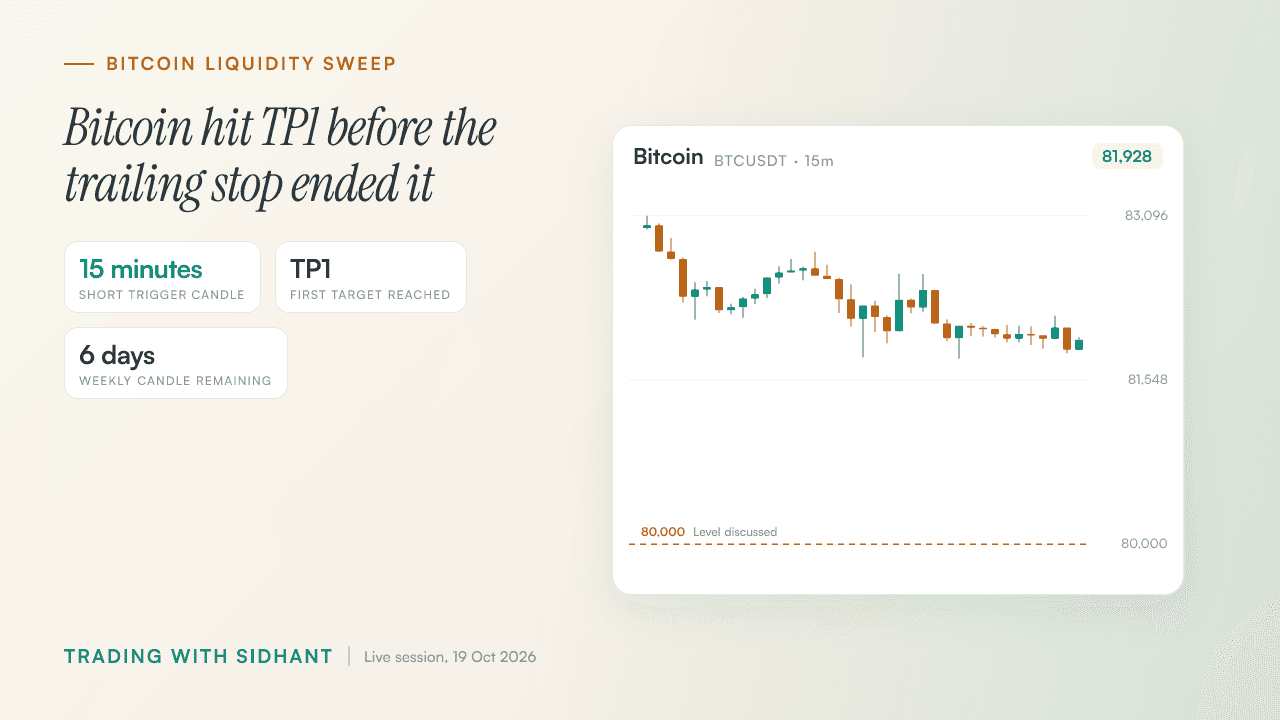
Bitcoin Liquidity Sweep Trading Strategy: TP1 and Stops
A Bitcoin short reached TP1, but the bigger lesson came from the trailing stop that ended the trade.
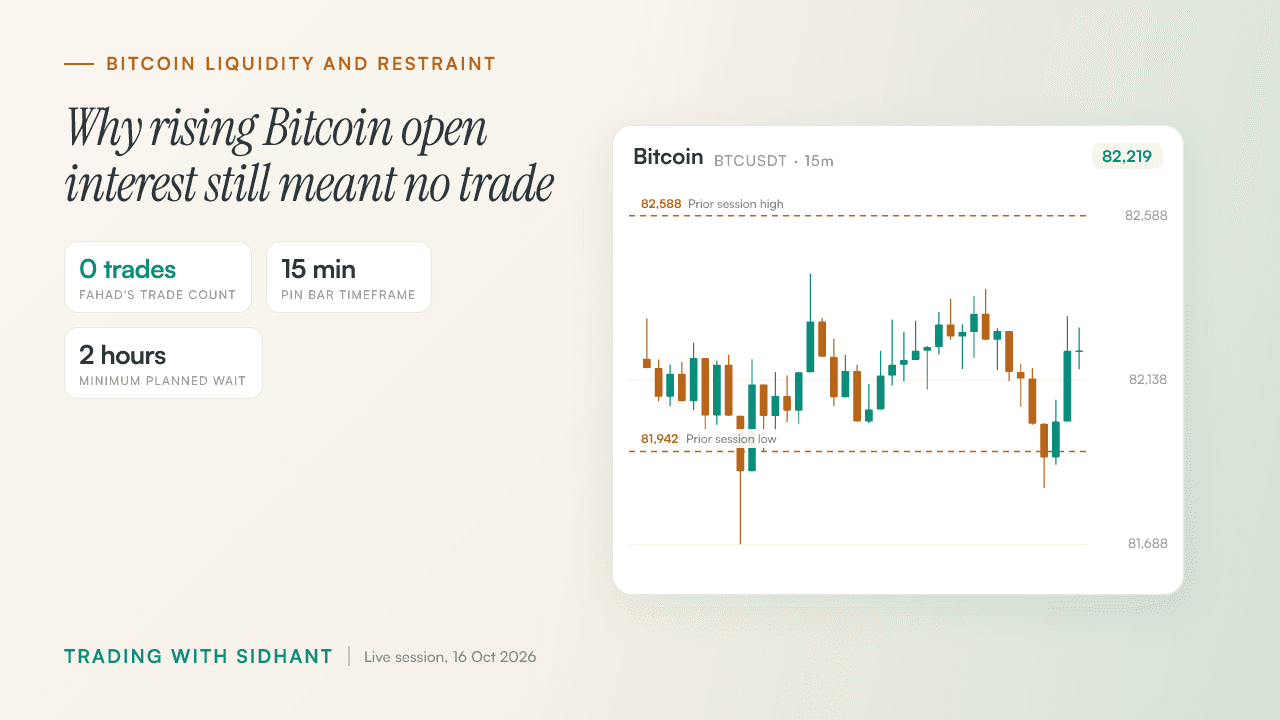
When Not to Trade Bitcoin: Rising OI, Zero Trades
Bitcoin open interest rose as CVD fell, but weak volume and conflicting signals kept Fahad out of the market.
Get post alerts in your inbox.
New blog post? We'll email you. No spam, unsubscribe anytime.
Join our Telegram community.
Get post alerts, trading discussions, and market updates.