How to trade bitcoin around news events: a 4-minute pause
Fahad called the Bitcoin pump, but first told viewers to avoid new trades for four minutes as open interest fell.
7 min read
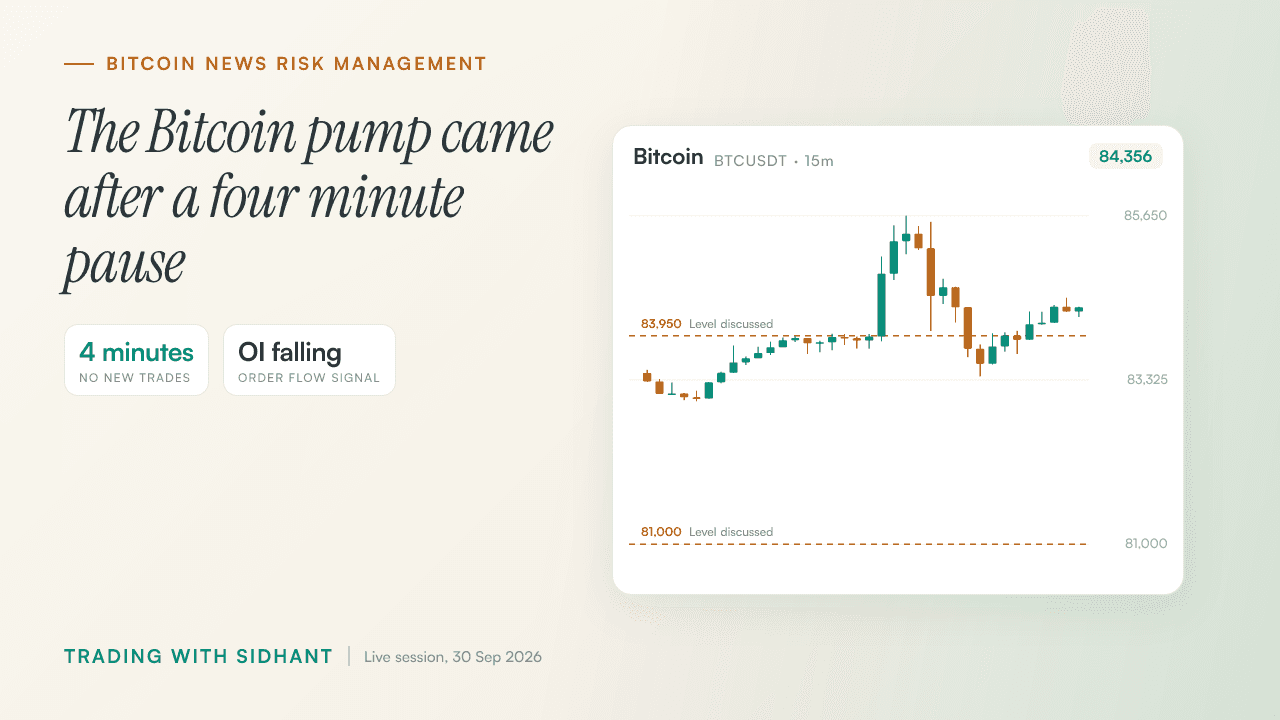
Fahad expected Bitcoin to pump, then told everyone on the stream to avoid new trades for four minutes. The news was close, open interest was falling, and both longs and shorts were closing. For anyone asking how to trade bitcoin around news events, the useful part was his restraint. Bitcoin rose as he expected, but he gave no entry price or target for the move.
Key Takeaways
- Fahad's clearest pre-news decision was to pause new entries, even though he expected Bitcoin to rise.
- A falling open-interest reading did not cancel Fahad's upside view, but it gave us no confirmed Bitcoin entry.
- The pump validated Fahad's immediate read, not an undocumented entry or a claim that upside would continue.
- Oil had a condition that kept Fahad out; silver had reversal structure behind an active trade; Bitcoin had neither stated entry.
- Fahad's $10 example showed why a visible scalp gain needed a fee check before anyone called it a win.
Fahad paused new Bitcoin trades for four minutes before the news
With news approaching, Fahad told everyone on the stream not to open a new trade for the next four minutes. He asked viewers already in positions to manage risk. We could see the distinction he was making: expecting Bitcoin to rise was one thing; finding an entry just before the event was another.
His instruction was direct. 'Do not open any trades for the next four minutes.' Fahad did not identify the news item, so we cannot tie the move to a specific headline.
- New entries: Pause them for four minutes.
- Existing positions: Manage the risk already on the book.
- News reaction: Wait rather than turn a directional expectation into a hurried entry.
The stream had covered Bitcoin, gold, oil, and silver. Once the event drew near, Fahad shifted from chart discussion to what viewers should do right then. He still expected upside, but asked them to stand aside during the immediate news window.
Timing matters in event-driven crypto trading. Here, the instruction was narrower than a general strategy: do not mistake a forecast for an entry plan.
The Bitcoin chart below includes 83,950, which appeared in a garbled viewer question, and 81,000, which came up in audience banter. Fahad did not give either as his entry or target for the pump.
◆ Interactive Lab
Open in new tab ↗Drive the order book yourself
Falling open interest weakened the case for an immediate Bitcoin entry
Bitcoin open interest was falling, and Fahad said both long and short positions were closing. He described the order-flow picture as less than ideal while still expecting a pump. We could follow his directional view without treating the participation data as confirmation of an entry. Those were separate readings of the same moment.
The call and the evidence did not match neatly. A rising candle later made the call look straightforward, but the information available before it was mixed.
- Price expectation: Fahad expected Bitcoin to pump around the news.
- Order-flow observation: Open interest was decreasing as longs and shorts closed.
- Entry decision: He told viewers to avoid new trades for four minutes.
Open interest counts outstanding positions. A decline means positions are closing on net, but it cannot identify the direction of the next candle by itself. Fahad was watching both sides close, which gave him little reason to present the order flow as a clean signal for his upside view.
Our guide to Bitcoin open interest when price rises explains why price and participation need separate readings. On the stream, Fahad kept that distinction intact even as he called for a pump.
He also wondered whether a fake pump would lead to a dump, or a fake dump would come first. It was a question about the reaction, not a second trade plan. We heard no Bitcoin entry condition that resolved the uncertainty.
Bitcoin pumped as Fahad expected, without a stated entry or target
Bitcoin rose after Fahad called for a pump. 'I was hoping for a pump, and I got one,' he said when the move appeared on the stream. We can credit the immediate read without inventing a trade: he gave no clear entry, target, or stop for his own Bitcoin position, and later said a dump might follow.
A correct call was not an executable setup. Nobody heard a price where Fahad entered, a target where he would exit, or a stop that defined the risk. The first move matched his expectation. It supplied none of those missing details.
Then Fahad joked, 'I sold my house and entered this Bitcoin trade.' He was imitating an exaggerated trading-video hook, not reporting an actual position. The joke landed because viewers had also heard him warn against new entries before the move.
His later thought that Bitcoin might dump left the next decision open. Our Bitcoin value-area piece on waiting for confirmation covers that distinction in another setup. On this stream, Fahad got the immediate direction right and did not specify a follow-up trade.
Oil and silver showed what trade confirmation looked like
Fahad would short oil only if a specified low broke, and he stayed out while that break was unconfirmed. On silver, he discussed an active trade after a strong reversal, a five-minute low, and a higher low. We had two concrete contrasts with Bitcoin, where he stated a direction but no personal entry.
Oil had a condition he could check. Fahad had said publicly that he would short only after the low broke. It had not broken when he evaluated the setup, so he did not enter. He gave no numerical oil level and, although he later said oil was being dumped, did not establish that he had entered a short.
What Fahad required or observed across three setups
| Instrument | Condition or observation | Entry status on the stream |
|---|---|---|
| Bitcoin | Expected an immediate news pump; no personal entry, target, or stop stated | No clear personal entry stated |
| Oil | Short depended on a specified low breaking; no numerical level given | No entry while the break was unconfirmed; no later entry established |
| Silver | Strong reversal, five-minute low, then a higher low | Active trade discussed; no numerical entry given |
A viewer asked why Fahad had not waited for a retracement on silver. He pointed to the reversal structure behind his decision rather than imposing the same sequence on every setup. He also said the setup could remain valid even if his stop was hit.
The oil chart below shows crude oil during the stream's market discussion. It does not supply a numerical trigger, because Fahad gave none. Our piece on trading confirmation covers the principle behind waiting for a condition to be met.
◆ Interactive Lab
Open in new tab ↗Drive the order book yourself
A correct scalp call still has to survive fees and risk
Fahad warned that a scalp showing $10 in profit might leave $2 to $4 when booked, depending on fees. Those figures were an example, not an exchange fee schedule. He also said he did not believe in trades below 1:2 reward-to-risk. We heard two different checks to make before celebrating a small move.
The displayed gain is not necessarily what a trader keeps. Fahad's concern was that a short-time-frame call could look impressive on stream while fees took much of the profit.
How Fahad illustrated scalp profit after fees
| Measure | Illustrative amount | What to check |
|---|---|---|
| Displayed scalp gain | $10 | What the position shows before booking |
| Amount after booking | $2 to $4 | The applicable exchange fees; Fahad's example, not a fixed rate |
| Reward-to-risk preference | At least 1:2 | Whether planned upside is twice the defined risk |
The risk-reward ratio explanation sets out the calculation behind the separate 1:2 test. Fees and defined risk need their own checks. Passing one says nothing about the other.
Fahad declined to recommend an exchange or share a referral link before finding one he trusted and could use on stream. Calling the Bitcoin pump took a directional read; showing that a scalp was worth taking after costs would have required details he did not give.
Fahad got the first Bitcoin move right, but the four-minute warning came before the candle. Open interest was falling, both sides were closing positions, and he asked viewers not to add new trades. We would rather keep that sequence than turn his call into a trade with an entry nobody heard. On oil, he had a low that needed to break and stayed out when it had not. On silver, he could explain the reversal behind his active position. The Bitcoin call stood on its own, with no stated execution plan. Join the Hitpoint community for live market coverage and real-time trade alerts.
Watch the full stream: How to trade bitcoin around news events: a 4-minute pause on YouTube
Disclaimer: This article is for educational purposes only and is not investment advice. The price levels, setups and trades described are a review of market events that have already occurred, shared to illustrate a method of analysis rather than to recommend any trade. Trading With Sidhant LLP is not a SEBI-registered Investment Adviser or Research Analyst, and nothing here constitutes a recommendation to buy or sell any security. Investments in securities markets are subject to market risks; read all the related documents carefully before investing. Past performance is not indicative of future results. Please consult a SEBI-registered financial adviser before acting on any information in this article.
Frequently Asked Questions
- Should I open a Bitcoin trade just before a news event?
- Fahad asked everyone on the stream not to open a new trade for the next **four minutes** as news approached. He told viewers already in positions to manage risk. He expected Bitcoin to pump, but his directional view did not come with an entry plan, and he described the order-flow picture as less than ideal.
- What does falling Bitcoin open interest mean when price rises?
- Falling open interest means outstanding positions are declining on net, even if Bitcoin's price rises. On the stream, Fahad said both longs and shorts were closing. He did not present that reading as confirmation of an entry for his expected pump. Open interest alone could not tell viewers which direction the next candle would take.
- Did Fahad give a Bitcoin entry or target for the pump?
- No, Fahad gave no clear entry or target for his own Bitcoin position, and he stated no stop for it either. He expected an immediate pump, warned viewers away from new trades for four minutes, and watched Bitcoin rise. We can credit the directional call without presenting it as a trade with execution details.
- Can Bitcoin pump first and dump after a news event?
- Yes, an initial pump does not establish what happens next. On the stream, Bitcoin rose after Fahad called for upside, but he later said a dump might follow. He had also raised the possibility of a fake pump followed by a dump. Neither remark came with a confirmed entry or target for a later move.
- How do trading fees affect the profit from a Bitcoin scalp?
- Fees reduce what a trader keeps after booking a scalp. Fahad illustrated this with a **$10** displayed gain that might leave **$2 to $4**, depending on exchange fees. That was an example, not a quoted fee schedule for Bitcoin or a named exchange. He declined to recommend an exchange before finding one he trusted.
Share this post
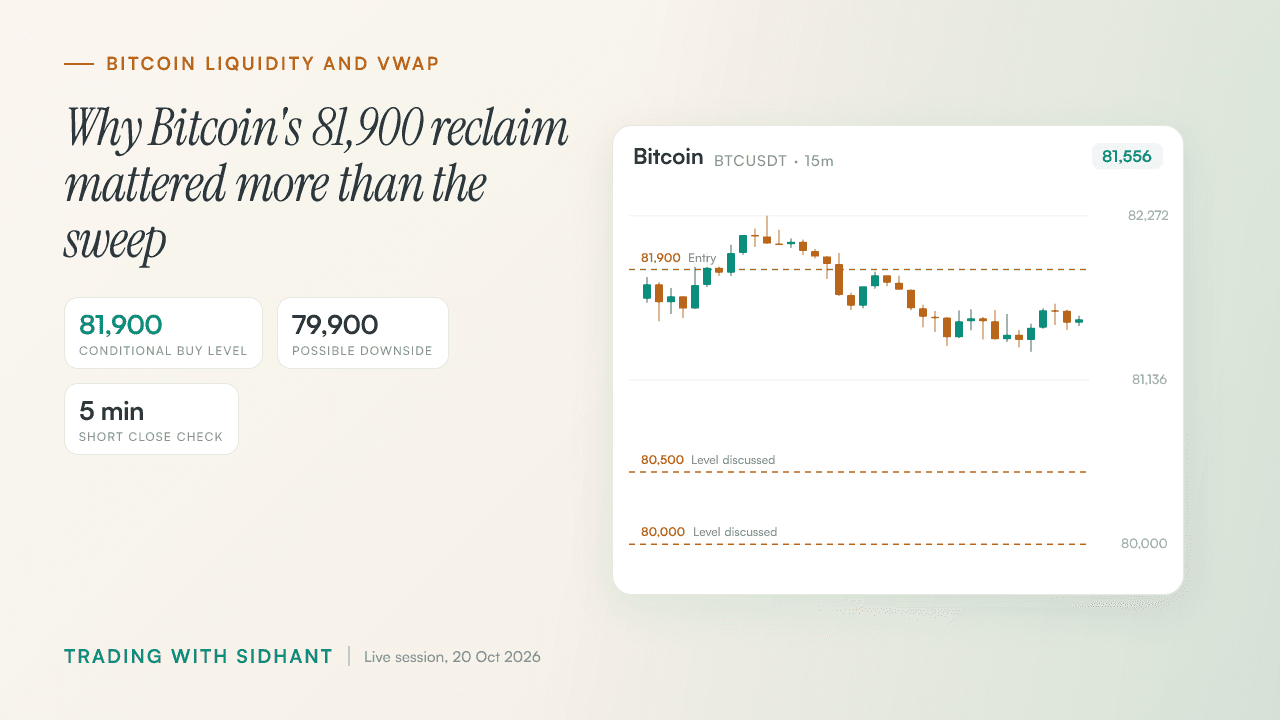
How to Trade Bitcoin Liquidity Sweeps Near 81,900
Bitcoin swept both sides of its range, but Fahad wanted an 81,900 reclaim to buy or a confirmed VWAP loss to short.
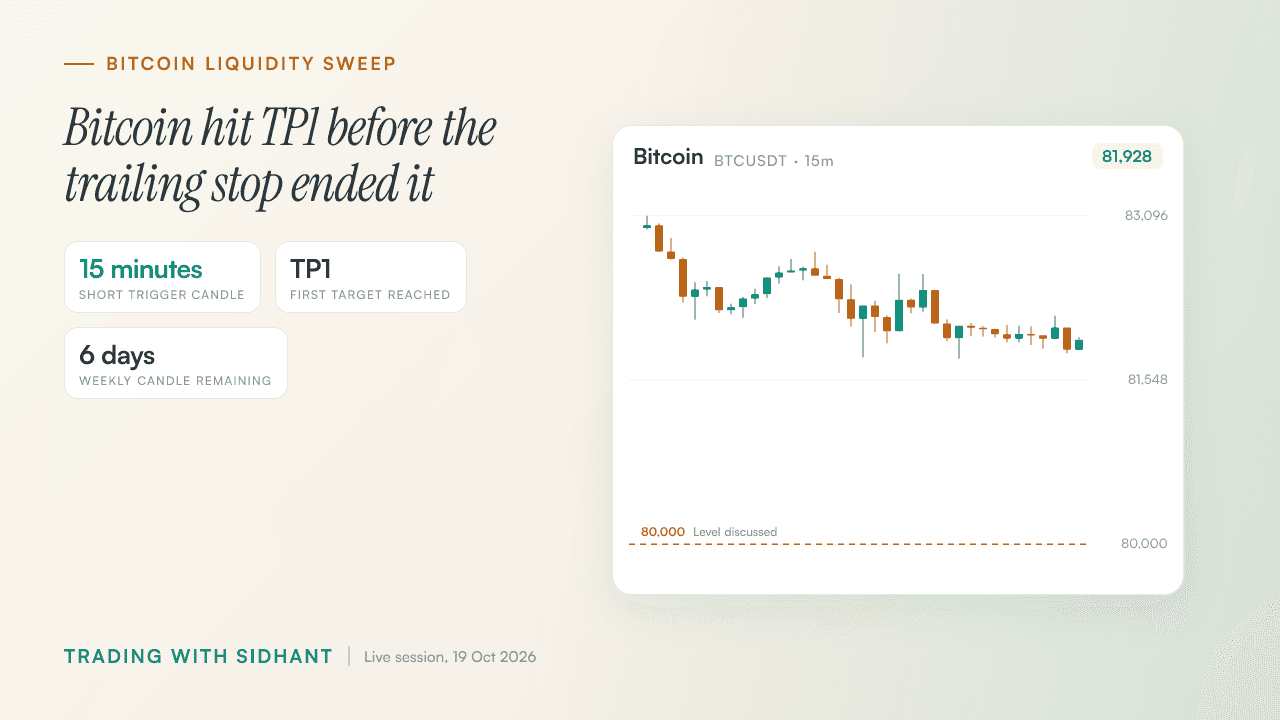
Bitcoin Liquidity Sweep Trading Strategy: TP1 and Stops
A Bitcoin short reached TP1, but the bigger lesson came from the trailing stop that ended the trade.
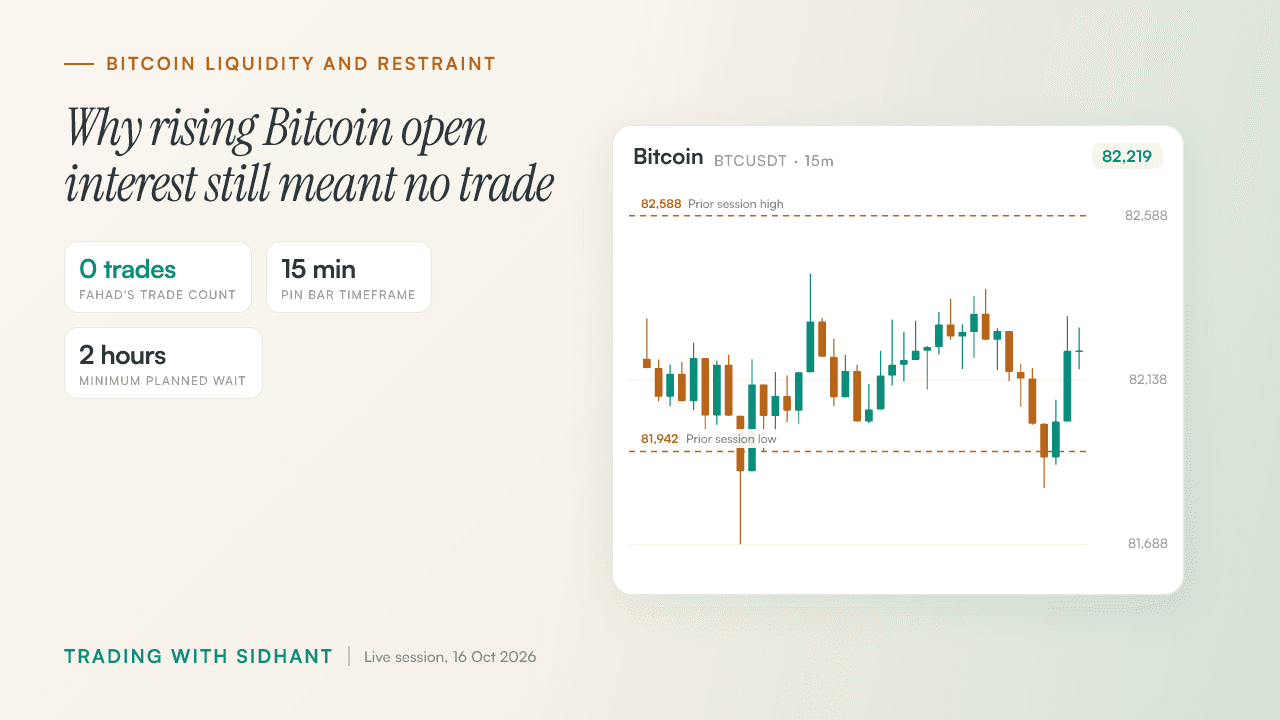
When Not to Trade Bitcoin: Rising OI, Zero Trades
Bitcoin open interest rose as CVD fell, but weak volume and conflicting signals kept Fahad out of the market.
Get post alerts in your inbox.
New blog post? We'll email you. No spam, unsubscribe anytime.
Join our Telegram community.
Get post alerts, trading discussions, and market updates.