Bitcoin Trading Strategy for 2026: Key Insights and Techniques
Discover our 2026 Bitcoin trading strategy with Fahad's insights on market trends and effective risk management.
11 min read

Fahad took zero trades all week. Not because the market was dead. The setup wasn't there. That's the Bitcoin trading strategy for 2026 in one sentence: patience over impulse, system over emotion. On the stream, Fahad was eyeing a short on BTC with the daily open sitting at 63,440 and a stop at 63,747. The read was simple: lose the daily open, you're heading for the daily low, then lower. No heroics, no gambling, just waiting for the market to show its hand. Here's what our team broke down, from short setups to risk rules to why discipline is the only edge that actually compounds.
Key Takeaways
- Recognizing daily open levels as structural anchors, not just price points, is what separates reactive traders from systematic ones.
- A short trade without a defined stop and structural reason isn't a trade. It's a guess with leverage attached.
- Sizing every position so a stop-loss hit costs exactly 1% of account equity turns risk management from theory into a repeatable habit.
- Cross-market analysis, watching oil and gold alongside BTC, gives context that price charts alone can't provide.
- Zero trades in a week can be the most disciplined and profitable decision a trader makes when conditions aren't right.
What makes Bitcoin trading unique in 2026?
In 2026, Bitcoin trading features increased volatility and emerging trends that older playbooks simply don't account for. India's growing market involvement adds real complexity, with retail participation up and regulatory conversations shifting the way price discovers itself across sessions. It's not the same asset it was in 2021. Not even close.
So basically, the game has changed, and most traders? Still playing by old rules. You know what I mean?
Here's the thing: the volatility isn't random noise anymore, it's structured in ways that create identifiable patterns as ETF inflows, Federal Reserve policy expectations, and macro sentiment all feed into BTC price action. Bitcoin price predictions from analysts at CoinGecko show forecast ranges so wide they'd make your head spin, which tells you one thing: nobody knows the exact number, but everybody agrees the moves will be large.
What does that mean for traders? The daily open matters more than ever. On the stream, our team called out 63,440 as the critical level with a simple read: "If we lose a daily open, we're going for a daily low and then eventually lower." That's not a prediction. That's a framework, a repeatable structure you can apply session after session.
The Indian market angle is real, by the way. Traders operating from India are dealing with session overlaps, INR-denominated risk, and a crypto regulatory environment that's still finding its shape. (We've seen this create some wild timing mismatches.) That creates specific entry and exit timing considerations that a trader in New York simply doesn't face. If you're navigating that, understanding Bitcoin market strategy tailored for Indian retail traders is worth your time.
The market conditions on this stream were described as mixed. Not clearly trending, not clearly ranging. (And this is where it gets interesting.) That in-between zone is where most traders blow up because they force trades, they get impatient. Our take? Zero trades for the week was the right call. Waiting isn't weakness. It's the strategy.

How to implement a Bitcoin short strategy?
To short Bitcoin effectively, you analyze market signals for weaknesses and use stop-loss orders wisely to manage risks. Setting precise entry, target, and stop levels is the entire job. Everything else? Noise. Vague shorts get vague results.
On the stream, Fahad was direct about it: "I want to get into a short position right now on Bitcoin." The reasoning wasn't a hunch, it was structural. BTC was showing weakness below the daily open at 63,440, and losing that level meant the path of least resistance was the previous day's low. That's the trade logic.
Wait, let me check. The stop placement here is worth understanding because the stop was set at 63,747, which isn't arbitrary but positioned above the daily open to give the trade room to breathe without invalidating the thesis. If price reclaims that level convincingly? The short idea is wrong. Full stop.
For anyone building a Bitcoin shorting strategy that targets local liquidity zones, this is exactly the kind of structure you want: a clear invalidation point, a defined target, and a reason for the trade beyond "it feels like it wants to go down."
Here's the setup our team identified on the stream:
Bitcoin Short Strategy Key Levels
| Position | Entry Price | Target | Stop-Loss |
|---|---|---|---|
| Short | Market Price (~63,440 area) | Previous Day's Low | 63,747 |
| Short (aggressive) | Retest of daily open | Daily Low extension | 63,750 |
The caution Fahad applied here is worth noting: "Even if I give stop loss fine. But I would like to be a little cautious." That's not indecision, that's a trader who knows that being right about direction and being right about timing are two completely different things. You can nail the setup and still get stopped out if you size too heavy or enter too early. (We've all been there.)
Alright, so here's the thing: shorting Bitcoin isn't just about finding a downtrend, it's about finding the specific moment where the structure breaks down and the sellers take control. That moment, identified correctly? That's where the edge lives.

Why is risk management essential in crypto trading?
Risk management in crypto trading minimizes losses by employing strategies like setting drawdown limits and using stop-loss orders on every single trade. It's not optional, it's not just for beginners, it's the only thing standing between a bad week and a blown account. Full stop.
Fahad put it plainly on the stream: "Trading is like a very, very sensitive business." That word, sensitive? It's doing a lot of work here. A 1% drawdown limit sounds conservative until you realize it's what keeps you in the game when the market does something nobody predicted. And crypto does that constantly. (More often than we'd like to admit.)
The specific advice from the session was to reduce drawdown to 1% per trade. Not 5%, not "whatever feels comfortable," one percent. That forces you to think about position sizing before you think about potential profits. Crypto risk management strategies from CoinBureau back this up with a framework that's consistent across serious traders: define your max risk first, build the trade around it.
Honestly, most traders do this backwards. They see a setup they like, decide how much they want to make, and then figure out the position size. That's how accounts die slowly. The right order is:
- Define max drawdown: How much of your account are you willing to lose today?
- Set stop-loss before entry: Not after. Before.
- Size the position so that if the stop hits, you lose exactly 1% (or whatever your defined limit is).
- Don't move the stop once the trade is live, unless you're moving it in your favor.
The accountability piece matters too. Hitpoint's trader accountability framework covers how our team approaches this, and it's not complicated, but it requires consistency. (Actually, consistency is the hardest part.)
Here's our take: the traders who struggle most with risk management aren't the ones who don't know the rules, they're the ones who know the rules and break them anyway because the trade "feels different this time." It never does.

How do market analyses drive trading decisions?
Market analyses inform traders by identifying price trends and potential move points, making the difference between a reactive trade and a planned one. Especially in volatile conditions, the traders who have done their analysis before the candle forms are the ones who execute cleanly. Everyone else? Chasing.
On the stream, our team wasn't just watching BTC. Oil was on the radar too, with potential upside seen on smaller timeframes, and gold was in the mix. The point is this: cross-market awareness matters because when oil shows strength and gold is holding, it tells you something about the broader risk environment that feeds directly into how you read BTC price action. Why take the harder path?
Fahad's framework for reading the session was anchored to one rule: "As long as the market is between these two, you should not trade." Right? That's a range-bound condition, no edge, no trade. The analysis told him to sit on his hands, and he did, which is the kind of discipline (informed by analysis rather than boredom) that separates consistent traders from inconsistent ones.
For oil specifically, our team spotted potential upside push toward resistance levels, but entry hadn't been specified yet. That's honest analysis. You don't force a level just because you want a trade, you wait for the market to confirm what your analysis suggested. If you want to understand how Fahad approaches gold alongside Bitcoin, the breakdown in Fahad's gold market trading insights covers the methodology.
Look, the broader picture here? ETF inflows and Federal Reserve policy also feed into BTC's price drivers. Capital.com's analysis on Bitcoin price and ETF inflows highlights how institutional flows are now a structural part of the market, not a temporary phenomenon. Changes how you read price trends at the daily level.
Key move points our team was tracking:
- Daily open at 63,440: the line in the sand for BTC direction
- Stop cluster at 63,747: above this, the short thesis breaks
- Previous day's low: primary target if daily open loses
- Oil resistance levels: being monitored for confirmation before entry
Analysis doesn't give you certainty. It gives you a framework for acting when conditions align, and sitting still when they don't.

What is the role of trading discipline?
Trading discipline maintains consistency and helps avoid impulsive decisions that quietly destroy accounts over time. It's the factor that determines whether a good strategy actually produces results or just looks good on paper. Without it? Even the best setups get mismanaged.
Here's the most honest thing Fahad said on the stream: "I will be very honest. I have taken zero trades this week." Not because there was nothing happening in the market, but because the setups weren't clean enough to justify the risk. That's discipline in its purest form. The ability to do nothing when nothing is the right call. (And that's harder than it sounds.)
Most traders can't do that. The screen is open, the market is moving, and the urge to participate feels overwhelming. You know what I mean? That urge is the enemy of long-term profitability. As Fahad puts it, "Trading is like a very, very sensitive business." Sensitive businesses don't reward impulsive decisions.
The consistency angle is practical, not motivational. It means:
- Same process every session: pre-market analysis, level identification, condition check
- No trades outside your defined setup criteria: if it doesn't fit, it doesn't exist
- Post-session review: what worked, what didn't, what you'd change
- Weekly accountability: our team drops content every third day to keep the community sharp
Fahad's approach to this was summed up in one line: "As a trader, it is literally my habit." Habits compound. Good trading habits compound into good results, while bad habits (chasing moves, moving stops, doubling down on losers) compound into the opposite.
We think the traders who build real consistency aren't the ones with the most sophisticated strategies. They're the ones who execute a simple strategy the same way, every time, without exception. If you're building that kind of approach, understanding how to build a trading strategy that holds up is the foundation.
Look, discipline isn't exciting. It's not the part of trading that gets the highlight reel. But it's the only part that actually determines whether you're still trading in five years or explaining to someone why you quit.
The session was honest, specific, and a little uncomfortable. Exactly what good market analysis should feel like. Here's what our team walked away with:
- Daily opens are structural anchors. BTC's 63,440 level wasn't just a number. It was the entire directional thesis. Lose it, and the path to the daily low opens up.
- Zero trades is a valid result. Fahad took no trades all week. That's not failure. That's a trader respecting his own criteria.
- Risk management is the trade. 1% drawdown limits and pre-defined stops aren't restrictions. They're what keeps you in the game long enough to catch the real moves.
- Cross-market awareness sharpens decisions. Oil and gold context informed the BTC read. Markets don't exist in isolation.
- Discipline compounds. The same process, executed consistently, is worth more than any single brilliant trade.
Watch that whole damn video, and then come back next session ready to apply it.
Join the Hitpoint community for live market coverage and real-time trade alerts. Our team is live every session, breaking down exactly what we see and why we're acting on it.
Watch the full stream: Bitcoin Trading Strategy for 2026: Key Insights and Techniques on YouTube
Disclaimer: This article is for educational purposes only and is not investment advice. Crypto assets are unregulated in India, are highly volatile, and can lose value rapidly; there is no established investor-protection or grievance-redressal mechanism for them. Trading With Sidhant LLP is not a SEBI-registered Investment Adviser or Research Analyst, and nothing here constitutes a recommendation to buy or sell any asset. Income from virtual digital assets is taxable in India at 30% plus applicable cess, with 1% TDS on transfers. Past performance is not indicative of future results. Do your own research before trading.
Frequently Asked Questions
- What is the current Bitcoin trading strategy for 2026?
- The Hitpoint team's Bitcoin trading strategy for 2026 centers on daily open levels as directional anchors, strict 1% drawdown limits, and waiting for structural confirmation before entering any position. On the stream, Fahad identified 63,440 as the key BTC daily open. Lose that level, and the target becomes the previous day's low. No setup, no trade. Patience is the strategy.
- How can I effectively manage risk in crypto trading?
- Effective risk management in crypto trading starts with defining your maximum drawdown before placing any trade. Our team recommends keeping it at 1% per position. Set your stop-loss before entry, not after. Size the position so that if the stop hits, you lose exactly that 1%. Never move a stop against your position. These rules sound simple because they are. The hard part is following them every time.
- What are key indicators to watch in Bitcoin markets?
- The daily open is the single most important level to watch. It defines the session's directional bias. Beyond that, track the previous day's low as a primary target in bearish conditions, and monitor stop clusters above key levels (like 63,747 in this session) as invalidation points. Cross-market signals from oil and gold also provide context that pure BTC charts miss.
- How does market analysis impact trading decisions?
- Market analysis determines whether a trade happens at all. On the stream, Fahad's analysis of BTC's position relative to the daily open led to a short bias. His analysis of the range-bound condition in other instruments meant no trades were taken there. Analysis doesn't guarantee profit, but it replaces guesswork with a framework, which is the only sustainable edge in volatile markets.
- Why is trading discipline essential for long-term success?
- Discipline is the mechanism that turns a good strategy into consistent results. Without it, even the best setups get mismanaged. Entries too early, stops moved, position sizes inflated. Fahad took zero trades in a full week because conditions didn't meet his criteria. That restraint, applied consistently over months and years, is what separates traders who last from traders who blow up and quit.
Share this post

How to Use Direction Area Trigger in Nifty Trading
A Nifty short near 24,000 needed more than a pin bar: daily bias, a defined area and footprint evidence had to agree.
Bitcoin Order Flow Analysis After a Rally
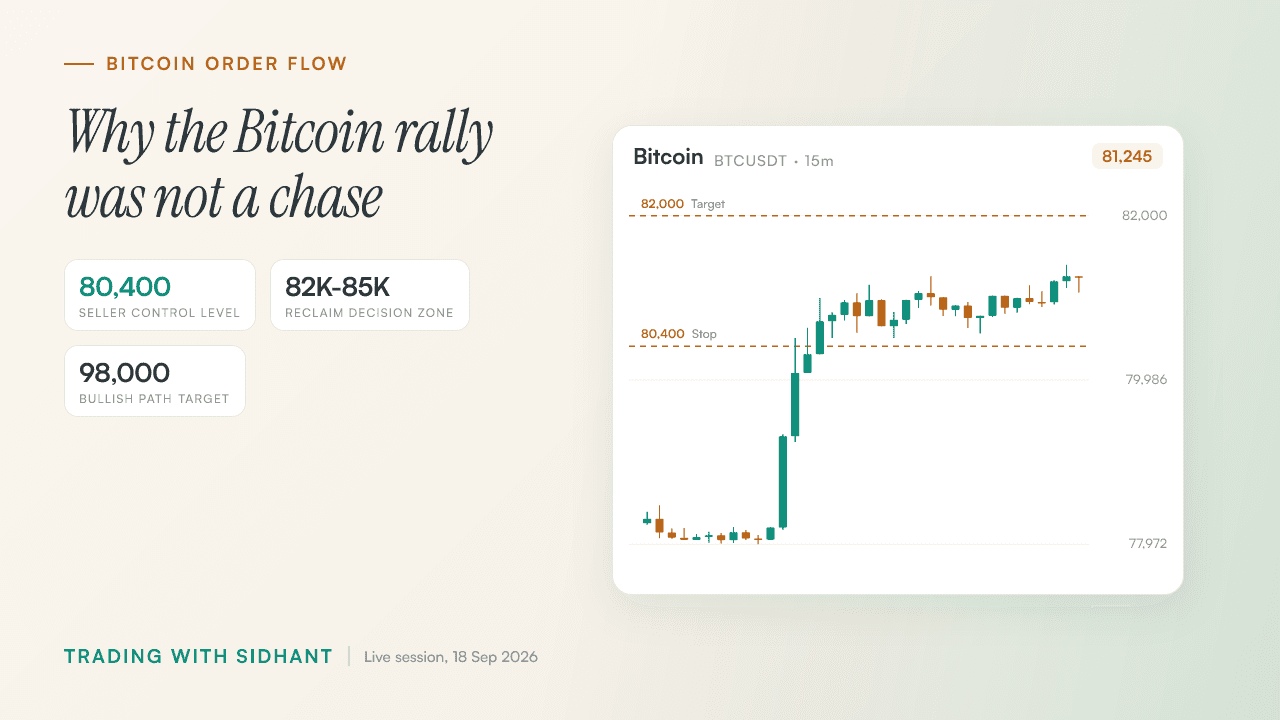
Bitcoin had already rallied, so Fahad used 80,400, delta and seller exhaustion to explain why waiting beat a FOMO entry.
When to Quit a Profitable Intraday Strategy
Rs 12 lakh in profit looked different after Sidhant counted the 1,500 hours and the freedom the strategy had consumed.
Get post alerts in your inbox.
New blog post? We'll email you. No spam, unsubscribe anytime.
Join our Telegram community.
Get post alerts, trading discussions, and market updates.