Can AI Trade Bitcoin Futures Profitably? A 30-Day Test
Claude returned 12.3% in 30 days, but the trade it refused after three losses may explain more than the profit.
7 min read

Claude refused a $76,900 Bitcoin long after three losses. Bitcoin later fell to about $76,530, below the stop I had proposed for that unplaced trade. I had given Claude Rs 1,000,000 of real money and 30 days to trade Bitcoin futures. I still hadn't told anyone at home. As I said in the video, 'Please don't forward this video to my mom.' The test asked: can AI trade Bitcoin futures profitably when strict rules control every trade? Claude finished up 12.3%, but the trade it refused stayed with me.
Key Takeaways
- A risk limit has value only if it still controls the trade when the trader wants an exception.
- A winning streak did not create a fourth setup; Claude let three days pass rather than invent one.
- The timeout cost Claude a possible trade, and the later price check made that restraint easier to understand.
- Claude reached its planned exit because it held through two days that had offered no target hit.
- The realised loss and tax questions deserve as much attention as the headline return.
Five rules put a Rs 5,000 limit on each planned loss
I gave Claude Rs 1,000,000 and restricted it to Bitcoin futures on the daily chart. Before opening a position, it had to name an entry, stop and target, with no more than Rs 5,000 in planned risk. It could place at most one new trade per day. Three consecutive losses meant three days without trading.
I wrote those limits before I knew the result. A profitable trade is easy to explain after the chart has moved. A rule that blocks the next trade has to hold up while I still want to place it.
The constraints Claude had to follow
| Rule | Limit | Behaviour it restricts |
|---|---|---|
| Market and chart | Bitcoin futures, daily chart | Switching markets or timeframes to find a trade |
| New trades | At most one per day | Repeated entries |
| Planned loss | Rs 5,000, or 0.5% of starting capital | Oversized risk |
| Trade plan | Entry, stop-loss and target set first | Improvised exits |
| Position management | No moving stops or adding to losers | Increasing risk after entry |
| Position size | No position above the account size | Excess size |
| Losing streak | Three losses meant three days out | Immediate revenge trades |
Claude spent its first day reading the rules. 'The first time I've seen someone read the terms and conditions,' I said in the video. The checklist reminded me of the one a mother gives you before you leave for a hostel: repetitive until the day you need it. I used AI as a rule follower here, the same distinction I make when discussing AI in trading strategies.
Three early wins led to three days without a trade
Claude's first three Bitcoin futures trades won, leaving the account up Rs 28,780 after five days. Then it placed nothing for three days because it found no clear setup. That pause caught my attention. A winning streak can make the next entry feel urgent, even when the chart gives you no reason to take it.
The first short had a $78,500 entry, a $79,600 stop and a $76,800 target. The target was hit the next day. An early long from $77,600 reached its $81,800 target, and a short from $81,000 was the third winner.
- Three wins: The first trades gave Claude a profitable start.
- Three days out: It reported no clear setup and made no new trade.
- My reaction: 'After three wins, wait. That line is going on my phone wallpaper.'
After three wins, I can picture a trader choosing a Lamborghini colour before checking the next entry. Claude waited instead. Those days without a position belong in the account of what happened, which is why I keep coming back to quality versus quantity in a trading strategy.
The three-loss timeout blocked a likely fourth loss
Three consecutive losses triggered Claude's required three-day timeout. I wanted to consider another long, with a proposed $76,900 entry and $76,600 stop, but the rule blocked it. Bitcoin later fell to about $76,530. That low suggests the hypothetical trade would have hit its stop. Claude never placed it.
The account had gone from about Rs 1,028,000 to Rs 1,012,000 during the losing streak, with losses roughly Rs 5,000 each. I didn't enjoy sitting out. 'My own rules had stopped me,' I said in the video. It felt like putting a lock on my own door and finding I couldn't get in.
- Losses: Three stopped trades took the account down by roughly Rs 16,000.
- Enforced pause: Claude made no new trade for three days, despite my frustration.
- Later check: The hypothetical long had a $76,900 entry and $76,600 stop. The reported low was near $76,530.
I was thinking about getting the loss back, not about whether the next entry deserved a place in the plan. That is the behaviour I discuss in how to handle losses without revenge trades. This time, the rule held while I argued with it.
A $75,500 Bitcoin long reached its target on day three
After the timeout, Claude entered a Bitcoin long at $75,500, with a $74,900 stop and $80,000 target. The target stayed out of reach on the first two days, so the position remained open. On day three, Bitcoin reached about $81,000, and Claude's planned $80,000 target was hit.
The entry-to-stop distance was $600. Claude returned to its usual Rs 5,000 planned risk, and I described the profit in the video as roughly eight times that risk. It had already set the exit. Holding the position did not require a fresh explanation each morning.
The planned levels and outcome of Claude's patient long
| Point in the trade | Bitcoin price | What Claude did |
|---|---|---|
| Entry | $75,500 | Opened the long |
| Predefined stop | $74,900 | Kept the planned exit level |
| Profit target | $80,000 | Held while the target remained unhit on days one and two, then exited when it was hit on day three |
| Price reached on day three | About $81,000 | Did not treat that price as its exit |
'If it were me, I might have got out at $200 profit and gone to get pani puri,' I admitted. I know how quickly a small open profit can make a planned target seem too far away. Executing a planned trading exit is harder than writing one down.
About the chart below: It marks several Bitcoin price levels, including $80,000. It is not a replay of Claude's full 30-day test.
◆ Interactive Lab
Open in new tab ↗Drive the order book yourself
The 12.3% result beat holding Bitcoin but proves little alone
The video reports Rs 122,583 profit on Rs 1,000,000 over 30 days, or 12.3%, after about Rs 8,362 in fees. Buying and holding Bitcoin returned 7.4% over the same period. Claude did better in this test. I cannot tell from one month whether it would do so again under different market conditions.
What the 30-day Bitcoin experiment actually reported
| Measure | Claude experiment | Comparison or qualification |
|---|---|---|
| Starting capital | Rs 1,000,000 | |
| 30-day return | 12.3% | Bitcoin buy and hold: 7.4% |
| Reported profit | Rs 122,583 | After reported fees, before tax |
| Fees | About Rs 8,362 | Included in the reported result |
| Average winning trade | About Rs 16,750 | |
| Average losing trade | About Rs 5,634 | |
| Maximum single-trade loss | Rs 5,834 | Above the Rs 5,000 planned-risk figure |
The realised loss matters. Claude planned around a Rs 5,000 limit, yet its largest single-trade loss was Rs 5,834. The video also mentioned India's 30% tax on crypto gains and said crypto losses cannot simply be offset against profits. The reported return was before tax. I would check the treatment of the specific futures transactions rather than assume it is identical for every trade.
Crypto prices can move sharply, as CoinDCX's overview of crypto assets cautions. I would use Claude again alongside my trading journal, but this result does not make it a trader I can leave alone with the account. My read in the video was blunt: 'This isn't brains, bro. This isn't intelligence. This is discipline.' Don't copy the trades. Copy the rules.
The number everyone noticed was 12.3%. I kept thinking about the trade Claude never placed. I wanted to consider that $76,900 long, and the rule made us sit out. When I checked the later low near $76,530, I had to admit what my impatience could have cost. I would use Claude again alongside my trading journal, where I can check its decisions against rules I understand. I would not hand it the account and walk away. The video gave me one good month of evidence, including a pause I disliked while it was happening. Catch the next TWS video on YouTube for more of the process behind the decisions.
Watch the full video: I Gave AI ₹10 Lakh to Trade For 30 Days on YouTube
Disclaimer: This article is for educational purposes only and is not investment advice. Crypto assets are unregulated in India, are highly volatile, and can lose value rapidly; there is no established investor-protection or grievance-redressal mechanism for them. Trading With Sidhant LLP is not a SEBI-registered Investment Adviser or Research Analyst, and nothing here constitutes a recommendation to buy or sell any asset. Income from virtual digital assets is taxable in India at 30% plus applicable cess, with 1% TDS on transfers. Past performance is not indicative of future results. Do your own research before trading.
Frequently Asked Questions
- Can AI trade Bitcoin futures profitably on its own?
- Claude made a reported **Rs 122,583** profit in this 30-day test, but I would not let it trade on its own. I supplied the risk limits and reviewed what happened. One profitable month cannot show whether the result will repeat, and the three-loss pause mattered because the rules overrode my urge to consider another entry.
- What risk rules did Claude follow in the Bitcoin experiment?
- Claude traded Bitcoin futures on the daily chart with at most one new trade per day and **Rs 5,000** in planned risk per trade. It had to state an entry, stop and target first. It could not move a stop, add to a losing position or size a position above the account. Three consecutive losses required three days out.
- Why did Claude stop trading after three losses?
- Claude stopped because I had set a mandatory **three-day timeout** after three consecutive losses. I wanted to consider a **$76,900** long with a **$76,600** stop, but the rule blocked it. Bitcoin later fell to about **$76,530**, suggesting that unplaced trade would have lost too. The pause interrupted my urge to recover the losses immediately.
- How did Claude's return compare with buying and holding Bitcoin?
- Claude's reported return was **12.3%** over 30 days, against **7.4%** for buying and holding Bitcoin during the same period. The experiment's profit was **Rs 122,583** after about **Rs 8,362** in fees. That comparison describes this one test. It does not establish that the trading approach will keep beating a hold.
- Were fees and Indian crypto taxes included in the reported profit?
- The reported **Rs 122,583** profit included about **Rs 8,362** in fees but was stated before Indian crypto tax. In the video, I mentioned a **30%** tax on crypto gains and restrictions on offsetting losses. I would check the applicable treatment for the specific Bitcoin futures transactions rather than assume it from the headline return.
Share this post
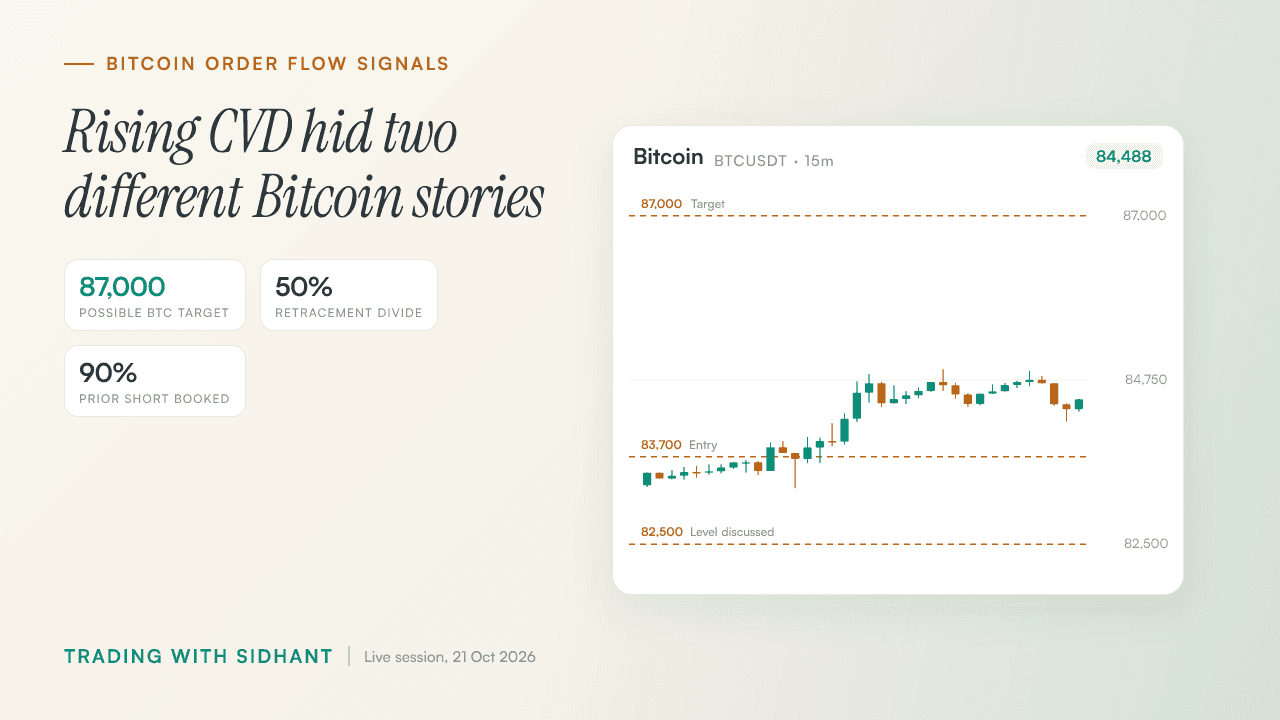
How to Read Bitcoin Open Interest and CVD Before 87,000
Rising CVD supported Fahad's Bitcoin upside bias, but a later drop in open interest changed what the buying meant.
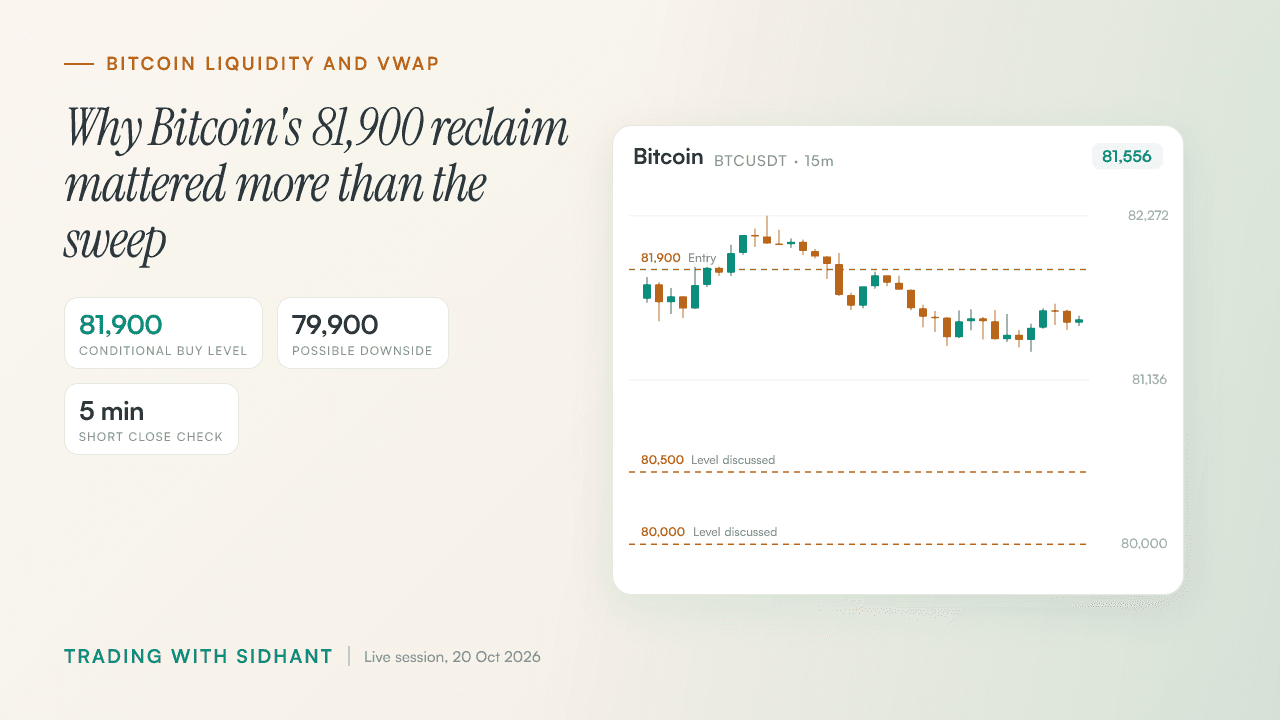
How to Trade Bitcoin Liquidity Sweeps Near 81,900
Bitcoin swept both sides of its range, but Fahad wanted an 81,900 reclaim to buy or a confirmed VWAP loss to short.
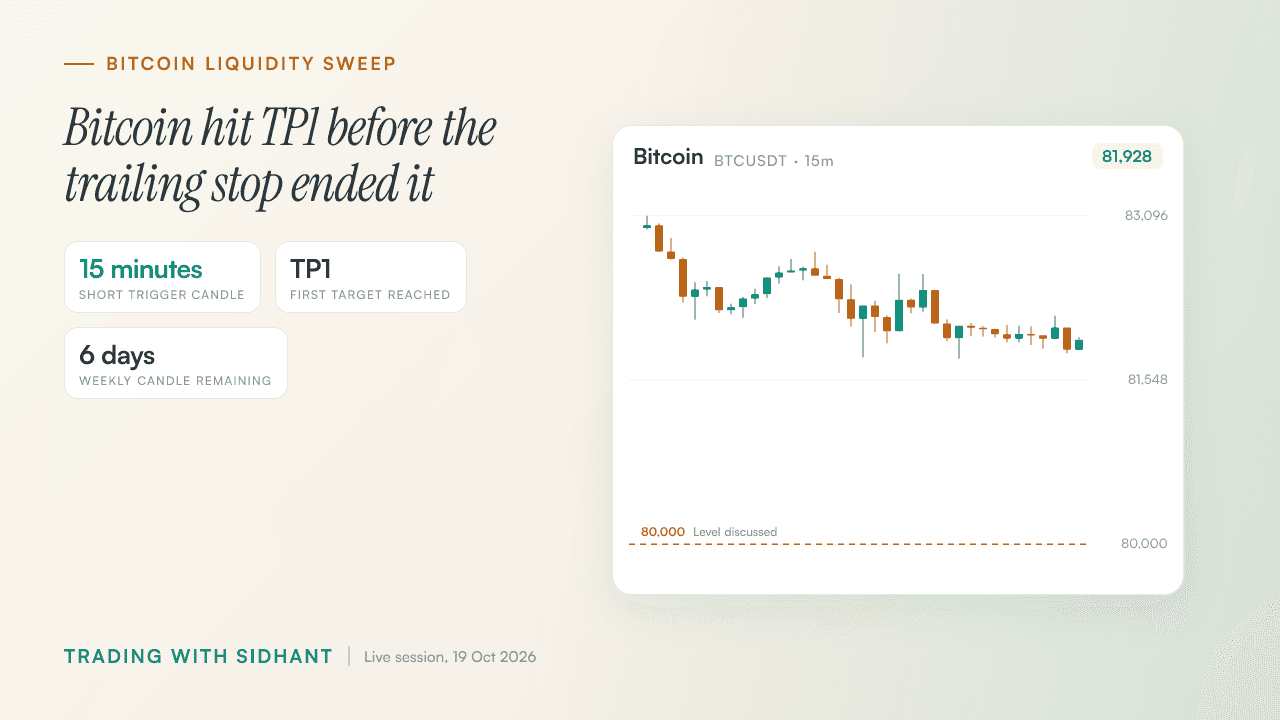
Bitcoin Liquidity Sweep Trading Strategy: TP1 and Stops
A Bitcoin short reached TP1, but the bigger lesson came from the trailing stop that ended the trade.
Get post alerts in your inbox.
New blog post? We'll email you. No spam, unsubscribe anytime.
Join our Telegram community.
Get post alerts, trading discussions, and market updates.