How to stop overtrading in the stock market
After almost 300 trades on his worst day, Sidhant built a three-step pause between the urge to trade and the next click.
8 min read
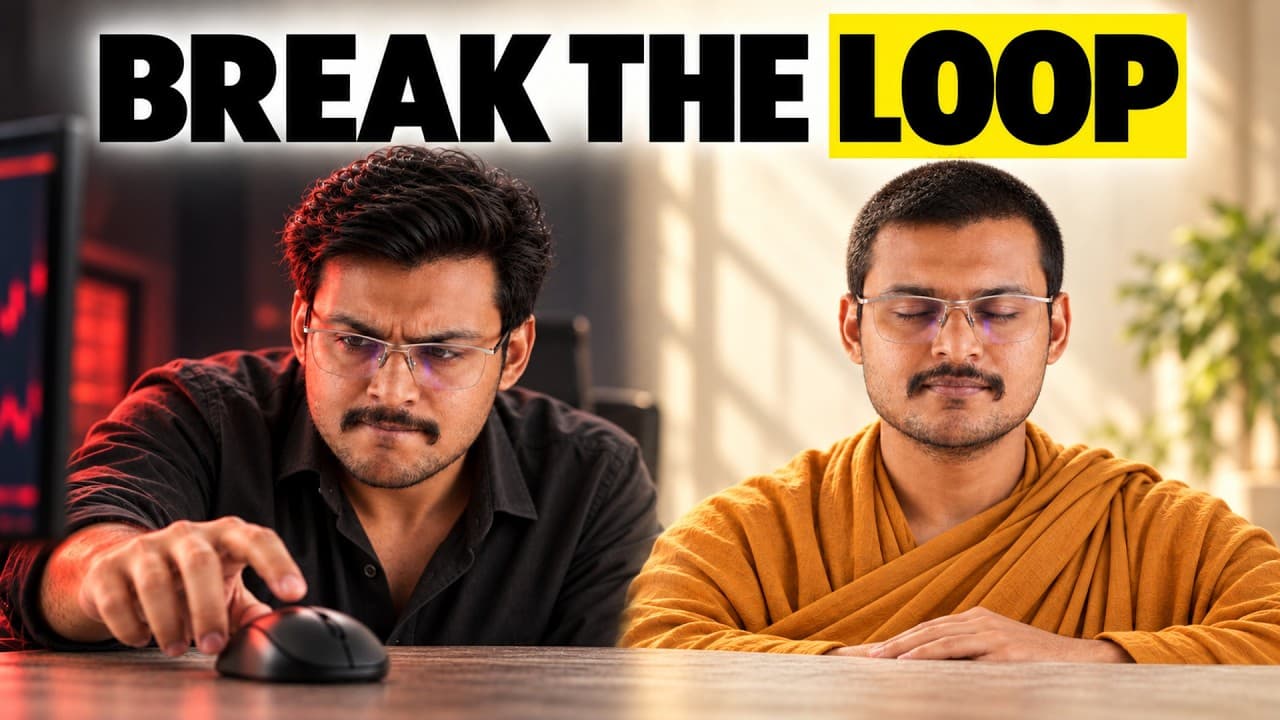
'On my worst day, I took almost 300 trades.' I said that in the video because I know how quickly one finished position can turn into another click. Not even a minute. No plan, just an itch. If you searched for how to stop overtrading in the stock market, I would start there, not with a speech about discipline. I call my response the Monk Method: name the urge, watch it without clicking, and reset after a larger-than-normal loss. No incense, no offerings needed. The hard part is letting the urge stay while my hand stays off the mouse.
Key Takeaways
- An uncertain next outcome was a powerful reason to pause, but it was never a trading setup.
- Feeling pressed to act gave me information about my state, not evidence about the trade.
- The pause did not demand that fear of missing out vanish; it gave me time to test the reason for the click.
- A loss belonged in the record, not in the reasoning for the next position.
- The bell was useful only if it interrupted an automatic click long enough for an honest rule check.
Almost 300 trades showed me how uncertainty fuels overtrading
On my worst day, I took almost 300 trades. I kept closing one position and reaching for another uncertain outcome without a plan. In the video, I used research on trading activity and reward-seeking to explain the pull of that next click, not to prove why any individual trader places an order.
I did not need another chart to see the problem. I needed to catch the moment between closing a trade and wanting the next one. 'Overtrading isn't greed, friend. It's your brain asking for the next maybe.'
The historical US research I cited covered more than 66,000 American families who traded stocks in 1990. The study, published in 2000, reported these annual returns:
Returns cited from the historical US household study
| Comparison group | Annual return | Important context |
|---|---|---|
| Most active traders | 11.4% after fees | Historical US household figure, not an expected return for Indian traders |
| Market | 17.9% | Comparison from the same US research, not an Indian market return |
That comparison does not explain my nearly 300 trades. In the 2003 monkey study I discussed, the chance of receiving juice was uncertain at 50%, and dopamine activity was strongest around that uncertainty. Monkeys are not traders. What I recognised was the pull of another unknown outcome: a chart moving every few minutes could keep offering me one.
For my own decisions, quality versus quantity in a trading strategy was the better lens. The count showed how often I clicked, not how often I had a reason.
Stress can make the next click feel urgent
Large profit-and-loss swings could leave me tense after the immediate move had passed. In the video, I connected that pressure to research on reward circuitry and trader stress. Neither study explains a particular order. I could feel an urgent need to act and still have no setup worth taking.
Stress signal versus setup: A racing pulse told me how I felt. It gave me no entry reason.
Think of jalebi. The smell catches you first; the argument for buying it comes later. A 2005 Stanford investing-game study found activity in a reward circuit before some risky choices that later turned out badly. That happened in a lab game, not in an NSE order book.
London researchers tested saliva from 17 traders twice a day. Their cortisol rose on days with larger profit-and-loss swings. I took that as a reason to notice pressure, not to diagnose myself from a losing trade. The distinction also matters in building a trading strategy in India: I needed to know my rule before I could say I had followed it.
The Monk Method starts by naming and riding the urge
The first two steps of my Monk Method were to name the impulse and watch it without clicking. In the video, I made the pause concrete: hand off the mouse, 10 slow breaths, then a check against my trading rules. I did not have to feel calm before checking whether a setup existed.
'You're not fighting the feeling. You're naming it.' Revenge, boredom and fear of missing out gave me more useful descriptions than 'I need to trade.'
The sequence I showed was short:
- Name the urge: revenge, boredom or fear of missing out.
- Move your hand away from the mouse.
- Take 10 slow breaths.
- Notice where you feel the urge in your body.
- Check whether the trade still meets your rules.
The 2007 UCLA study I mentioned asked people to label emotions shown in angry or fearful faces. Researchers found reduced amygdala activity during labeling. Those people were not placing trades, so I used the study to explain why naming was worth trying, not to claim it removed market risk.
A mosquito bite gave me another image for the exercise. Scratching relieves the itch briefly, then invites another scratch. In the 2009 urge-surfing study I cited, college students who smoked reported fewer cigarettes after one week, although their cravings persisted. That did not turn a smoking study into trading evidence. It helped me think about feeling an urge without obeying it.
'The FOMO may never stop showing up. But clicking because of FOMO can stop.' For the rule check, direction, area and trigger in Nifty trading is more specific than any itch to enter.
A 15-minute reset stops a loss from choosing the next trade
After a larger-than-normal loss, I would close the chart, record what happened and whether I followed my rules, then spend 15 minutes away from the screen. In the video, that reset kept the last result out of the next decision. Losing money gave me a reason to review, not a reason to enter again.
Consider a bad movie with a Rs 500 ticket. The money is gone whether you stay or leave; sitting through another hour only costs you time. Trying to recover a trading loss with the next order can put more of the account at risk. 'The last trade is over, friend. It gets no vote in the next trade.'
My post-loss routine had three parts:
- Close the chart after the larger-than-normal loss.
- Record the loss and whether I followed my rules.
- Take 15 minutes away before assessing another trade.
In a 2014 business-school lab test, 15 minutes of slow, mindful breathing reduced attempts to recover a sunk cost in the next decision. It did not show that my next trade would improve. The case for stepping away also appears in rules and pauses for overtrading control.
My scorecard stayed blunt: 'A trade that loses while you follow your rules is a good trade. A winning trade that breaks your rules is a bad trade.' The account statement showed the result. Handling losses without revenge trades dealt with what I did after seeing it.
A 30-minute bell checks whether I am chasing a maybe
In the video, I suggested a phone alert every 30 minutes while the Indian market was open. At each alert, I would step away from the mouse, take three breaths and check whether I was following my plan. After one week, I would compare my decisions with the week before, not judge the exercise by profit alone.
I borrowed the pause from the bell practice at Plum Village: when the bell rings, people stop and take three breaths. The video mentioned the Indian market opening at 9:15 AM; a recurring phone timer made the interruption practical during market hours. 'Am I following my plan, or chasing a maybe?'
Use the pause that fits the trigger. The timer did not replace the longer break after a loss.
Which pause to use and when
| Trigger | Pause | Decision check |
|---|---|---|
| Urge to enter a position | 10 slow breaths | Does the trade meet my rules, or am I acting on an urge? |
| Larger-than-normal loss | 15 minutes away | What happened, and did I follow my rules? |
| Recurring 30-minute alert | Three breaths | Am I following the plan or chasing a maybe? |
For that week, I would count the impulses I noticed, the pauses I took and the decisions that followed my rules. A bell could catch me on autopilot even after a winning trade. It could not do the rule check for me.
'The Monk Method won't make the urge disappear. It changes what you do when the urge shows up.' That was the change I wanted to test.
Nearly 300 trades on my worst day showed me that knowing a rule and following it were separate jobs. In the video, the Monk Method gave me a way to catch the gap: take my hand off the mouse, name what I was feeling and ask whether the next order had a reason. I would look at my trading record after a week, including the orders I chose not to place. The next maybe could still feel tempting. That feeling did not get to make the decision for me.
Find more Trading With Sidhant videos on YouTube for the process behind the decisions.
Watch the full video: Why You Can't Stop Overtrading (Dopamine Explains It The Monk Method Fixes It) on YouTube
Disclaimer: This article is for educational purposes only and is not investment advice. The price levels, setups and trades described are a review of market events that have already occurred, shared to illustrate a method of analysis rather than to recommend any trade. Trading With Sidhant LLP is not a SEBI-registered Investment Adviser or Research Analyst, and nothing here constitutes a recommendation to buy or sell any security. Investments in securities markets are subject to market risks; read all the related documents carefully before investing. Past performance is not indicative of future results. Please consult a SEBI-registered financial adviser before acting on any information in this article.
Frequently Asked Questions
- Why do I keep trading immediately after closing a position?
- An uncertain next outcome can pull your attention back to the order screen even when you have no fresh trade reason. In the video, I described closing one position and wanting another almost immediately. I treated that urge as something to notice, not proof that the next trade met my rules.
- How can I stop overtrading when I feel FOMO?
- I would name the feeling, move my hand off the mouse, take **10 slow breaths** and check the trade against my rules. The point was not to wait for perfect calm. I wanted to find out whether a valid reason remained once I had stopped reaching for the order screen.
- What should I do after a larger-than-normal trading loss?
- I would close the chart, record what happened and whether I followed my rules, then take **15 minutes** away. An immediate attempt to recover the money was not a trade reason. Writing down the decision let me judge whether I had followed my process separately from the money I had lost.
- Does taking 10 breaths make the urge to trade go away?
- No, **10 breaths** do not guarantee that the urge will disappear. I used the pause to notice the feeling without placing an order. The urge-surfing research mentioned in the video drew a similar distinction in a different setting: cravings persisted among the smokers studied, although they smoked fewer cigarettes after **one week**.
- How do I tell a good trade from a profitable trade?
- I judged a good trade by whether it followed my rules, not by whether it made money. In the video, I called a rule-following loss a good trade and a rule-breaking win a bad one. Profit and loss recorded the outcome; my notes on the setup and execution recorded the decision.
Share this post
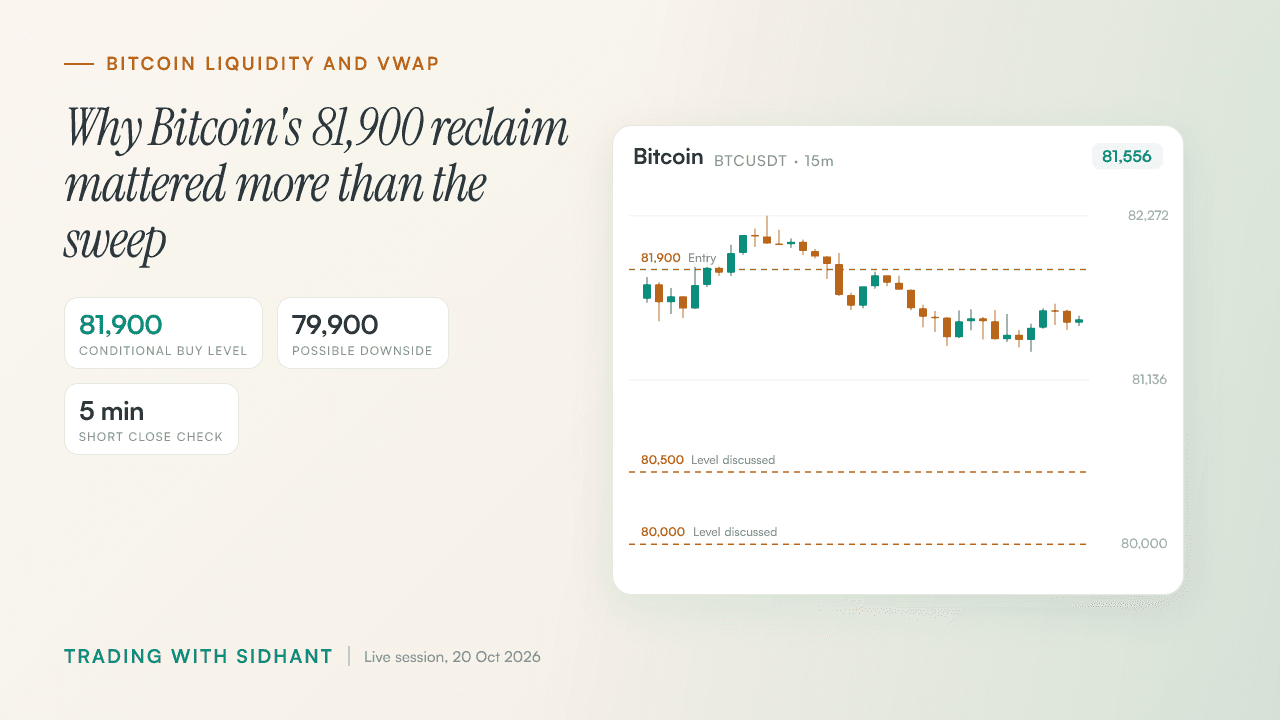
How to Trade Bitcoin Liquidity Sweeps Near 81,900
Bitcoin swept both sides of its range, but Fahad wanted an 81,900 reclaim to buy or a confirmed VWAP loss to short.
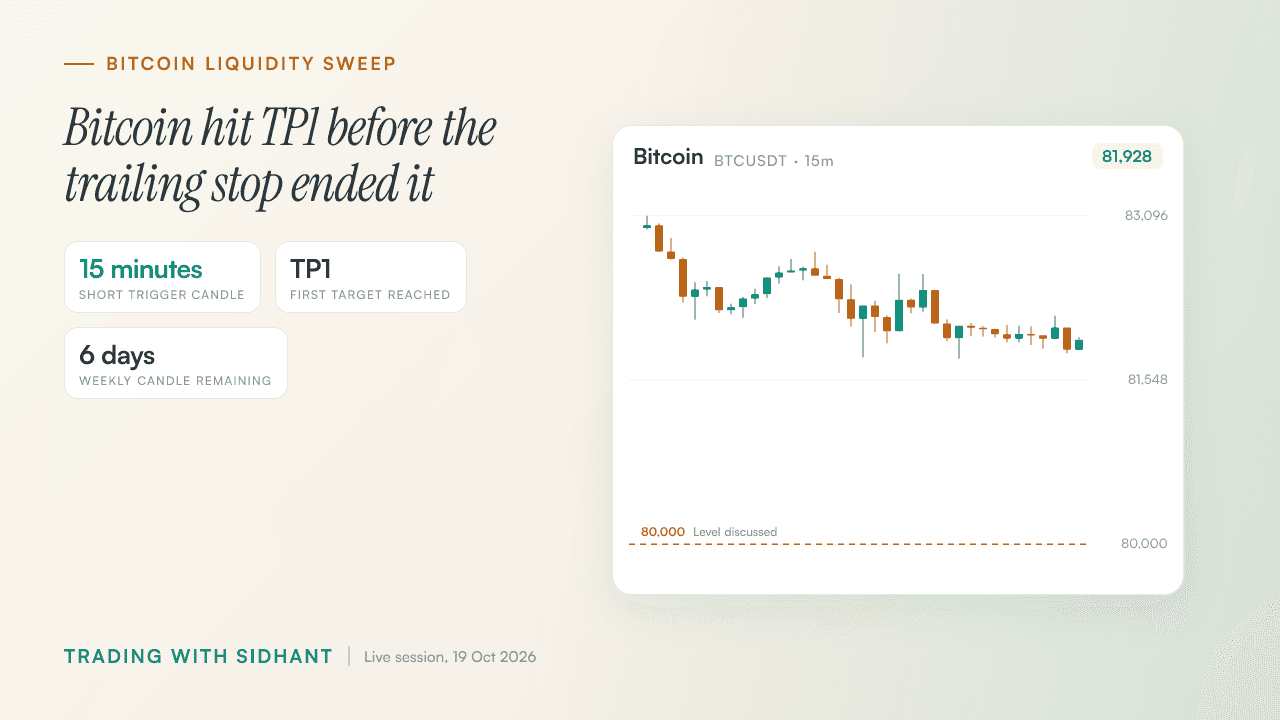
Bitcoin Liquidity Sweep Trading Strategy: TP1 and Stops
A Bitcoin short reached TP1, but the bigger lesson came from the trailing stop that ended the trade.
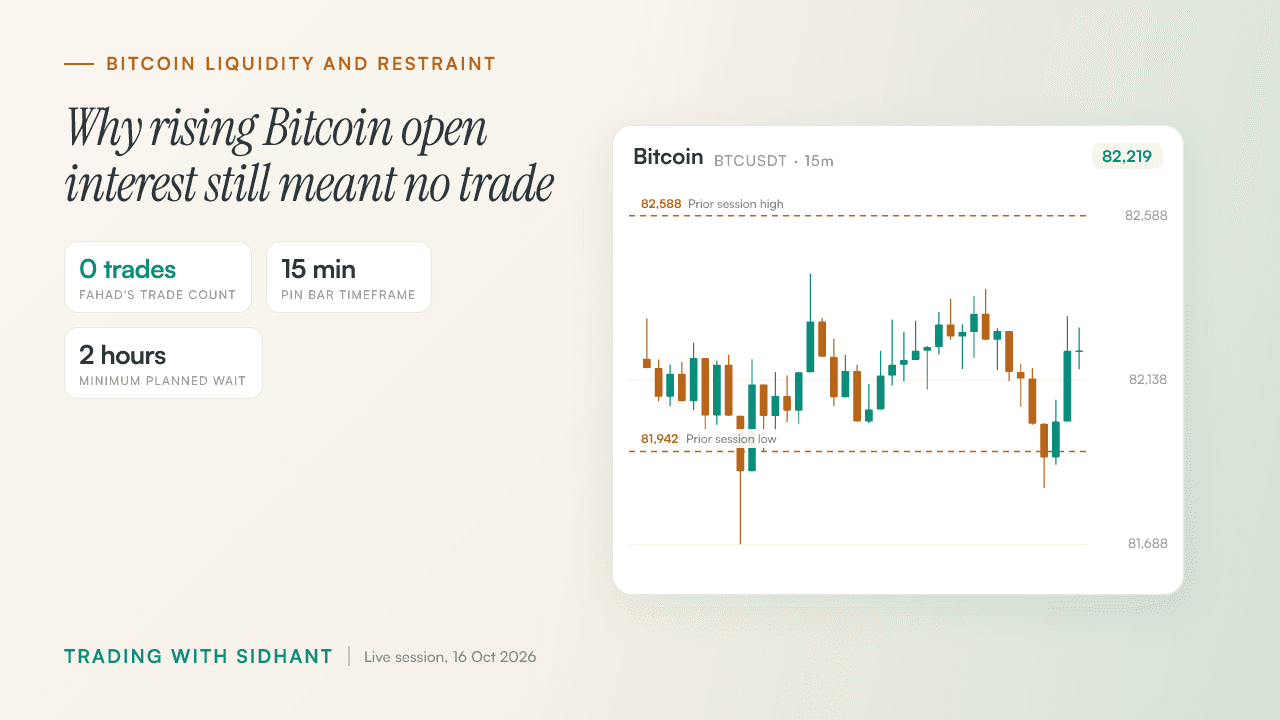
When Not to Trade Bitcoin: Rising OI, Zero Trades
Bitcoin open interest rose as CVD fell, but weak volume and conflicting signals kept Fahad out of the market.
Get post alerts in your inbox.
New blog post? We'll email you. No spam, unsubscribe anytime.
Join our Telegram community.
Get post alerts, trading discussions, and market updates.