Bitcoin Trading Strategy for Indian Traders Unveiled
Discover reliable Bitcoin trading entry points and manage emotions like a pro.
10 min read
On this stream, the Bitcoin trading strategy for Indian traders came into sharp focus when Fahad called a long entry at exactly $63,900. Not a range. Not a zone. A number. The weekly bias was technically bearish, but our team spotted a structural setup that flipped the short-term read bullish. Fahad went live with the trade and announced it out loud: "I'm in a long trade, everyone, just saying it out pretty loud." That kind of transparency is what the Hitpoint community is built on. This post breaks down the full session: how the entry was identified, why emotional control was the real edge, and what market structure told us before price moved.
Key Takeaways
- Weekly bias sets context, but intraday structure determines the actual entry: both must agree before sizing in.
- Emotional neutrality, not positivity, is what keeps decisions clean when markets move against you.
- Entry at $63,900 was valid because structure, trend alignment, and a live confirmation all appeared together, not just price proximity.
- Poor highs and poor lows are magnets: price sweeps them before making the real directional move, and entering before the sweep is the most common structural mistake.
- Stating your trade plan publicly forces clarity: the community functions as a real-time pressure test for your thinking, not just a support network.
How to Develop a Bitcoin Trading Strategy?
Building a Bitcoin trading strategy means reading the bigger picture first, then drilling down to find your entry. Trend identification, clear entry and exit levels, and the discipline to not trade when the setup isn't there. Those three things, in that order. Miss any one of them and you're just gambling with extra steps.
On this session, Fahad walked through exactly that process. The weekly timeframe was showing bearish signals. As he put it, "If you listen to yesterday's analysis, yesterday's bias, then bigger time frames like weekly were bearish." That's the context. Bias does not give you a trade. The wires, meaning price action and structure at lower timeframes, give you direction.
Our team did not blindly follow the weekly bias. We looked at the intraday structure and spotted an uptrend potential forming. Price was showing signs of wanting to push higher, and the data supported a long setup.
The specific plan that came out of the session:
- BTC long entry identified at $63,900
- TP1 target near the golden pocket (the 61.8% to 65% Fibonacci retracement zone, the most reliable magnet in trending markets)
- Stop loss moved to break even once price showed continuation
The golden pocket is not a random target. It's where institutional orders tend to cluster in a trending move. When you're entering a long after a pullback, price gravitates toward that zone before deciding whether to continue or reverse. Fahad's target there was deliberate.
For building a structured trading approach, the sequence matters: weekly bias first, intraday structure second, entry trigger third. Skip steps and you're reacting, not trading.
The session also reinforced a core principle: "Trading is your number one priority is to save funds. And then comes making profits." The break-even stop wasn't laziness. It was capital protection built directly into the trade plan.

What Are the Emotional Challenges in Trading?
Stress, impulsive entries, revenge trades after a loss, and overconfidence after a win: these are the emotional challenges that end trading accounts faster than any bad strategy. Managing them isn't soft psychology. It's the actual edge.
Fahad made this point directly on the stream, and it landed with the whole team. He described his own mental state during the session: "When I am neither feeling happy nor sad, it is very obvious that I am not going to take emotional based decisions." That flatness, that neutrality, is the goal. Not excitement. Not fear. Just neutral.
The teaching moment from this part of the session was one of the clearest of the day: "When you're learning, losses will make you sad, profits will make you feel like you're invincible." Both reactions are dangerous. Sadness leads to hesitation. Invincibility leads to oversizing.
Fahad's own relationship with outcomes is worth noting here. "I won't mind. Because I am so used to winning but I am also so used to losing trades." That's not indifference. That's the result of enough screen time that individual trade outcomes stop triggering emotional responses.
Three practical things our team flagged for emotional control:
- No trading on days when you're emotionally compromised. If someone had a no-trade day when conditions were unclear, they knew exactly what they were doing.
- Avoid decisions based on recent results. One green day does not confirm a strategy. One red day does not break it.
- Size positions where a loss doesn't hurt your mood. If losing the position changes how you feel, the size is too big.
For a deeper look at how Fahad approaches price action under pressure, the principle is the same: process over outcome, every time.

Bitcoin Entry Points: Where Should You Start?
Good Bitcoin entry points come from three things working together: market structure telling you the direction, a confirmation signal telling you the timing, and a broader trend telling you which side to be on. When all three line up, the trade is obvious. When only one or two line up, you wait.
On the stream, our team identified $63,900 as the long entry level for BTC. The reasoning was not arbitrary. Price action at that level showed a reaction to structure, and the intraday setup was showing upside potential despite the bearish weekly backdrop. Fahad called the trade live, which is the kind of real-time accountability that separates analysis from noise.
We also discussed what does NOT qualify as a trade. Just because price touches a level doesn't mean you enter. "This is not a trade as I said and I would also not take it," Fahad noted at one point during the session, referring to a setup that lacked proper confirmation. Discipline means skipping trades that don't meet the full criteria, not just the ones that feel risky.
For context on reading current Bitcoin market conditions before selecting entry levels, structure and volume confirmation matter most.
Analysts tracking Bitcoin's options market have flagged the potential for significant price range expansions in the months ahead, with options data suggesting a $20,000 price range by late September, which makes precise entry discipline even more important right now.
BTC Entry Points and Market Reactions
| Entry Point | Market Reaction | Confirmation Needed |
|---|---|---|
| $63,900 (long) | Upside potential with intraday structure supporting move | Volume confirmation, break above local high |
| Below $63,900 | Risk of deeper pullback toward weekly support | Wait for demand zone reaction and candle close |
| Golden pocket zone (TP1) | Likely area of institutional interest, potential reversal or continuation | Watch for rejection or absorption at the level |

Market Structure Analysis: Key to Trading Success?
Price movements and potential reversals become readable when you understand the structure underneath them. Market structure analysis gives you a map. Without it, you're reacting to candles. With it, you're anticipating where price wants to go and positioning before it gets there.
Our team spent significant time on this during the session. The specific concept Fahad kept returning to was poor highs and poor lows. A poor high is a swing high that didn't attract enough selling to create a clean rejection. It's a magnet. Price tends to come back and sweep it before making a real move. Same logic applies to poor lows on the downside.
Why does this matter for entries? Because entering before a poor high gets swept is often entering into a trap. Our approach is to wait for the sweep, watch the reaction, and then enter in the direction of the real move. It's slower. It feels like you're missing the move. But it's structurally sound.
On BTC specifically, the session showed:
- The weekly structure remained bearish at the time of analysis, with higher timeframe resistance still in play
- Intraday structure showed a series of higher lows, which is the early signal of a short-term bullish shift
- The $63,900 area represented a structural inflection, where buyers had previously stepped in
Fahad's core teaching on this: "The logic behind this is what I am saying that I can take such trades, this is not for beginners." Reading structure takes time. You need to know what a real breakout looks like versus a sweep and reverse. Getting those two confused is expensive.
For traders wanting to go deeper on this, understanding Bitcoin's liquidity levels and how they interact with structure is the natural next step. Liquidity pools often sit right above poor highs and below poor lows, which is exactly what makes those areas so important to track.
Market analysts have also highlighted that retail traders are most at risk during large Bitcoin moves precisely because they misread structure and enter at the wrong side of a sweep. Structure analysis is the specific skill that addresses that vulnerability.

Engaging with the Trading Community: Why It Matters?
Sharing insights, hearing how others read the same chart, and being held accountable for your plan in real time. Trading community interaction gives you all three. It's not about feel-good motivation. It's about forcing you to articulate your thesis out loud, which immediately reveals the gaps in your thinking.
The Hitpoint stream runs exactly this way. Fahad opened the session by asking viewers directly: "How was your trading yesterday? Did you guys close green, red, what's the update on break even Monday?" That question is not filler. It sets a tone where people are expected to show up with an actual position on what happened, not just passive observation.
Throughout the session, our team pushed viewers to engage with their own analysis. "Pick any chart that you want to and what is your trading plan on that." When you have to state your plan publicly, you think about it more carefully. You check whether it actually makes sense. The community becomes the accountability mechanism.
Three things we consistently do to make community interaction useful:
- Asking for trading results at the start of each session, which keeps viewers tracking their own performance
- Encouraging viewers to share their setups and trade plans, not just consume analysis passively
- Explaining the reasoning behind every call, so the community learns the process, not just the outcome
For more on how our team structures accountability within the community, the accountability strategies from Hitpoint Live cover this in detail.
Trading alone, without any feedback loop, is one of the slower ways to improve. The community is not a support group. It's a pressure test.

The session packed a lot in. What to carry forward:
- Structure before bias. The weekly was bearish, but the intraday setup said long. Fahad took the long. Bias sets context, structure makes the call.
- $63,900 was the level. Not a range, not a zone. A specific number with reasoning behind it, and a break-even stop built into the plan from the start.
- Emotional neutrality is the actual skill. Not excitement when it works, not despair when it doesn't. Flat is the target state.
- Poor highs and lows are traps for unprepared traders. Know them, wait for the sweep, then react to the real move.
- Community keeps you honest. Stating your plan out loud changes how carefully you build it.
If you want to be in the room when these calls happen live, that's exactly what the Hitpoint community is for. Join the Hitpoint community for live market coverage and real-time trade alerts, and see the analysis as it unfolds, not after the fact.
Watch the full stream: Bitcoin Trading Strategy for Indian Traders Unveiled on YouTube
Disclaimer: This article is for educational purposes only and is not investment advice. The price levels, setups and trades described are a review of market events that have already occurred, shared to illustrate a method of analysis rather than to recommend any trade. Trading With Sidhant LLP is not a SEBI-registered Investment Adviser or Research Analyst, and nothing here constitutes a recommendation to buy or sell any security. Investments in securities markets are subject to market risks; read all the related documents carefully before investing. Past performance is not indicative of future results. Please consult a SEBI-registered financial adviser before acting on any information in this article.
Frequently Asked Questions
- What is the best strategy for trading Bitcoin?
- The most reliable approach combines higher timeframe bias with intraday structure confirmation before entering any trade. On this stream, Fahad identified a long setup at $63,900 despite a bearish weekly bias, because the intraday structure supported upside. Capital protection comes first: move your stop to break-even as soon as the trade shows confirmation, and target structurally significant zones like the golden pocket.
- How do Indian traders set entry points in crypto?
- Entry points come from three factors aligning: the broader trend, a structural level where price has reacted before, and a real-time confirmation signal. Our team used $63,900 as the BTC long entry because it met all three criteria. Entering on price proximity alone, without structure or confirmation, is how traders end up on the wrong side of a sweep.
- What role does emotional management play in trading?
- Emotional management is what separates consistent traders from reactive ones. Fahad's approach is to reach a neutral state before any session: "neither feeling happy nor sad" means decisions come from data, not mood. Losses won't cause hesitation and wins won't cause oversizing when you've trained yourself to treat each trade as an isolated event with a defined risk.
- How can market structure analysis aid in trading?
- Market structure shows you where price is likely to go before it gets there. Poor highs and poor lows act as magnets: price sweeps them to collect liquidity before making the real directional move. Traders who understand this wait for the sweep and enter after the reaction, rather than entering ahead of it and getting caught on the wrong side.
- Why is Bitcoin favored among Indian traders?
- Bitcoin offers 24/7 access, high liquidity, and clear technical structure that responds well to price action analysis. For Indian traders who can't always trade during domestic market hours, BTC's round-the-clock availability is a practical advantage. The market structure concepts, poor highs, liquidity zones, and Fibonacci targets, translate directly from traditional markets and are well-suited to the analytical frameworks our team uses.
Share this post

How to Use Direction Area Trigger in Nifty Trading
A Nifty short near 24,000 needed more than a pin bar: daily bias, a defined area and footprint evidence had to agree.
Bitcoin Order Flow Analysis After a Rally
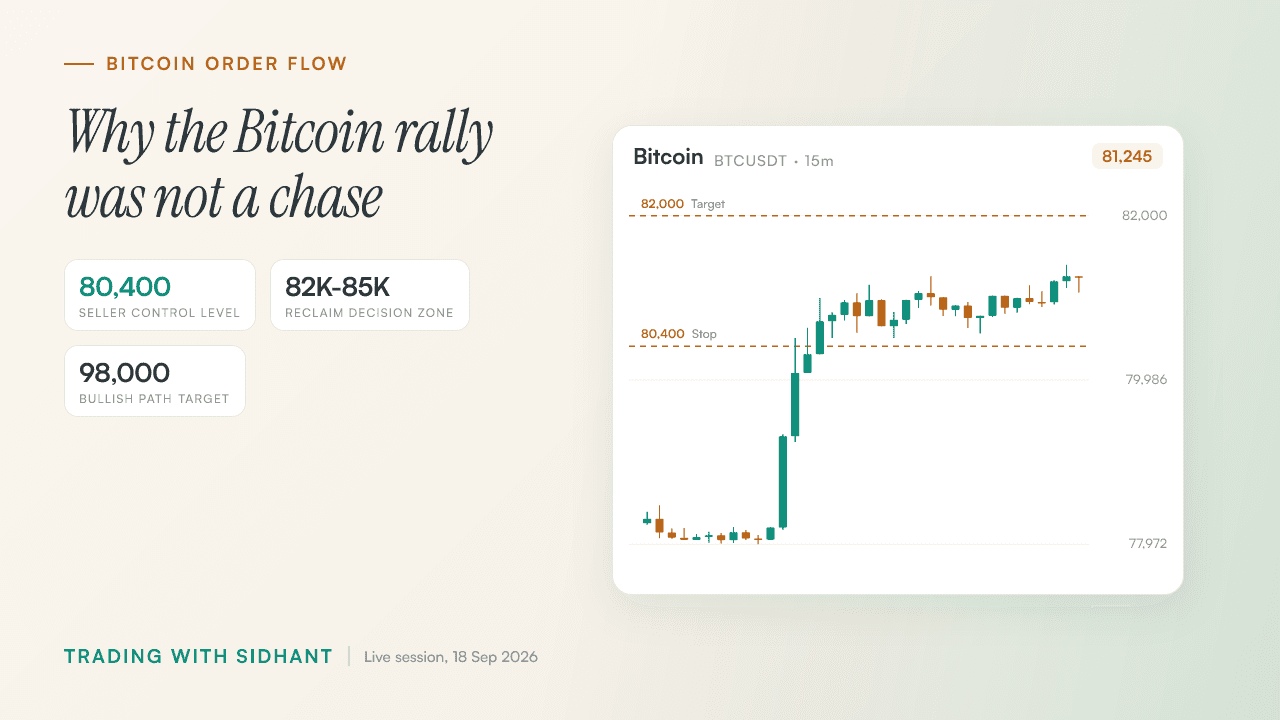
Bitcoin had already rallied, so Fahad used 80,400, delta and seller exhaustion to explain why waiting beat a FOMO entry.

When to Quit a Profitable Intraday Strategy
Rs 12 lakh in profit looked different after Sidhant counted the 1,500 hours and the freedom the strategy had consumed.
Get post alerts in your inbox.
New blog post? We'll email you. No spam, unsubscribe anytime.
Join our Telegram community.
Get post alerts, trading discussions, and market updates.